
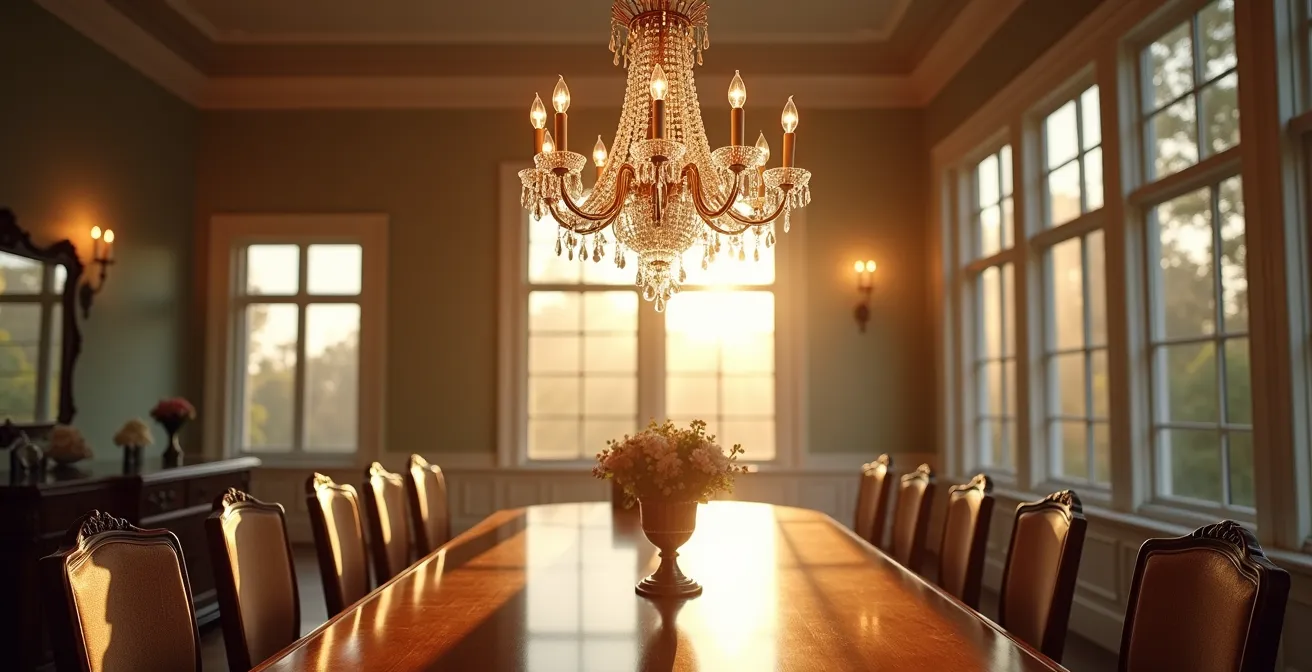
A vintage crystal chandelier can be a powerful value-add to your property, but only when treated as a strategic asset, not just a decoration.
- Its return on investment hinges on correct proportional sizing, professional maintenance, and the integrity of its supporting electrical systems.
- Harmonizing the chandelier’s metallic finishes with existing home hardware is crucial to amplifying, not diminishing, the space’s perceived value.
Recommendation: Focus on authenticated, well-maintained pieces and budget for professional installation and compatible systems to maximize your financial return.
As a homeowner, you stand at a frequent crossroads in design: the choice between a safe, generic modern fixture for your foyer or dining room, and an expensive, statement-making antique crystal chandelier. The latter promises character and grandeur, but the significant price difference raises a crucial question from a real estate appraiser’s perspective: is it a sound investment that will increase your home’s resale value, or is it merely a costly personal indulgence?
The common advice often circles around vague notions of “timeless elegance” or creating a “focal point.” While true, these descriptions fail to provide a tangible framework for calculating return on investment (ROI). The real value of a statement lighting piece isn’t just in its aesthetic appeal, but in its ability to signal quality and luxury to potential buyers. This value, however, is not automatic. It’s a calculated outcome based on a series of market-driven factors.
This analysis moves beyond simple aesthetics. We will treat a vintage chandelier as what it should be: an asset-class investment. The true financial return is not determined by its purchase price, but by a formula of proportional scaling, maintenance liability, system compatibility, and authenticated quality. Understanding these components is the difference between acquiring a valuable asset and installing an expensive liability.
This guide breaks down the essential appraisal criteria for evaluating a vintage chandelier’s impact on home value. We will explore the specific, actionable steps that ensure your lighting choice contributes positively to your bottom line, transforming a beautiful object into a strategic financial asset.
Summary: Analyzing the Investment Value of Vintage Chandeliers
- How to Calculate the Perfect Chandelier Size for Your Dining Table?
- How to Clean a Crystal Chandelier Without Taking It Down?
- Brass and Chrome: Can You Mix Metals in the Same Bathroom?
- The Circuit Overload Risk of Installing Multiple Pendant Lights
- Edison vs. Frosted: Which Bulb Won’t Blind Your Dinner Guests?
- Why Do 80% of DIY Green Walls Die Within the First 6 Months?
- Dimmer Compatibility: Why Do Your New LED Spots Flicker?
- How to Light Your Driveway for Security Without looking like a Prison Yard?
How to Calculate the Perfect Chandelier Size for Your Dining Table?
From an appraiser’s standpoint, the first factor that determines a chandelier’s contribution to home value is proportion. An improperly sized chandelier doesn’t just look wrong; it actively devalues a space. A fixture that is too small appears insignificant and cheapens the room’s perceived scale, while one that is too large overwhelms the space, making it feel cramped and ill-conceived. This is not a matter of taste, but of architectural balance that buyers perceive, consciously or not.
Getting the scale right is the first step in securing your investment. A perfectly proportioned chandelier signals thoughtful, high-end design and enhances the perceived value of the entire room. It suggests that every detail in the home has been carefully considered, which is a powerful message to a prospective buyer. The visual harmony created by correct sizing is fundamental to achieving a positive ROI.
The following visual demonstrates the “Goldilocks principle” of chandelier sizing, showing how the central, correctly-proportioned fixture enhances the room’s appeal compared to the poorly-sized examples.

To eliminate guesswork, appraisers and designers use a clear mathematical formula. This ensures the chandelier works in harmony with the room and the furniture beneath it, maximizing its positive financial impact. Applying this objective standard is the first test of a chandelier as a serious asset.
Action Plan: The Formula for Chandelier Sizing Success
- Room Diameter Calculation: Add the room’s length and width in feet. Convert this sum directly into inches to find the ideal chandelier diameter. (e.g., a 12ft x 14ft room = 26ft, suggesting a 26-inch diameter chandelier).
- Table-Specific Sizing: For a dining table, select a chandelier diameter that is between 1/2 and 2/3 the width of your table to ensure balanced proportions.
- Edge Clearance Verification: Confirm the chandelier’s widest point is at least 6 inches from the edge of the table on all sides to prevent a cramped feeling and avoid head bumps.
- Hanging Height Adjustment: For standard 8ft ceilings, the bottom of the chandelier should hang 30-36 inches above the tabletop. For each additional foot of ceiling height, add 3 inches to the hanging height.
- Vertical Scale Check: Ensure the final choice looks vertically balanced. An overly tall chandelier can feel oppressive in a room with lower ceilings, just as a very flat one can get lost in a two-story foyer.
How to Clean a Crystal Chandelier Without Taking It Down?
Once a chandelier is installed, its value is directly tied to its condition. A dusty, grimy crystal chandelier is not a luxury feature; it’s a maintenance liability that buyers will mentally discount. The question isn’t just “how to clean it,” but “how to preserve its asset value.” While DIY methods seem cost-effective, they pose a significant risk of causing microscopic scratches, chipping fragile crystals, or damaging antique metal patinas, which permanently diminishes the piece’s value.
Professional maintenance should be viewed as a mandatory part of the investment strategy. Specialists understand the nuances of antique materials and use techniques that protect the fixture’s integrity. As noted by a leading restoration service, this is not a task for amateurs.
Preservation of antique chandeliers requires a delicate touch and specialized knowledge that only professionals possess.
– Bailey Boys Inc. Restoration Services, Professional Chandelier Restoration Guide 2024
The ROI on professional cleaning is clear and quantifiable. It’s not an expense; it’s an investment in retaining and increasing the asset’s worth. A clean, sparkling chandelier broadcasts luxury, while a neglected one signals deferred maintenance throughout the property.
Case Study: The ROI of Professional Restoration
A documented case by International Chandeliers provides compelling evidence. They followed the restoration of a neglected 19th-century crystal chandelier, where a professional cleaning and minor restoration was performed. The $800 investment in professional servicing yielded a $3,200 increase in the chandelier’s appraised market value. The process removed decades of grime while preserving the valuable patina, a result unattainable with DIY methods. This 300% return demonstrates that professional maintenance is a direct value multiplier for investment-grade lighting.
Brass and Chrome: Can You Mix Metals in the Same Bathroom?
A vintage chandelier does not exist in a vacuum. Its ability to add value is contingent on its integration with the home’s existing hardware. Mismatched metallic finishes create visual discord, which reads to a buyer as a lack of cohesive design and cheapens the overall impression. The goal is to make the chandelier feel like a deliberate, anchoring element of a unified design palette, not an afterthought. According to a 2023 real estate study, this cohesion pays dividends, as homes with ‘luxury lighting upgrades’ sold for 1-3% more than comparable properties.
The key is to either match the chandelier’s primary metal (e.g., antique brass) with other hardware or to use it as a “bridge” piece that intentionally incorporates multiple metals found elsewhere in the room. A chandelier with both brass and iron elements, for instance, can masterfully tie together brass doorknobs and iron stair railings, making the entire design feel intentional and high-end. This is a sophisticated design move that signals luxury to discerning buyers.
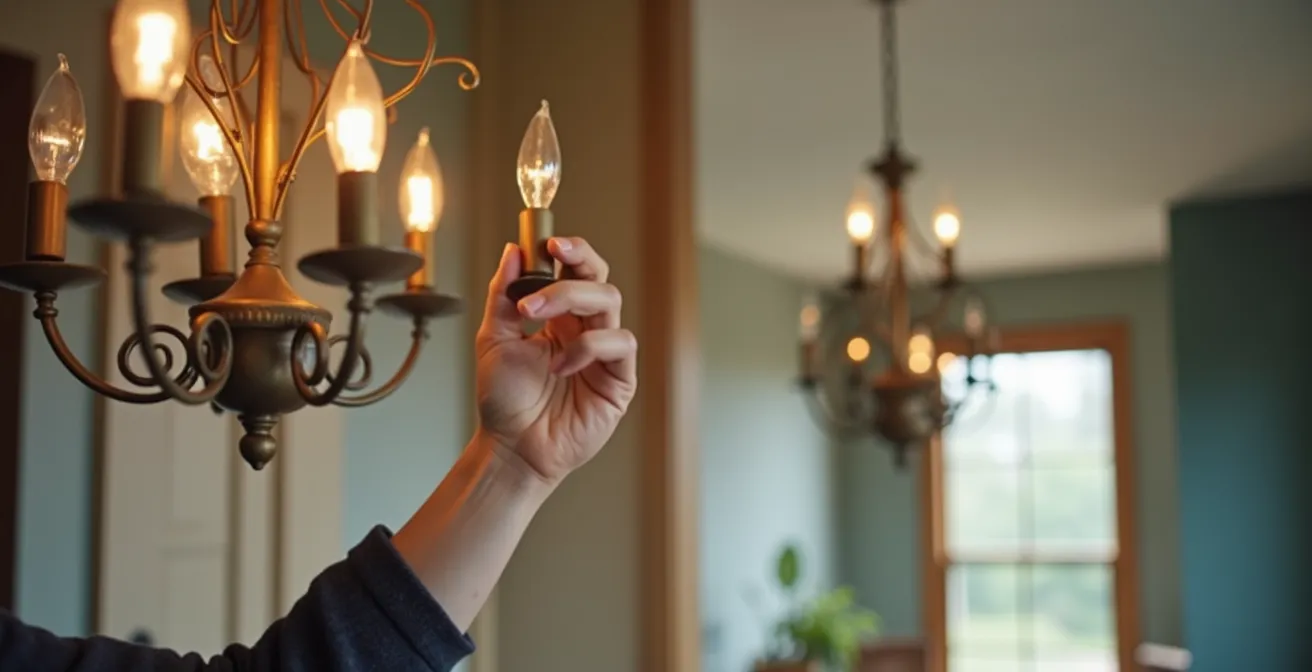
The following matrix provides a clear, value-driven guide for an appraiser’s assessment of metal compatibility. Mismatching is not just a style faux pas; it is a direct financial risk that can negate the chandelier’s investment potential.
| Chandelier Metal | Compatible Home Hardware | Value Impact | Risk Level |
|---|---|---|---|
| Antique Brass | Oil-rubbed bronze, warm metals | +2-3% home value | Low |
| Polished Chrome | Stainless steel, cool metals | +1-2% home value | Low |
| Mixed Metals | Transitional hardware | +3-4% if done right | Medium |
| Mismatched Metals | Conflicting finishes | -1-2% home value | High |
The Circuit Overload Risk of Installing Multiple Pendant Lights
The investment value of a vintage chandelier can be completely nullified if it presents a safety or liability risk. This is especially true when it comes to the electrical system. Many older homes, where a vintage piece feels most appropriate, have wiring that is not equipped to handle the load of a heavy, multi-bulb crystal chandelier. An overloaded circuit is not only a functional nuisance but a significant fire hazard that any home inspector will flag, immediately turning your “asset” into a “defect” in the eyes of a buyer.
From an appraisal perspective, the cost of making a chandelier safe is part of its total acquisition cost. This often includes reinforcing the junction box in the ceiling to support the weight and, crucially, running a dedicated circuit from the electrical panel. As restoration experts note, “Wiring kits are essential for replacing old or unsafe wiring to ensure the chandelier is safe for modern electrical systems.” This is non-negotiable for preserving both safety and value.
Potential buyers and their inspectors are wary of old wiring. Investing in the necessary electrical upgrades is not an “extra”—it’s a requirement for the chandelier to be recognized as a positive feature. Failing to do so creates a significant financial objection that can derail a sale or lead to costly concessions. For a homeowner making an investment, budgeting for these hidden costs is critical; they are what transform a beautiful object into a safe, functional, and valuable home feature.
Edison vs. Frosted: Which Bulb Won’t Blind Your Dinner Guests?
The final layer of a chandelier’s value is its user experience. A stunning fixture that casts harsh, glaring light or is either “off” or “100% on” fails as a luxury item. The choice of bulbs and, more importantly, the control system, directly impacts the ambiance and functionality of the space. This is a detail that sophisticated buyers notice. Period-authentic Edison bulbs may look great in photos, but their intense glare can make a dining room unusable. The goal is to provide a beautiful *and* livable experience.
The solution lies in a strategic approach to bulb selection and dimming technology. This includes:
- Choosing warm white (2700K) LED bulbs that replicate the inviting color of vintage incandescent light.
- Investing in high-CRI (Color Rendering Index) of 90+ bulbs to ensure the crystals refract light beautifully and colors in the room appear true.
- Using candelabra base LEDs with an exposed filament design to maintain period authenticity without the harshness of true Edison bulbs.
- Installing a high-quality, compatible smart dimmer system to allow for versatile mood settings, from bright and functional to low and intimate.
The dimming system is not a peripheral accessory; it is a value multiplier. It elevates the chandelier from a simple light source to a sophisticated tool for atmospheric control, a hallmark of a luxury home. The ROI of pairing a vintage piece with modern controls can be substantial.
Case Study: The Lutron Effect as a Value Multiplier
A real estate case study in California highlighted a home with a $5,000 vintage chandelier. The sellers took the crucial step of pairing it with a high-end Lutron dimming system. This combination became a central talking point during open houses, allowing agents to demonstrate the sophisticated lighting control. According to the report, the combination of the statement fixture and its advanced controls contributed to a bidding war that drove the final sale price up by $50,000. It proves how quality infrastructure signals a level of luxury that buyers are willing to pay a premium for.
Why Do 80% of DIY Green Walls Die Within the First 6 Months?
When assessing home features for resale value, appraisers categorize them on a spectrum from “durable asset” to “high-maintenance liability.” A DIY green wall, for example, is a classic liability. Its high failure rate and constant need for care make it a red flag for buyers. They don’t see a beautiful feature; they see a future problem and expense. In fact, real estate professionals report that high-maintenance features can deter a significant portion of potential buyers, who are looking for turnkey solutions, not new chores.
This is where a vintage crystal chandelier, when chosen and maintained correctly, excels as an investment. Unlike trendy, perishable features like a living wall, a well-crafted chandelier is a durable, long-term asset. Its maintenance is minimal and predictable (periodic professional cleaning) compared to the constant upkeep of a biological system. Its lifespan is measured in generations, not months.
A buyer’s perception of maintenance burden is a major factor in their valuation of a home. A feature that is beautiful but perceived as fragile or difficult to care for will have its value discounted. The following comparison starkly illustrates why a vintage chandelier is a superior investment for resale value compared to a high-maintenance trend.
This data from a comparative analysis of home feature investments shows the clear advantage of choosing durable, timeless assets.
| Feature | DIY Green Wall | Vintage Crystal Chandelier |
|---|---|---|
| Initial Investment | $500-2,000 | $2,000-10,000 |
| Annual Maintenance | $600-1,200 | $100-300 |
| Lifespan | 6 months – 3 years | 100+ years |
| Failure Rate | 80% within 6 months | 5% if professionally installed |
| Resale Value Impact | Negative if dead/dying | +1-3% if well-maintained |
Dimmer Compatibility: Why Do Your New LED Spots Flicker?
The investment integrity of a vintage chandelier is only as strong as its weakest link. A homeowner can invest thousands in a magnificent fixture, only to have its value undermined by an incompatible, low-quality dimmer switch. The flickering and buzzing that result from pairing a sophisticated LED-retrofitted chandelier with a cheap dimmer does more than just annoy; it signals poor workmanship and potential electrical issues to a prospective buyer. It plants a seed of doubt about the quality of the entire home’s systems.
This is a common and costly mistake. Buyers, especially those with an eye for detail, can spot the difference. As a National Association of Realtors study on luxury features noted, “Cheap, mass-produced chandeliers may not carry the same weight as a well-crafted or designer piece. Buyers with an eye for detail can often spot the difference.” This same principle applies to the supporting infrastructure. A premium fixture paired with a cut-rate component creates a jarring disconnect that erodes trust and value.
Ensuring system integrity by investing in a high-quality dimmer specifically designed for LEDs (like a Lutron LED+ or similar) is not an upsell; it is essential investment protection. This small component ensures the chandelier performs flawlessly, reinforcing its status as a luxury feature and preventing buyers from questioning the quality of your home’s electrical work.
Case Study: The $20 Mistake That Killed a $5,000 Investment
A well-documented homeowner experience illustrates this risk perfectly. The owner installed a $5,000 Swarovski crystal chandelier but paired it with a standard $20 dimmer from a hardware store. During a home showing, the resulting flicker and audible buzzing caused multiple buyers to voice concerns about the state of the home’s wiring. The “luxury” feature had become a liability. After seeking advice, the owner replaced the cheap switch with a $150 Lutron LED+ dimmer. The flickering and buzzing vanished. The very same chandelier then became a celebrated selling point, helping to secure a final offer $15,000 above the asking price, proving the immense ROI of ensuring system integrity.
Key Takeaways
- A chandelier’s market value is a direct equation: (Correct Sizing + Design Cohesion + Authenticated Quality) – (Maintenance Burden + Installation Risk).
- Supporting systems like high-quality dimmers and dedicated wiring are not ancillary costs, but essential investments that multiply the fixture’s perceived value.
- Authenticated vintage pieces with documented provenance offer stable, long-term asset value that outperforms trendy, high-maintenance, or mass-produced alternatives.
How to Light Your Driveway for Security Without looking like a Prison Yard?
The principle behind high-value exterior lighting is to signal security, quality, and thoughtful design from the moment a person approaches a property. It sets the first impression. A vintage crystal chandelier performs the exact same function for the home’s interior. As soon as a potential buyer steps through the door, a magnificent, well-maintained chandelier immediately signals a higher standard of quality and provides a sense of investment security.
This “aura of quality” is a powerful, if subconscious, sales tool. As interior design experts confirm, “Vintage lighting gives the aura of quality – things were made with higher quality 50 years ago.” This perception of superior craftsmanship and materials extends to the rest of the home. A genuine vintage piece suggests durability and a commitment to lasting value, distinguishing the property from homes filled with generic, mass-produced fixtures that will be dated in a few years.
The authenticity is palpable in the details: the intricate hand-cut facets of the crystals, the subtle patina on aged brass, the heft and presence that cannot be replicated by modern machines. These are the details that justify a higher valuation.
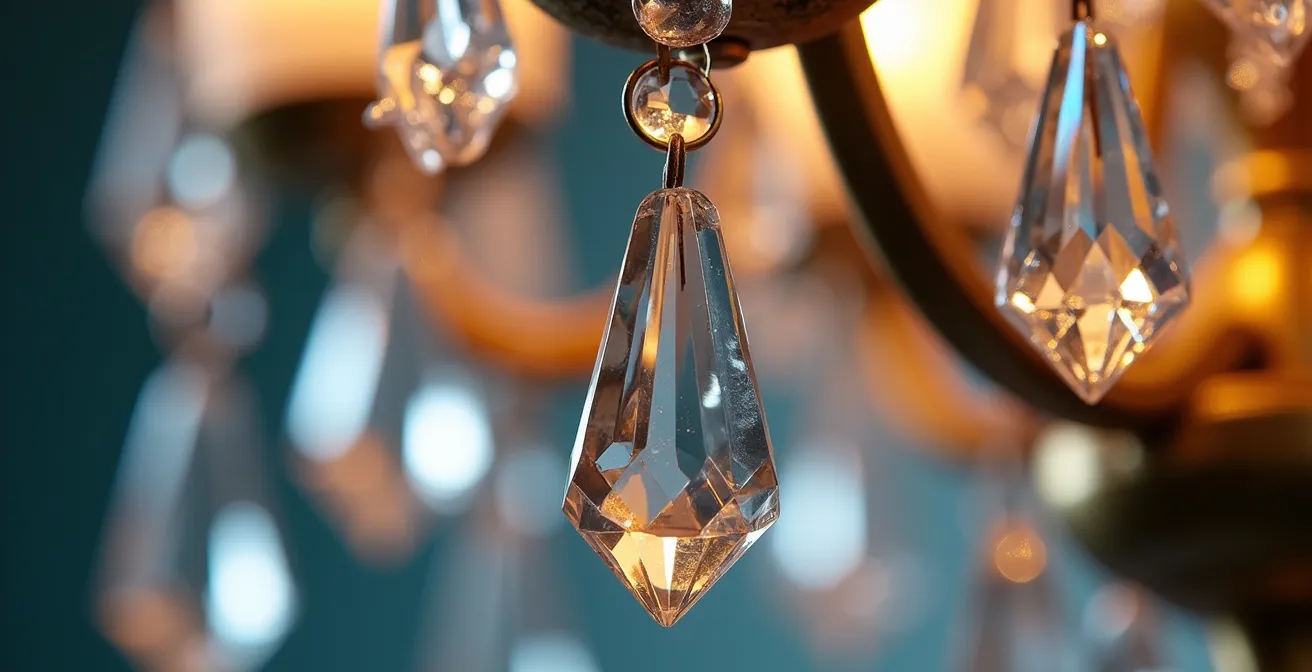
Ultimately, a documented and authenticated vintage chandelier serves as a hedge against buyer skepticism. It’s a tangible piece of history and craftsmanship that holds its value. As one appraisal service states, it provides a unique form of financial assurance.
A well-documented and authenticated vintage chandelier provides ‘investment security’ against market fluctuations and buyer skepticism.
– Elite Chandelier Services, Chandelier Appraisal and Authentication Services
To determine the true investment potential for your property, the next step is to assess specific pieces against these market criteria. Evaluate potential chandeliers not just on their beauty, but on their quantifiable contribution to your home’s total appraised value.
Frequently Asked Questions about Vintage Chandelier Investment
What’s the true cost of installing a heavy vintage chandelier?
Beyond the purchase price, you must budget for the total cost of safe installation. A professional assessment is key, but you should anticipate an additional $500 to $2,000 for necessary electrical upgrades. This typically includes reinforcing the ceiling junction box to handle the weight and often running a new, dedicated circuit to meet modern safety codes and prevent overloads.
Does rewiring an antique chandelier destroy its value?
This is a common concern, but the opposite is often true. Professional rewiring that carefully preserves original, non-electrical components while updating the fixture for modern safety standards is an act of value preservation. This process typically maintains 85-90% of the chandelier’s core antique value while completely eliminating the significant liability risks and functional issues associated with outdated wiring, making it a marketable asset.
Can old home wiring handle a vintage crystal chandelier?
It is highly unlikely, and assuming so is a major risk. Homes built before the 1960s, in particular, often have original 60-amp service panels and wiring that cannot safely support the combined load of modern household appliances plus a high-wattage, multi-bulb fixture. An electrical consultation will almost certainly recommend a panel upgrade or, at a minimum, a dedicated circuit to prevent fire hazards and ensure the installation is up to code.