
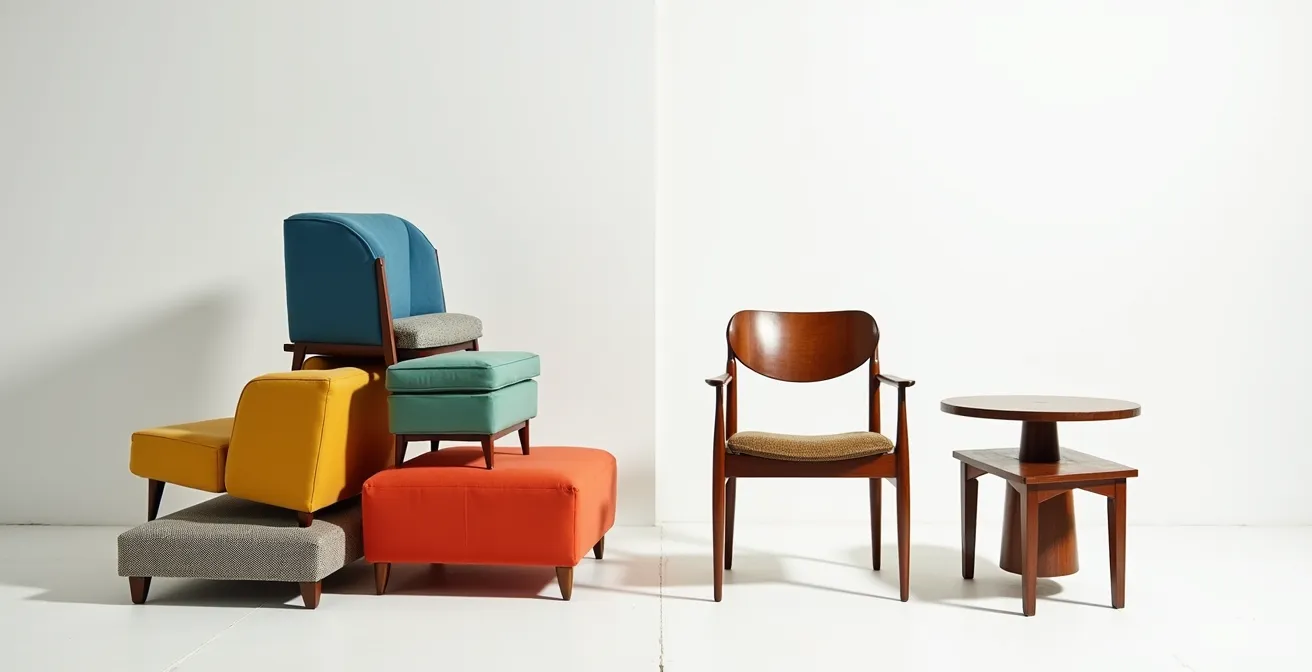
Chasing fleeting interior design trends is a psychological trap that quietly drains your wallet, costing far more than the initial price tag.
- The constant cycle of buying and replacing “fast decor” creates a hidden “trend tax” due to rapid depreciation and low quality.
- True value lies not in the initial cost of an item but in its “Total Cost of Ownership” over a decade.
Recommendation: Shift your mindset from a short-term consumer to a long-term curator by building a “capsule home” collection, saving you money and creating a style that lasts.
The gentle scroll through social media suddenly stops. There it is: the fluted side table, the checkerboard rug, the bouclé armchair. A familiar pang of desire hits—a mix of inspiration and inadequacy. Your own living room, once a source of pride, now feels dated. This feeling is not an accident; it’s the engine of the micro-trend economy. It creates a powerful form of cognitive dissonance, an uncomfortable gap between the home you have and the idealized, ever-changing version you see online. This discomfort drives a powerful urge to “fix” the problem by consuming.
The common advice is to “buy what you love” or “invest in quality,” but these platitudes fail to address the root cause. They don’t explain the psychological pull of these fleeting fads—the quick dopamine loop that comes from the click-to-buy, the unboxing, and the temporary satisfaction of feeling “on-trend.” This cycle, however, leads to decision fatigue and a home filled with items that lose their appeal as quickly as they gained it. The financial and environmental costs are staggering, but they are often invisible at the point of purchase.
But what if the solution wasn’t about resisting trends with sheer willpower? What if, instead, you could build a “decorating immune system”? This guide takes a consumer psychologist’s approach to reveal the hidden costs of fast decor. We will dissect the mechanisms that make you spend more and provide a strategic framework to create a timeless, personal, and financially savvy home. It’s about moving from being a passive trend follower to an active curator of your own space.
text
This article will provide a clear roadmap to navigate the complex world of home decor. We will explore how to identify lasting quality, update your space on a budget, and ultimately build a home that reflects you, not just a fleeting algorithm. The following sections break down each crucial step of this journey.
Summary: A Strategic Guide to Escaping the Trend Cycle
- How to Distinguish a Future Classic from a 6-Month Fad?
- How to Update Your Living Room for Under $200 Without Painting?
- The Hidden Environmental Cost of “Fast Decor” Items You Buy Online
- Mid-Century vs. Industrial: Can You Mix Them in a 1990s House?
- When to Buy Decor: The Best Time of Year to Snag High-End Trends on Sale
- The $500 Chair vs. The $50 Chair: Which Is Cheaper over 10 Years?
- Scratched Brass: When to Polish It and When to Leave It Alone?
- How to Build a “Capsule Home Collection” That Saves You $1,000 a Year?
How to Distinguish a Future Classic from a 6-Month Fad?
The ability to differentiate a piece with lasting power from a fleeting trend is the first line of defense for your wallet and your sanity. A six-month fad is typically characterized by extreme or highly specific features—an unusual color, a novel shape, or a material tied to a momentary cultural reference. These items shine brightly but burn out fast, leaving you with an object that feels dated almost as soon as the next trend emerges. The financial consequence is severe; most mass-market furniture is designed to be disposable, and according to industry standards, furniture depreciates at 15-20% per year, a rate that accelerates for trendy items.
In contrast, a future classic possesses a quiet confidence. It relies on three core pillars: quality materials, timeless form, and versatility. Quality materials like solid wood, natural fibers, and well-crafted metals not only last longer but often improve with age. A timeless form is one based on clean lines, balanced proportions, and ergonomic function, allowing it to transcend specific eras. Finally, versatility is the ultimate test. Can the piece exist in different rooms and adapt to evolving styles? A truly classic design is a chameleon, fitting seamlessly into various contexts.
To make this tangible, apply the “Versatility Litmus Test” before any purchase. Visualize the item in three distinct settings: a minimalist modern apartment, a rustic farmhouse, and a formal traditional home. If it looks plausible and stylish in at least two of these environments, it has the versatility to be a long-term investment rather than a short-term fling. This simple mental exercise shifts the focus from “Does this fit the trend now?” to “Will this serve my home for years to come?”
How to Update Your Living Room for Under $200 Without Painting?
The impulse to refresh a room doesn’t have to trigger a major expense. The pressure to buy something new is often an external suggestion, not an internal need. Before opening your wallet, the most powerful and cost-effective strategy is to “shop your own home.” This involves a creative audit of everything you already own, treating your house like a free boutique filled with untapped potential. Often, the pieces needed for a fresh look are already there, just misplaced or underutilized.
Start by moving things around. Swap the rug from the bedroom with the one in the living room. Bring in a side table from the guest room or a lamp from your home office. This simple act of rearrangement can dramatically alter the feel and function of a space without costing a dime. The goal is to break familiar patterns and see your possessions with fresh eyes. This process not only saves money but also builds a deeper connection with the items you’ve chosen to live with over the years.
If you still feel the need for something new after this exercise, focus on high-impact, low-cost textiles. A new set of pillow covers, a textured throw blanket, or updated curtains can inject new color and personality for well under $200. The key is to leverage these small changes to create a feeling of novelty, satisfying the psychological urge for newness without succumbing to the high cost of a “fast decor” overhaul. The “Shop Your Own Home Framework” is your best tool: audit underused items, test new furniture arrangements, and swap textiles and decor between rooms to create new combinations.
The Hidden Environmental Cost of “Fast Decor” Items You Buy Online
The instant gratification of online shopping conceals a dark and inconvenient truth: the “fast decor” industry is a significant contributor to environmental waste. The low price of that trendy vase or side table is made possible by a system built on low-quality materials, unethical labor practices, and a disposable mindset. These items are not designed to last; they are designed to be replaced. Every year, Americans throw out more than 12 million tons of furniture, and a large portion of this waste ends up in landfills, where materials like particleboard and synthetic fabrics can take decades or centuries to decompose.
This macro-level waste is a direct result of the materials and construction methods used in fast furniture. The degradation is visible and rapid, turning a once-stylish object into a piece of refuse. The peeling laminate, crumbling particle board, and fraying fabrics are the physical symptoms of a flawed economic model.

As the image above illustrates, the very materials that make these items cheap are what destine them for the landfill. This cycle of consumption and disposal is not just wasteful; it’s an inefficient pipeline that has significant consequences for our planet’s resources.
Furthermore, the environmental cost extends beyond the landfill. Many online returns, especially for bulky decor items, are not restocked. As one analysis highlights, the logistics of returning, inspecting, and repackaging are often more expensive than simply discarding the item.
Case Study: The Return-to-Landfill Pipeline
Research reveals that many returned home decor items from large online retailers are sent directly to landfills because the logistical costs of restocking them are too high. This issue is compounded by the carbon footprint of global shipping. A study featured in The Week notes that if global shipping were a country, it would be the sixth-largest producer of greenhouse gas emissions, with furniture requiring multiple shipping stages from source to consumer.
Mid-Century vs. Industrial: Can You Mix Them in a 1990s House?
One of the biggest sources of decorating anxiety is the fear of mixing styles. Homeowners, especially those in homes with less-defined architectural character like many 1990s builds, often feel they must commit to a single, rigid “look” to avoid a chaotic result. This fear makes them vulnerable to pre-packaged trends, which offer a seemingly safe, coordinated solution. However, the most personal and timeless interiors are often those that confidently blend different styles. Mixing aesthetics like the organic warmth of Mid-Century Modern with the raw edge of Industrial is not only possible but can create a space with unique depth and character.
The key to successful style mixing is the 80/20 Dominance Rule. This principle dictates that you choose one style to be your 80% foundation and use the second style for the remaining 20% as accent pieces. For example, your sofa, main storage, and color palette might be firmly Mid-Century, while your accent chairs, lighting, and small decor objects could be Industrial. This creates a clear visual hierarchy and prevents the two styles from competing with each other. The second crucial step is to identify a “unifying bridge”—a common element that ties the disparate pieces together. This could be a shared material (like black metal or warm wood), a consistent color, or a repeated texture.
In a 1990s house, which can be a neutral canvas, this approach works particularly well. You can use the 80/20 rule to impose a strong design identity. The table below offers a practical guide for blending Mid-Century and Industrial elements by identifying where to commit and where to accent, and how to bridge the two styles.
| Element | Mid-Century (80%) | Industrial (20%) | Unifying Bridge |
|---|---|---|---|
| Furniture | Walnut wood pieces, curved sofas | Metal accent chairs | Black metal details on both |
| Lighting | Brass pendant lights | Edison bulb fixtures | Warm metallic tones |
| Color Palette | Warm woods, cream | Black, raw metal | Neutral base colors |
| Textures | Smooth wood, soft fabrics | Raw metal, leather | Natural materials throughout |
When to Buy Decor: The Best Time of Year to Snag High-End Trends on Sale
Part of building a “decorating immune system” is shifting from impulsive buying to strategic purchasing. Resisting the urge to buy a trendy item at full price is much easier when you know a better opportunity is just around the corner. The retail cycle for home goods is highly predictable, and understanding its rhythm allows you to acquire higher-quality pieces—even those that touch on current trends—for a fraction of the cost. This requires patience, but the financial payoff is significant.
New furniture collections are typically released twice a year, in the spring and fall. The months leading up to these launches are when retailers are most desperate to clear out old inventory. This means late winter (January/February) and late summer (August/September) are prime times for major sales on floor models and last season’s stock. Outdoor furniture, for instance, sees its deepest discounts in September and October, as stores make way for holiday items. Lighting and large upholstery pieces are often on sale in February after the holiday rush and before spring collections arrive.
This seasonal approach allows you to plan your purchases rather than react to marketing. By creating a wishlist and waiting for the right buying window, you take control of the transaction. You are no longer a passive consumer swayed by a “limited time offer” but a strategic shopper who understands the market’s cycles.
For a more granular approach, different categories have their own specific deal seasons. By tracking these, you can furnish your home with high-quality, lasting pieces at fast-decor prices. The key is to know what you’re looking for and be prepared to act when the time is right, as outlined in the “Category-Specific Furniture Buying Calendar”: September for outdoor furniture, February for lighting, and late spring for floor models.
The $500 Chair vs. The $50 Chair: Which Is Cheaper over 10 Years?
The most pervasive myth of budget decorating is that the lowest initial price equals the cheapest option. This flawed logic ignores the single most important factor in furniture economics: Total Cost of Ownership (TCO). TCO forces you to look beyond the price tag and consider the full lifecycle of a product, including its lifespan, replacement costs, and resale value. When viewed through this lens, a high-quality, more expensive item often proves to be the far more frugal choice in the long run.
Consider a tale of two chairs. The $50 “fast furniture” chair seems like a bargain. However, its particleboard frame and synthetic fabric give it a realistic lifespan of 2-3 years under normal use. Over a decade, you will likely need to replace it 3 to 4 times, bringing your total expenditure to $150-$200. At the end of its life, it has zero resale value and contributes to landfill waste. The $500 quality chair, constructed from solid wood and durable upholstery, may have a higher upfront cost, but it is built to last 10 years or more. It requires zero replacement cost within that decade. Furthermore, due to its quality and timeless design, it retains significant resale value.
This concept is perfectly illustrated when we calculate the true cost over a ten-year period. The cheap chair’s cost is its full purchase price multiplied by replacements, while the quality chair’s true cost is its initial price minus its retained resale value.
As the experts at Accounting Insights point out, this financial logic is tied directly to the nature of the design:
Trend-driven designs may become outdated within a few years, while classic styles like mid-century modern or antique reproductions hold value longer.
– Accounting Insights, How Much Does Furniture Depreciate Over Time
| Factor | $500 Quality Chair | $50 Fast Furniture Chair |
|---|---|---|
| Initial Cost | $500 | $50 |
| Lifespan | 10+ years | 2-3 years |
| Replacements Needed (10 years) | 0 | 3-4 times |
| Total Replacement Cost | $0 | $150-200 |
| Resale Value | $250 (50%) | $0 |
| True 10-Year Cost | $250 | $200-250 |
| Comfort/Quality Factor | High | Low |
Scratched Brass: When to Polish It and When to Leave It Alone?
In a culture obsessed with flawless newness, learning to appreciate the signs of age is a radical act. Nothing embodies this philosophy more than the concept of patina. A material like brass tells a story over time. Daily use, exposure to air, and the oils from our hands create a soft, rich layer of oxidation that deepens its character. This natural aging process, or patina, is not damage; it is a mark of authenticity and history that cannot be replicated in a factory.
The crucial distinction to make is between patina and damage. Patina is a uniform, aesthetically pleasing change in the material’s surface. It often darkens the color and reduces the shine, lending the object a sense of warmth and gravity. In contrast, damage includes deep scratches that break the surface, corrosion (green or white powdery spots), or uneven staining from spills. Knowing the difference is key to proper care. The impulse to polish away every imperfection can strip a piece of its most valuable attribute: its story.
So, when should you act? Leave it alone if the surface has a consistent, warm, and even darkening. This is desirable patina, especially on antique or vintage pieces, where it can significantly contribute to the item’s value. Consider polishing only under specific circumstances:
- If the piece is meant to be highly reflective as part of a modern or glam design scheme.
- If there is active corrosion (verdigris) that could damage the metal over time.
- If the tarnish is uneven and blotchy, appearing more like a stain than a consistent finish.
Embracing patina is a powerful psychological shift. It moves you from the mindset of a consumer, always seeking the next new thing, to that of a curator, appreciating the objects you live with as they evolve alongside you.
Key Takeaways
- Chasing micro-trends is a psychological and financial trap; focus on building a “decorating immune system” instead.
- The true cost of an item is its “Total Cost of Ownership” (TCO) over a decade, not its initial price tag.
- A “capsule home” built on a foundation of 5 timeless, high-quality pieces is the most effective strategy for long-term savings and style.
How to Build a “Capsule Home Collection” That Saves You $1,000 a Year?
The ultimate strategy for escaping the trend cycle is to adopt the “capsule home” concept, an idea borrowed from the world of minimalist fashion. Instead of a collection of disconnected, trendy items, you build a core foundation of high-quality, timeless, and versatile pieces that work together harmoniously. This approach not only creates a more cohesive and personal space but also generates significant financial savings by eliminating impulsive, short-term purchases. With U.S. consumers spending an average of $1,598 on home decor each year, consciously redirecting that spending can have a massive impact.
The core of the capsule home is the “5-Piece Foundation Framework.” This involves identifying the five cornerstone pieces of furniture in your primary living space. These are typically the hardest working and most visually dominant items. For most people, this includes:
- Your main sofa
- A dining table
- Your bed frame
- Primary source of lighting (e.g., a statement floor lamp or pendant)
- The main area rug
The strategy is to invest the majority of your budget and decision-making energy into these five items, ensuring they are of the highest quality and most timeless design you can afford. Every other item in your home—from pillows and throws to side tables and decorative objects—is then treated as a rotational accent. These smaller pieces can be changed out affordably over time to reflect evolving tastes or seasonal moods, but your foundational investment remains solid and stylish for decades.
Adopting this framework forces a disciplined “One In, One Out” rule. Before purchasing a new accent, you commit to selling or donating an old one. This prevents clutter and reinforces a curatorial mindset. The savings are concrete: avoiding just 3-4 micro-trend impulse buys per year (at an average of $150 each) can save you over $750 in five years, easily surpassing the $1,000-a-year mark when applied across your entire home. The following plan helps you put this into practice.
Your Action Plan: Building Your Capsule Home Foundation
- Identify Cornerstones: List your five most essential furniture pieces (e.g., sofa, dining table, bed frame, primary lighting, main rug) that anchor your home.
- Budget Allocation: Commit to investing the majority of your future decor budget in the quality and longevity of these five foundation pieces.
- Define Accents: Categorize all other items (cushions, vases, side tables) as rotational “accents” that can be changed affordably over time.
- Implement ‘One In, One Out’: Before buying any new accent piece, make a rule to sell, donate, or repurpose an existing one to prevent clutter and encourage mindful consumption.
- Calculate Savings: Track the impulse buys you avoided. Avoiding just 3-4 trendy items ($150) annually saves over $750 in 5 years, proving the financial benefit of the capsule approach.
By shifting your focus from chasing trends to curating a thoughtful collection, you not only save a significant amount of money but also create a home that is a true and lasting reflection of your personal style. Evaluate your space today and begin identifying the foundational pieces that will serve you for years to come.