

“Destination duping” is more than finding a cheaper city; it’s a strategic overhaul of your travel habits to unlock authentic experiences and significant savings.
- True cost includes hidden fees, travel time, and local economic impact—not just the ticket price.
- Smart tech choices, from fintech cards for currency exchange to multi-layered offline maps, create financial efficiency and travel resilience.
Recommendation: Shift your focus from “where” you go to “how” you travel to transform any destination into a rewarding, responsible experience.
The dream of a gondola ride through Venice often crashes against a stark reality: overwhelming crowds and sky-high prices. When a city of just over 50,000 residents is swamped by approximately 30 million visitors annually, the charm can quickly fade. This has fueled the rise of the “destination dupe”—the idea of swapping an over-visited hotspot for a lesser-known, more affordable alternative. But this trend isn’t without its critics.
As some observers note, this mindset can be reductive. As one travel blogger points out, the dupe movement can relegate “alternative gems to second-class status, as if they’re merely backup plans instead of destinations worthy of their own spotlights.” The truth is, a more sophisticated approach is needed, especially as travel bookings climbed to near pre-COVID-19 numbers in recent years, forcing many destinations to implement tourist caps to manage the influx.
The real art of “duping” isn’t about finding a cheap copy of a famous city. It’s about adopting a strategic travel mindset. It means re-engineering every facet of your journey—from timing and technology to packing and payment—to unlock authentic experiences and create economic value, effectively turning any trip into a smarter, more rewarding venture. This isn’t about finding a lesser Venice; it’s about becoming a better traveler.
This guide breaks down the core tactics of this savvy, alternative-focused approach. By mastering these practical strategies, you can bypass the common frustrations of modern travel and discover the authentic European charm you’re looking for, no matter where you land.
Summary: A Strategic Guide to Smarter European Travel
- October vs. May: Which Shoulder Season Offers Better Weather for the Mediterranean?
- Airbnb vs. Local Guesthouses: Which Actually Supports the Local Economy?
- Train vs. Plane: When Is the Eurail Pass Actually Cheaper?
- The “Offline Maps” Prep: How to Navigate When You Have Zero Signal?
- The 3-Layer System: Packing for Mountains and Beaches in One Carry-On
- Revolut or Wise: Which Fintech Saves More on Currency Exchange Fees?
- Google Translate vs. Phrasebook: Which Wins for Genuine Connection?
- Photography Etiquette: How to Take Portraits of Locals Without Being Offensive?
October vs. May: Which Shoulder Season Offers Better Weather for the Mediterranean?
The standard advice to “travel in the shoulder season” is a good starting point, but it lacks strategic depth. May and October, the two primary shoulder seasons for the Mediterranean, offer vastly different experiences. A savvy traveler doesn’t just pick one randomly; they engage in a form of travel arbitrage, weighing factors like daylight hours, local events, and pricing trends to maximize the value of their trip. The choice isn’t just about avoiding summer crowds; it’s about aligning the trip’s timing with your specific travel priorities.
For instance, May offers longer days perfect for extensive sightseeing and the vibrant energy of spring festivals. However, prices are often on an upward trajectory toward the summer peak. Conversely, October brings the rich atmosphere of harvest season and cooler temperatures ideal for hiking, with accommodation prices typically declining. Analyzing these trade-offs is the first step in engineering a superior travel experience. The following comparison breaks down the key differences to help you make a calculated decision.
| Factor | May | October |
|---|---|---|
| Average Temperature | 18-22°C (64-72°F) | 15-20°C (59-68°F) |
| Daylight Hours | 14-15 hours | 10-11 hours |
| Tourist Density | Moderate-High | Low-Moderate |
| Local Events | Spring festivals, blooms | Harvest festivals, wine season |
| Accommodation Prices | Rising towards peak | Declining from peak |
Making the right choice requires a clear understanding of your personal travel style and priorities. This checklist provides a framework for thinking through the decision process strategically.
Action Plan: Choosing Your Mediterranean Shoulder Season
- Assess your heat tolerance: Evaluate if October’s cooler temperatures are better suited for your planned activities like hiking versus May’s warmer beach days.
- Determine your priority: Decide if longer daylight hours in May for sightseeing are more valuable to you than the cozy evenings and harvest events of October.
- Research local calendars: Cross-reference your travel dates with local harvest festivals (October) or flower blooms (May) to align with specific cultural experiences.
- Analyze flight data: Check flight prices 3-4 months in advance, noting that October often presents better deals after the summer rush.
- Evaluate accommodation strategy: Plan to book accommodations well in advance for May, while for October you might find last-minute deals as properties look to fill rooms.
Airbnb vs. Local Guesthouses: Which Actually Supports the Local Economy?
Your choice of accommodation is one of the most significant economic decisions you’ll make as a traveler. The rise of platforms like Airbnb has been marketed as a way to “live like a local,” but the reality is often more complex. Experience-centric planning means looking beyond the aesthetics of a listing and asking a crucial question: where is my money actually going? In many over-visited cities, the proliferation of short-term rentals owned by remote investors can hollow out residential neighborhoods and drive up living costs for residents.
The alternative, a locally-owned guesthouse or small hotel, often creates a more direct and positive economic multiplier effect. Money spent there is more likely to circulate within the community, paying local staff, sourcing local produce for breakfast, and supporting other nearby family-run businesses. This choice directly impacts the authenticity of the destination itself.
Case Study: Venice’s Hollowing-Out Effect
The impact of tourism-focused accommodation is starkly visible in Venice. The constant influx of tourists and the ecosystems built to serve them have contributed to thousands of residents leaving the city each year. This exodus has seen authentic artisan workshops and neighborhood grocery stores replaced by generic souvenir shops, fundamentally altering the city’s character and threatening its cultural fabric to the point of endangering its UNESCO World Heritage status.
Choosing a stay that genuinely supports the local fabric requires a bit of due diligence. An inviting, family-run guesthouse not only provides an authentic experience but also ensures your travel dollars contribute to preserving the very culture you came to see.

To make a more responsible choice, go beyond the photos and star ratings. Before booking, ask yourself a series of critical questions to vet the listing’s true local credentials:
- Is the host a permanent resident of the area, or is this managed by a large property company?
- Does the property operate year-round, serving the community, or only during peak tourist season?
- Are local staff employed for cleaning, maintenance, and reception?
- Does the listing mention or recommend specific, non-touristy local businesses?
- Is this a spare room within a family home, or is it one of many units in a building dedicated entirely to short-term rentals?
Train vs. Plane: When Is the Eurail Pass Actually Cheaper?
The allure of a cheap budget airline ticket is powerful, but it’s often a financial illusion. A savvy traveler understands the concept of the “True Cost Stack”—the total expense in both money and time. A €30 flight might seem cheaper than a €60 train ticket, but this initial price rarely tells the whole story. Once you add baggage fees, the cost of airport transfers to and from remote, out-of-town terminals, and the hours spent on security lines and transit, the train often emerges as the more efficient and even cheaper option.
The Eurail Pass, a classic symbol of European travel, isn’t always the most economical choice either. Its value depends heavily on your itinerary’s flexibility, the number of long-distance journeys you plan, and whether you’re traveling on routes that require expensive seat reservations. For shorter, regional trips, booking point-to-point tickets in advance is frequently more cost-effective. As research from BudgetYourTrip shows, transportation costs can vary significantly, and a traveler’s daily spend is heavily influenced by these choices.
The following table provides a real-world example, comparing the True Cost Stack for a journey between Ljubljana and Venice. It reveals how the “cheapest” option on paper can quickly become more expensive and time-consuming.
| Transport Method | Base Price | Hidden Costs | Total Journey Time | City Center to Center |
|---|---|---|---|---|
| Direct Bus | €33-45 | None | 3h 29m | Yes |
| Train via Villach | €45-85 | Seat reservation | 5h 35m | Yes |
| Budget Flight + Transfers | €30-80 | €15-30 baggage + €30-50 airport transfers | 4-5h total | No |
| Car Rental | €40-60/day | €8 toll + fuel | 2h 29m | Flexible |
As the data shows, the direct bus offers the best balance of cost and time for this specific route, delivering you directly to the city center. The flight, while seemingly cheap initially, becomes one of the most expensive and inefficient options once all costs are factored in. This analytical approach to transport is a cornerstone of the dupe mindset.
The “Offline Maps” Prep: How to Navigate When You Have Zero Signal?
In an age of constant connectivity, one of the biggest travel stressors is losing your digital lifeline. A dead phone battery, a lack of Wi-Fi, or the sudden realization that your data plan doesn’t cover a remote mountain pass can derail a day’s itinerary. Strategic resilience is about anticipating these friction points and building a robust, multi-layered navigation system that works even when you’re completely offline. Relying on a single app is a recipe for disaster.
The savvy traveler’s approach involves creating redundancy. This means downloading offline maps for your primary app, but also installing a secondary app known for its detailed hiking trails or deep offline functionality. It includes taking screenshots of key addresses and having a low-tech backup, like a hotel business card. This preparation isn’t about paranoia; it’s about ensuring your adventure remains smooth and enjoyable, free from the anxiety of getting lost.
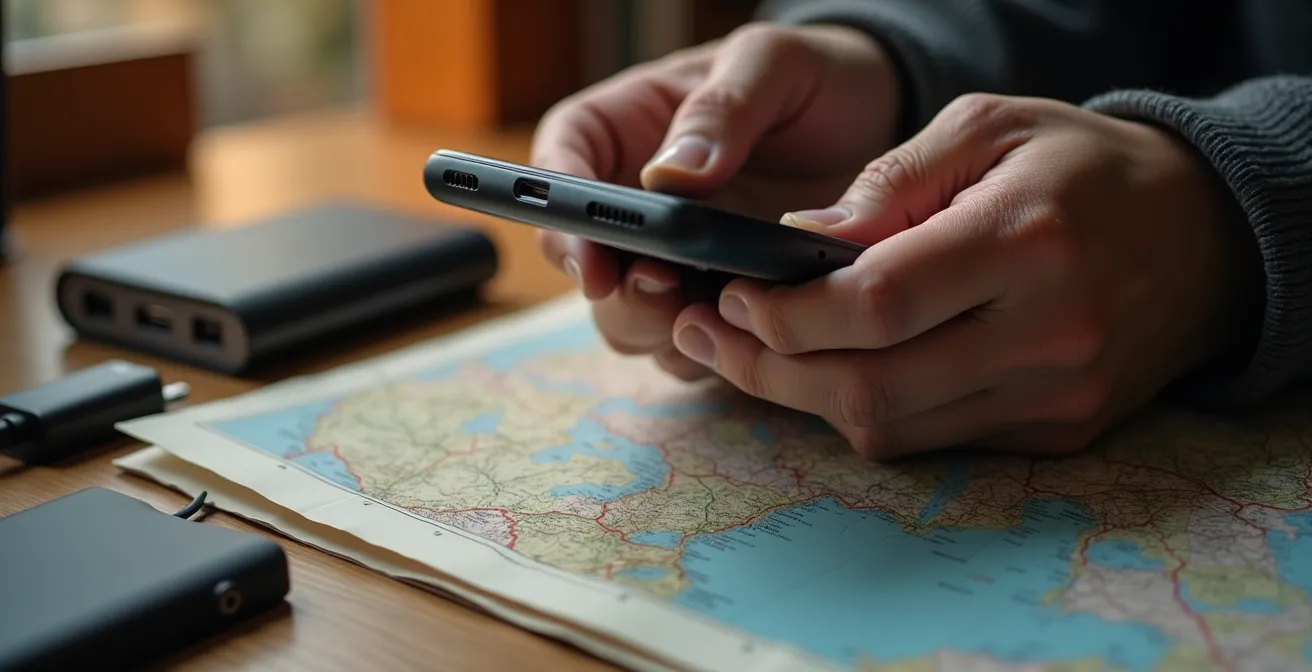
This isn’t a one-step process. A truly resilient strategy involves several layers of preparation, ensuring you have the right tool for every situation, from navigating a bustling city’s metro to finding a trailhead with no cell service. Follow this multi-layer strategy for foolproof navigation:
- Layer 1 (The Base): 24-48 hours before your trip, download the offline map areas for all your primary destinations within Google Maps or Apple Maps.
- Layer 2 (The Specialist): Install a secondary app like Maps.me or Organic Maps, which often have more detailed offline topographic data and hiking trails contributed by users.
- Layer 3 (The Itinerary): Take screenshots of your daily itinerary, including hotel addresses, train stations, and key meeting points, preferably with the names written in the local language.
- Layer 4 (The Transit): For urban travel, download dedicated public transport apps like Citymapper or Moovit, many of which have full offline functionality for major cities.
- Layer 5 (The Language): Ensure your translation app (like Google Translate) has the offline language pack for your destination downloaded, allowing you to read street signs and transit information without a connection.
The 3-Layer System: Packing for Mountains and Beaches in One Carry-On
The ultimate act of travel arbitrage is avoiding checked baggage fees and the hassle of lost luggage. This requires a disciplined and strategic approach to packing, especially when your itinerary includes diverse climates, like a trip with both mountain hikes and beach days. The key is the 3-layer system, a method borrowed from outdoor adventurers that relies on versatile, high-performance pieces that work together to cover a wide range of temperatures.
The system is simple: a moisture-wicking base layer, an insulating mid-layer, and a protective outer shell. By combining these, you can adapt to anything from a cool morning in the Alps to a warm afternoon on the Adriatic coast. The genius of this system lies in its efficiency; each item serves multiple purposes. This philosophy extends to your entire packing list, prioritizing multi-use items like a sarong that can be a scarf, towel, or beach cover-up. According to what travel packing experts calculate, wearing your bulkiest items like boots and a jacket on the plane can save 3-4kg of carry-on weight, keeping you comfortably under the strict limits of budget airlines.
This isn’t about packing less; it’s about packing smarter with a system built for versatility and efficiency.
- Base Layer: Consists of 2-3 merino wool t-shirts. They are naturally anti-odor, regulate temperature in both hot and cold weather, and dry quickly overnight.
- Mid Layer: A single lightweight fleece or a packable down vest. This layer provides crucial insulation and should have a maximum packed weight of around 200g.
- Shell Layer: One high-quality waterproof and breathable jacket. This serves as your rain protection and a windbreaker, making it essential for both mountain and coastal weather.
- Multi-Use Items: Supplement the core layers with items like convertible pants (that zip off into shorts), a buff or neck gaiter (for sun, wind, or warmth), and a sarong.
- Footwear Strategy: The heaviest and bulkiest items. Wear your hiking boots on the plane. Pack one pair of versatile sneakers and a pair of lightweight water shoes or sandals.
- Packing Cubes: Organize your carry-on with a modular system. Use separate cubes for your “beach module,” “mountain module,” and “city module” for quick and easy access without unpacking everything.
Revolut or Wise: Which Fintech Saves More on Currency Exchange Fees?
One of the most insidious hidden costs of travel is currency exchange fees. Traditional banks and airport currency exchange kiosks often charge hefty markups on the exchange rate, quietly siphoning money from your travel budget. The savvy traveler leverages financial technology (fintech) to bypass these fees. Services like Revolut and Wise have revolutionized travel finance by offering multi-currency accounts and cards that exchange money at or near the mid-market rate.
However, even within the world of fintech, there are nuances to understand. The choice between Revolut and Wise isn’t a simple one; it depends on your specific spending habits. For example, some services add a small markup for exchanges made on weekends when forex markets are closed, while others don’t. As demonstrated in a real traveler’s cost breakdown of a Slovenia trip, careful attention to payment methods can significantly impact a daily budget of around $116. This is financial travel arbitrage in its purest form.
Choosing the right card is about matching its features to your travel style. Will you be making large ATM withdrawals or frequent small purchases? Do you travel often on weekends? This comparison highlights the key differences to help you decide.
| Feature | Revolut (Standard) | Wise |
|---|---|---|
| Weekend Exchange Markup | 0.5-1% | None |
| Monthly Free ATM Limit | €200 | €200 |
| Card Delivery | 5-7 days | 7-10 days |
| Multi-currency Hold | Yes (30+ currencies) | Yes (50+ currencies) |
| Best For | Frequent small purchases | Large transfers/weekend use |
The takeaway is clear: for travelers who do a lot of spending or ATM withdrawals over a weekend, Wise’s policy of no weekend markup can lead to tangible savings. For mid-week, frequent small transactions, Revolut might be more convenient. Having both, and using them strategically, is the ultimate power move for a global traveler.
Google Translate vs. Phrasebook: Which Wins for Genuine Connection?
The goal of language in travel shouldn’t be perfect fluency, but genuine connection. This is the essence of achieving a high-fidelity travel experience. In this context, the debate between a translation app and a physical phrasebook misses the point. The most effective tool is a hybrid approach that uses technology as a backup, not a crutch, and prioritizes human interaction above all.
Holding up a phone screen creates a technological barrier between you and the person you’re speaking with. In contrast, stumbling through a phrase from a book, or even just attempting the five most important words in the local language, shows effort and respect. It signals vulnerability and a genuine desire to connect, which is often met with warmth and a willingness to help. Technology has its place, particularly for critical situations like explaining a dietary allergy or understanding complex directions, but it should not be the first resort for everyday social interactions.
The savvy traveler’s language strategy is a deliberate one, designed to foster authentic moments rather than simply to transact information. This approach combines the best of both worlds:
- Master the Core Five: Before you arrive, learn to pronounce “Hello,” “Thank you,” “Excuse me,” “Please,” and a humble “I am learning your language” perfectly.
- Use the Phrasebook for Social Contexts: Rely on a phrasebook for predictable interactions like ordering coffee, buying a train ticket, or shopping at a market. The act of searching for the phrase is part of the interaction.
- Reserve Google Translate for Critical Needs: Use your translation app for important, complex situations where accuracy is paramount, such as dealing with a medical issue or a booking problem.
- Make Tech a Shared Tool: When you must use a translation app, turn the screen toward the local. This transforms it from a personal barrier into a shared tool you are using together to solve a problem.
- Attempt the Local Language First: Always lead with your best attempt in the local language, no matter how imperfect. This gesture is more important than the words themselves.
Key takeaways
- “Dupe” travel is a strategic mindset, not just a cheaper location; it’s about re-engineering *how* you travel.
- Always analyze the “True Cost Stack” of any decision, factoring in hidden fees, travel time, and local economic impact.
- Authenticity is a direct result of mindful choices in accommodation, communication, and financial transactions.
Photography Etiquette: How to Take Portraits of Locals Without Being Offensive?
The final pillar of a high-fidelity travel experience is ethical interaction, and nowhere is this more crucial than in photography. A powerful portrait of a local can be a beautiful travel memory, but it can also be an act of objectification. For the residents of heavily touristed areas, being constantly photographed without permission can feel intrusive and dehumanizing. The savvy traveler understands that a person is not a landmark; a great portrait is a gift, not something to be taken.
The key is to prioritize interaction before transaction. This means engaging with the person first on a human level. Buy something from their market stall, have a conversation, or share a laugh before a camera is even considered. Using a long zoom lens to “snipe” photos from a distance is the epitome of low-fidelity, disconnected travel. Getting closer, both physically and emotionally, with permission, is what leads to authentic and respectful portraiture. This approach transforms the act of photography from a one-sided taking into a shared, collaborative moment.
Following a clear protocol ensures your photographic pursuits are respectful and result in more meaningful images.
- Interaction First, Photo Second: Always engage with the person before even thinking about photography. Buy their produce, compliment their craft, or ask a genuine question.
- The “Ask Twice” Method: First, ask for permission with your camera down. If they agree, take the photo, and then—crucially—show them the image on your camera screen. This closes the loop and makes them a participant.
- Read the Implicit “No”: Body language speaks volumes. Averted eyes, a slight hesitation, or a hand raised is a clear “no,” even if no words are spoken. Respect it immediately and move on.
- Use a Normal Lens: Avoid telephoto lenses. Use a standard focal length (like 50mm or 85mm) which requires you to get physically closer, forcing a more personal and permission-based interaction.
- Share the Photo: Offer to send the photo to them. Getting their WhatsApp number or email to share the portrait is a wonderful way to extend the connection.
- Consider Compensation: In many cultures, a person’s time is their livelihood. Offer to buy their products or provide a small tip as a thank-you for their time, especially if they are a street performer or artisan.
Ultimately, the “dupe” mindset is a holistic philosophy. It’s about applying intelligence and intentionality to every decision you make on the road. Armed with this strategic framework, your next step isn’t to search for a substitute destination, but to transform your next trip—wherever it may be—into a smarter, cheaper, and more authentic experience.
Frequently Asked Questions on Venice or Ljubljana: How to Find the “Dupe” Destination That Saves You 50%?
How much phone storage do offline maps require?
A typical city map requires 100-200MB of storage. For a country-wide map, such as for Slovenia, you should plan for approximately 500MB to 1GB of space to ensure comprehensive coverage.
Do offline maps work with GPS when the phone is in airplane mode?
Yes. A phone’s GPS receiver functions independently of its cellular data or Wi-Fi connection. You can enable airplane mode to save battery but keep your location services turned on, and your position will still be accurately tracked on your downloaded offline map.
Which power bank capacity is best for navigation-heavy days?
For a full day of heavy navigation use, a 10,000mAh power bank is recommended. This capacity typically provides two to three full charges for a modern smartphone, giving you a sufficient buffer to use GPS-intensive apps without worrying about running out of battery.