
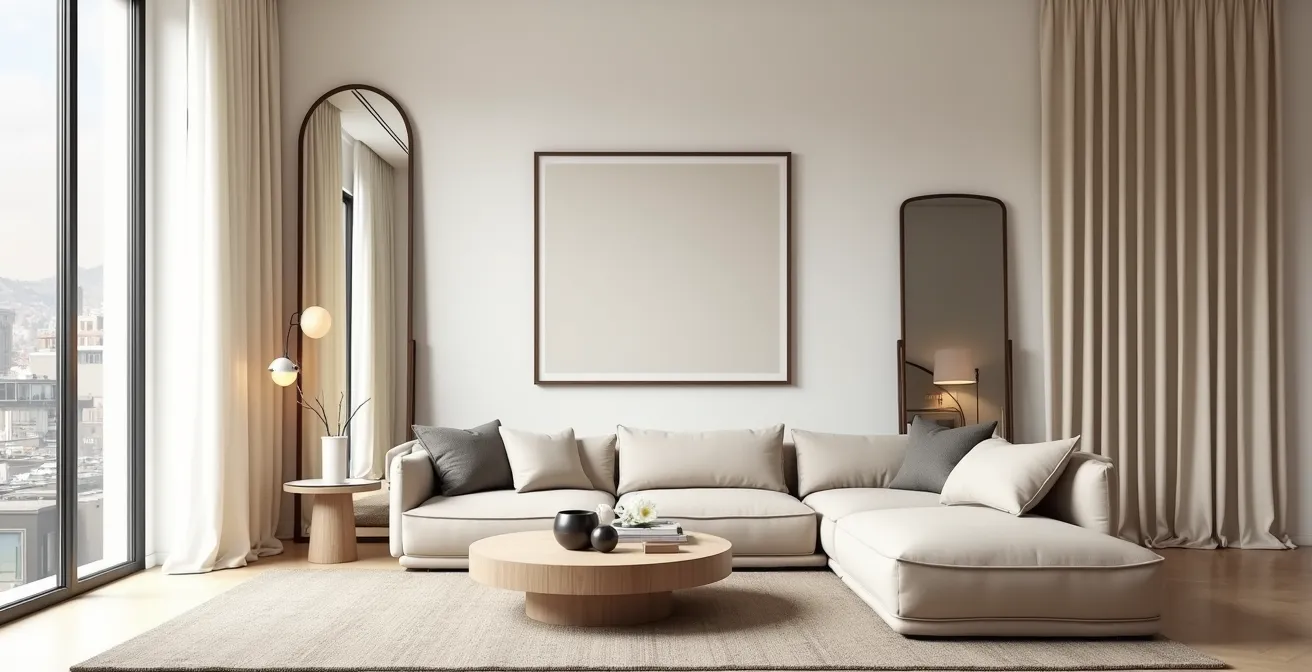
Contrary to popular belief, adding height isn’t about simple vertical stripes or generic white paint. The real magic lies in sculpting the room with implied vertical lines created through strategic lighting, architectural camouflage, and carefully curated objects that guide the eye upward, transforming a standard room into a space with perceived grandeur.
The quintessential 8-foot ceiling, a hallmark of post-war construction, often leaves homeowners feeling boxed in, a constant, low-hanging reminder of the room’s spatial limitations. The conventional wisdom for tackling this is a well-worn list of tricks: hang curtains high and wide, choose low-profile furniture, and paint everything a brilliant white. While not without merit, these are merely surface-level adjustments. They are the equivalent of a simple card trick when what you truly need is a grand illusion.
As a visual artist who works with space, I see low ceilings not as a constraint, but as a canvas. The challenge isn’t to fight the architecture, but to bend perception. This requires moving beyond decoration and into the realm of architectural illusion. The secret is not to just add vertical lines, but to sculpt with verticality. It involves a deliberate manipulation of light, shadow, texture, and form to create powerful, upward trajectories for the eye, crafting a sense of height and airiness that wasn’t there before. We will not be painting stripes; we will be building phantom architecture.
This guide will deconstruct the techniques of a spatial illusionist. We will explore how to use everything from living plants and shelving to light itself as a tool to fundamentally reshape the experience of a room. Prepare to see your space not for what it is, but for what it can become.
This article provides a detailed blueprint for these advanced techniques. Below is a summary of the core strategies we will dissect to elevate your space, transforming the mundane into the magnificent.
Summary: A Blueprint for Architectural Illusion
- Why Do 80% of DIY Green Walls Die Within the First 6 Months?
- Studs or Anchors: How to Hang Heavy Shelves on Drywall Without Disaster?
- Uplighting vs. Downlighting: Which Best Highlights Textured Feature Walls?
- Portrait or Landscape: Which Canvas Shape Corrects a Low Ceiling?
- The “Zone Strategy” to Triple Your Kitchen Cabinet Capacity
- Wall-Washing vs. Grazing: How to Highlight Stone Fireplaces?
- Mirrors or Light Paint: Which Maximizes Natural Light in North-Facing Rooms?
- Are Vintage Crystal Chandeliers a Good Investment for Home Resale Value?
Why Do 80% of DIY Green Walls Die Within the First 6 Months?
The failure of most DIY green walls stems from a fundamental misunderstanding of their purpose in a height-challenged room. They are not merely a collection of plants; they are a living, vertical cascade designed to pull the eye upward. The common mistake is focusing on horticultural survival rather than visual design. Homeowners choose bushy, dense plants that create a horizontal mass, effectively lowering the perceived ceiling. The key to success is treating the green wall as a dynamic waterfall of foliage that emphasizes downward vertical movement, paradoxically making the wall it’s on feel taller.
To achieve this, you must select trailing plants like Pothos, Philodendron, or Ivy, which naturally create strong, flowing vertical lines. The arrangement is equally crucial. Staggering the plants in vertical columns, rather than a uniform grid, creates negative space and enhances the height. Furthermore, research shows that well-designed living walls can improve air quality by 25% and lower indoor temperatures, making this illusion a functional one. The goal is a delicate, linear arrangement, not a bulky green hedge.
The final touch of the illusion is lighting. A narrow-beam uplight positioned at the base of the wall will cast dramatic vertical shadows through the foliage, extending the lines all the way to the ceiling. This turns the plant life into a piece of kinetic sculpture, where the interplay of growth and shadow continuously reinforces the illusion of height. It’s not about keeping plants alive; it’s about making your wall come alive with vertical energy.
Studs or Anchors: How to Hang Heavy Shelves on Drywall Without Disaster?
While the practical question of mounting heavy shelves—studs versus anchors—is a critical safety concern, the true “disaster” in a low-ceilinged room is a visual one. Traditional shelving introduces a series of strong, horizontal lines that chop up a wall and press the ceiling down. The illusionist’s approach reframes shelving not as storage, but as an opportunity to build a vertical structural framework. We are creating a “floating ladder” that guides the eye skyward, where the vertical supports, not the horizontal shelves, become the dominant feature.

The magic is in the execution. Floor-to-ceiling shelving systems are the most impactful, creating an unbroken line that visually stretches the wall. Asymmetrical spacing is another powerful technique; by creating significant vertical gaps between shelves, the empty wall space itself becomes a dominant vertical line. To make the shelves “disappear,” paint them the exact same color as the wall. This minimizes their horizontal presence and throws focus onto the vertical structure and the objects displayed. The choice of mounting method then becomes a servant to this visual goal, as this comparative analysis of mounting methods shows.
| Method | Weight Capacity | Visual Impact | Height Enhancement |
|---|---|---|---|
| Floating Ladder Style | 150-200 lbs per section | Strong vertical framework | Maximum – creates vertical lines |
| Wall-Mounted Brackets | 50-100 lbs per shelf | Minimal hardware visibility | Moderate – depends on spacing |
| Floor-to-Ceiling Units | 300+ lbs total | Monolithic appearance | Maximum – continuous vertical |
By prioritizing the vertical elements and demoting the horizontal ones, shelving transforms from a practical necessity into a powerful tool of architectural deceit. You are no longer just hanging shelves; you are installing a visual escalator for the eyes.
Uplighting vs. Downlighting: Which Best Highlights Textured Feature Walls?
In the art of spatial illusion, light is your most powerful brush. The common approach to lighting a room—a central downlight or pendant—is a disaster for low ceilings. It pools light on the floor and spotlights the ceiling itself, making it feel even closer and more oppressive. As one interior design expert noted in a feature in Homes and Gardens Magazine, this can actively work against your goal.
Central pendant lights are often not practical in a room with a low ceiling – and those that are fitted close to the ceiling can actually make the ceiling feel lower than it is by spotlighting the ceiling.
– Interior Design Expert, Homes and Gardens Magazine
The solution is to reverse the flow: use uplighting to wash your walls with light from the ground up. This technique draws the eye along the entire vertical plane, creating a sense of lift and expansion. For textured surfaces like brick, stone, or shiplap, uplighting is not just beneficial; it is transformative. It creates a “grazing” effect, where light skims across the surface, carving out dramatic vertical shadows and highlights. These shadows become a form of phantom architecture, a series of dark vertical lines that add immense perceived height.
To master this, position your uplights (like can lights or linear LED strips) 6 to 12 inches from the wall. This proximity is what creates the dramatic grazing effect rather than a flat, boring wash. The beam angle should be narrow, around 10-15 degrees, to keep the light focused in a tight vertical column. By “painting” your walls with these upward strokes of light, you guide the viewer’s gaze on a journey from floor to ceiling, making the destination feel much farther away than it truly is.
Portrait or Landscape: Which Canvas Shape Corrects a Low Ceiling?
The shape of the art on your walls is not a trivial choice; it’s a direct command to the viewer’s eye. A single, large landscape-oriented canvas will dominate a wall with its horizontal axis, effectively squashing the room. To counteract a low ceiling, you must be dictatorial with your vertical cues. The answer is unequivocally portrait orientation. A tall, narrow piece of art creates an immediate and unambiguous vertical line that the eye instinctively follows upward.
However, an even more potent strategy is the “Gallery Column.” Instead of one large piece, this technique uses multiple, smaller, portrait-oriented artworks arranged in a tight vertical column. As noted in case studies, interior designers leverage this to intentionally lead the eye on an upward trajectory. The small gaps between the frames create a rhythmic, ladder-like effect, encouraging the gaze to climb. The key to making this illusion seamless is to use identical, slim frames, preferably in a color that matches the wall. This minimizes the visual “stop” of each frame and unifies the column into a single, powerful vertical statement.
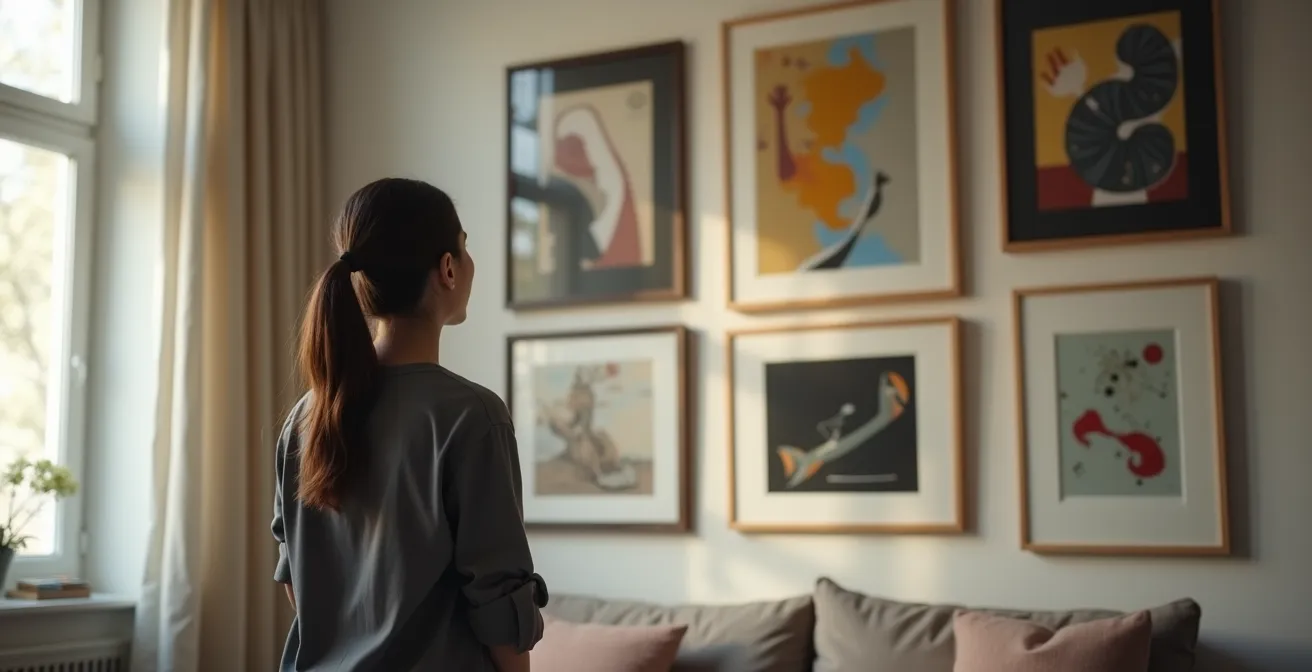
This isn’t simply hanging pictures; it’s constructing a line of sight trajectory. You are creating a visual path and forcing the viewer to follow it. The content of the art is secondary to the power of its collective shape. The column becomes a focal point that doesn’t just decorate the wall but actively reshapes its perceived dimensions, drawing the ceiling upward one frame at a time.
The “Zone Strategy” to Triple Your Kitchen Cabinet Capacity
The title is a misdirection. The “Zone Strategy” in a low-ceilinged kitchen isn’t about cramming more items into cabinets; it’s about expanding the *perceived* volume of the entire room, which in turn makes the kitchen feel more functional and spacious. Standard kitchens often feature upper cabinets that stop a foot short of the ceiling, creating a dusty, shadow-filled horizontal gap that visually crushes the space. The most powerful illusion you can perform here is the Cabinet Dissolve Technique. This involves making the upper cabinets visually merge with the wall, creating a single, soaring vertical plane.
The execution is a masterclass in camouflage. You extend the cabinets (or a fascia/molding) fully to the ceiling, eliminating that oppressive gap. Then, you paint the upper cabinets, the crown molding, and the walls an identical light color with the same finish. This act of “plane dissolution” erases the horizontal lines that define the top and bottom of the cabinets. Design studies confirm the power of this approach, showing that floor-to-ceiling cabinets can increase perceived room height by 15-20%. The cabinets cease to be boxes on a wall and become part of the wall itself.
To complete the illusion, remove any contrasting hardware from the upper doors or replace it with tone-on-tone options. For an advanced touch, using vertically reeded glass panels on some upper doors can add subtle vertical texture without breaking the monolithic effect. This isn’t about storage capacity; it’s about cognitive capacity. By freeing the space from visual clutter, the kitchen feels bigger, breathes better, and functions as if it were a third larger.
Action Plan: Auditing Your Kitchen for the Dissolve Technique
- Points of Contact: Identify all visual breaks. List every horizontal line created by cabinet tops, molding, soffits, and contrasting hardware.
- Collect Elements: Inventory your current cabinet and wall colors. Take photos of the gap above the cabinets and the existing hardware. This is your “before” state.
- Check for Coherence: Confront your inventory with your goal. Does the dark-wood cabinet against a light-grey wall serve your goal of creating height? The answer is no. Identify these points of conflict.
- Assess Emotional Impact: Does the gap above the cabinets create a dark, heavy shadow or a feeling of lightness? Does the ornate hardware draw the eye horizontally? Rate the “visual weight” of each element.
- Plan for Integration: Create a prioritized plan. Priority 1: Paint upper cabinets and walls the same color. Priority 2: Extend a panel to the ceiling. Priority 3: Replace hardware.
Wall-Washing vs. Grazing: How to Highlight Stone Fireplaces?
A floor-to-ceiling stone or brick fireplace is a gift in a room with low ceilings—it’s a pre-existing, powerful vertical element. The common mistake is to “wall-wash” it with light from a distance, which flattens its texture and diminishes its impact. To turn a fireplace into a skyscraper of visual interest, you must employ light grazing. This is an extreme form of uplighting where the light source is placed very close to the surface, skimming it at a steep angle. It’s the difference between a floodlight and a scalpel.

The magic of grazing light is that it treats shadow as a structural material. When light rakes across a textured surface like stone or brick, it casts deep, dramatic shadows in every vertical mortar joint and surface irregularity. These shadows become a series of sharp, dark vertical lines that multiply the height effect, drawing the eye up with forceful repetition. Professional installations show that grazing lights installed just 4-6 inches from the fireplace surface are most effective. You can hide narrow LED strips just above the firebox opening or within a mantelpiece, aimed straight up.
To amplify the effect, the material choices on and around the fireplace matter. Extending the fireplace surround material all the way to the ceiling creates one continuous, unbroken vertical plane. Placing tall, thin, reflective objects—like polished metal vases or slender crystal obelisks—on the mantelpiece will catch the uplight and project it even higher, like architectural exclamation points. Through grazing, you’re not just highlighting the fireplace; you’re excavating its hidden verticality and using it to reconstruct the room’s proportions.
Mirrors or Light Paint: Which Maximizes Natural Light in North-Facing Rooms?
In a dim, north-facing room with a low ceiling, light is a precious commodity. The typical debate pits light paint against mirrors, but this is a false choice. An illusionist uses both, but in a highly specific, synergistic way. Light paint is the foundation, but a mirror is the masterstroke, used to create the ultimate illusion: the Phantom Window Effect. A large, tall, floor-length mirror doesn’t just reflect light; it creates the convincing illusion of a whole new aperture in the wall, a portal to an adjacent space that doubles the light and, more importantly, provides a powerful vertical element.
The paint choice is nuanced. It’s not just about “light paint.” As interior design professional Sarah Gibson points out, the finish is paramount. The strategy is to create a subtle upward gradient of reflection that guides the eye.
Using a light paint with a subtle sheen like eggshell or satin on the walls and a flat/matte finish on the ceiling creates slight reflection on vertical surfaces that guides the eye up to the non-reflective ceiling, making it feel more distant.
– Sarah Gibson, Interior Design Professional
This technique turns your walls into soft, glowing vertical planes that direct attention to the non-reflective, “distant” ceiling. Once this foundation is laid, the floor mirror is introduced. Placed on a long wall, it doesn’t just make the room look wider; its height creates a strong vertical line that breaks up the horizontal expanse. It reflects your newly light-washed walls and any windows opposite, effectively doubling their impact. The combination of a reflective vertical surface (the mirror) and subtly reflective surrounding walls creates a layered, complex light environment that feels expansive, airy, and, most importantly, tall.
Key Takeaways
- True height illusion comes from sculpting with implied vertical lines, not just adding literal ones.
- Light is a tool: use uplighting and grazing to create vertical shadows that act as phantom architecture.
- Camouflage horizontal lines by painting elements like upper cabinets the same color as the walls to create monolithic vertical planes.
Are Vintage Crystal Chandeliers a Good Investment for Home Resale Value?
The question of a chandelier’s investment value often misses the point in a room with 8-foot ceilings. The wrong chandelier—a wide, bowl-shaped fixture—can be a value-destroying feature that makes a room feel claustrophobic. However, the *right* fixture is not just an investment; it’s the final, breathtaking act of the illusion. We must stop thinking of it as a light source and start seeing it as a vertical jewel. Real estate data supports this, showing that homes with slender, waterfall, or cascade-style chandeliers that create strong vertical lines command higher perceived values. Their value comes from solving an architectural problem with artistic flair.
For a low ceiling, the design must be predominantly vertical and transparent. A vintage crystal chandelier with a slender, cascading form is perfect. The multiple strands of crystal create dozens of tiny, reflective vertical lines. It doesn’t obstruct the line of sight but rather enhances it, drawing the eye down its length and then back up. It acts as a visual anchor in the room, but one that pulls energy upward instead of pressing it down. The sparkle and refraction of light create a sense of effervescence and airiness that counters the oppressive weight of a low ceiling.
Practical placement is, of course, critical. Over a dining table, professional designers recommend that the bottom of the fixture should hang 30-34 inches above the tabletop for an 8-foot ceiling. This preserves headroom while allowing the fixture to occupy the space with presence. Choosing such a piece is the ultimate commitment to the vertical line—a final, declarative statement that you are the master of your space’s perception, transforming a structural limitation into a point of dramatic beauty.
Your home is a stage, and you are its set designer. Start applying these principles today and begin the work of transforming your space, not by renovating, but by reimagining.