
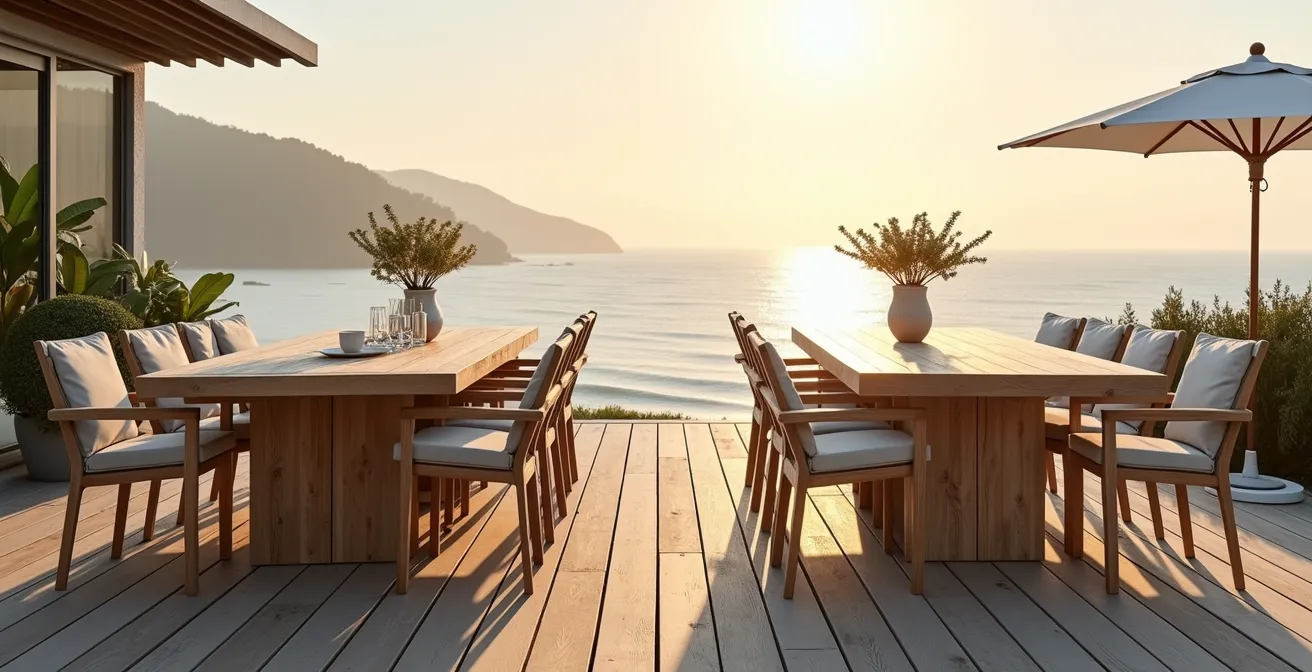
The choice between teak and aluminum in coastal areas isn’t about style; it’s about understanding specific material failure points to avoid costly repeat purchases.
- Aluminum’s primary weakness is its finish; powder coats inevitably blister in salt air, a failure mechanism often explicitly excluded from “frame only” warranties.
- Teak’s high upfront cost is offset by its inherent material integrity and high residual value, leading to a lower total cost of ownership over a decade.
Recommendation: Prioritize solid, marine-grade materials (Teak, HDPE, 316 stainless hardware) over coated or composite materials for any long-term coastal investment.
For any homeowner living near the ocean, the cycle is frustratingly familiar. You invest in a beautiful new patio set, and within two or three seasons, the insidious coastal air works its destructive magic. The sleek black finish on an aluminum chair begins to bubble and peel, revealing a chalky white corrosion underneath. The once-vibrant cushions fade to a pale imitation of their former selves. It’s a battle against chemistry that feels impossible to win, forcing costly replacements far too often.
The common advice is a simple dichotomy: choose teak for durability or aluminum for modern aesthetics and lower initial cost. But this oversimplification ignores the fundamental material science at play. The longevity of your outdoor furniture isn’t determined by the brand name, but by its resistance to specific, predictable failure mechanisms. True durability lies not in a surface-level coating, but in the inherent properties of the material itself and the quality of its smallest components.
But what if the key to a lasting investment wasn’t just picking the “right” material, but understanding precisely *how* each material fails? This analysis moves beyond the showroom and into the realm of materials engineering. We will dissect the common points of failure—from powder coat delamination and galvanic corrosion to fabric degradation—to provide a technical framework for evaluating outdoor furniture. This is not just a guide to buying a patio set; it’s a guide to making an informed engineering decision that will withstand the relentless assault of a coastal environment.
This article will deconstruct the most critical factors influencing the lifespan of your outdoor investment. By examining warranties, fabric science, protection strategies, and long-term cost, you will gain the expertise to choose furniture that not only looks good, but endures.
Summary: Teak vs. Aluminum: A Material Science Breakdown for Coastal Durability
- The “Frame Only” Scam: What to Look for in Patio Furniture Warranties
- Solution-Dyed Acrylic vs. Polyester: Is Sunbrella Worth the Extra Cost?
- Shrink Wrap or Storage Unit: Which Is Cheaper for Protecting Large Patio Sets?
- When to Re-Strap a Vinyl Chair vs. Buying a New One?
- How to Stop Your Patio Umbrella from Taking Flight in 30mph Winds?
- The $500 Chair vs. The $50 Chair: Which Is Cheaper over 10 Years?
- Leather or Performance Fabric: Which Survives Cat Claws Better?
- How much Value Does Professional Landscaping Actually Add to Your Appraisal?
The “Frame Only” Scam: What to Look for in Patio Furniture Warranties
A long warranty seems like the ultimate assurance of quality, but in the world of coastal furniture, it’s often a masterclass in misdirection. The most critical detail is not the number of years, but what is explicitly excluded. Many manufacturers offer impressive 10 or 15-year “structural” or “frame” warranties on aluminum furniture. However, the first and most visible point of failure in a salt-air environment is almost never the frame itself, but the powder-coated finish. This is where the “frame only” clause becomes a significant financial trap for the coastal homeowner.
Powder coating is a process where a polymer resin is applied to the aluminum and cured under heat, forming a protective skin. In benign environments, this is a durable finish. In coastal regions, however, salt-laden humidity is relentless. It infiltrates microscopic imperfections in the coating, leading to a process called filiform corrosion. This creates the characteristic bubbling or blistering as the finish delaminates from the aluminum substrate. As one manufacturer’s policy openly states, “Exposure to salt water and salt air may cause powder coat finishes to blister due to oxidation of the metal; such blistering and oxidization are not covered in this warranty.”
This is why a meticulous review of warranty exclusions is non-negotiable. Look for specific mentions of “finish,” “powder coating,” “blistering,” “corrosion,” or “coastal/salt-air environments.” A warranty that covers the frame from breaking but excludes the finish from peeling is of little value when your furniture looks dilapidated after two years. In contrast, materials like premium teak or high-density polyethylene (HDPE) have their color and integrity throughout the material. They don’t have a finish to fail, which is why their warranties often lack these coastal exclusions.
The following table, based on a typical coastal warranty coverage comparison, illustrates the critical differences in what is actually protected.
| Material | Standard Frame Warranty | Coastal Exclusions | Finish Coverage |
|---|---|---|---|
| Marine-Grade Aluminum | 15 years residential | Powder coat blistering from salt not covered | 3 years (voids near salt water) |
| Premium Teak | 10+ years | Natural checking/cracking excluded | N/A – solid material |
| HDPE/Poly Lumber | 20+ years | No coastal exclusions | Color throughout material |
Solution-Dyed Acrylic vs. Polyester: Is Sunbrella Worth the Extra Cost?
After the frame’s finish, the fabric is the next component to succumb to the coastal environment. The primary adversary here is not salt, but relentless, amplified UV radiation, which breaks down dyes and fibers, leading to fading and brittleness. The difference between a fabric that lasts a decade and one that disintegrates in two seasons lies in how the color is integrated into the yarn. This is the core distinction between cheap polyester and premium solution-dyed acrylics like Sunbrella.
Standard polyester fabrics are created from clear yarns that are then dyed on the surface. Think of it like a radish: the color is only skin-deep. When exposed to UV rays, these surface-level dye molecules break down, causing the fabric to fade rapidly. Furthermore, the polyester fibers themselves are susceptible to UV degradation, becoming weak and prone to tearing over time. For a coastal home, where sun exposure is intense and often reflected off water, a piece-dyed polyester cushion can look worn and faded in a single year.
In stark contrast, solution-dyed acrylic is engineered for extreme environments. During the manufacturing process, the color pigment is mixed into the liquid acrylic polymer *before* it is extruded into a fiber. This means the color is an integral part of the yarn, through and through, like a carrot. It cannot be bleached by the sun or washed out by rain. This fundamental difference in chemistry is why brands like Sunbrella can offer extensive warranties against fading. While the upfront cost is significantly higher—with current market pricing around $39 per yard for marine-grade material—the total cost of ownership is often lower. Replacing cheap, faded polyester cushions every two years quickly eclipses the one-time investment in a fabric designed to endure a decade or more of harsh coastal sun.
Shrink Wrap or Storage Unit: Which Is Cheaper for Protecting Large Patio Sets?
Protecting your patio furniture during the offseason or periods of intense weather is crucial, but the wrong method can be more damaging than no protection at all. The debate often centers on cost-effective solutions like shrink-wrapping versus the higher expense of a storage unit. However, from a material science perspective, the most important factor is not cost, but breathability. Trapping moisture against furniture in a humid, salt-laden environment is a recipe for accelerated corrosion and mildew.
Shrink-wrapping or using cheap, non-breathable plastic tarps is one of the worst things you can do for your furniture. While it keeps rain out, it also traps any existing moisture and condensation from daily temperature fluctuations. This creates a humid microclimate against the furniture’s surface. For powder-coated aluminum, this constant dampness is a catalyst for blistering and corrosion. For teak, it encourages the growth of black mold and mildew. A storage unit avoids this but comes with significant cost and logistical challenges.
The engineering-approved solution is the use of high-quality, breathable, water-resistant covers. These are designed with advanced fabrics and vents that allow moisture vapor to escape while preventing liquid water from penetrating. This maintains a dry environment around the furniture, inhibiting both corrosion and biological growth. While more expensive than a plastic tarp, they are a fraction of the cost of a storage unit and provide superior on-site protection. Elevating the furniture off the ground on small blocks further enhances airflow and prevents moisture wicking up from the deck or patio.
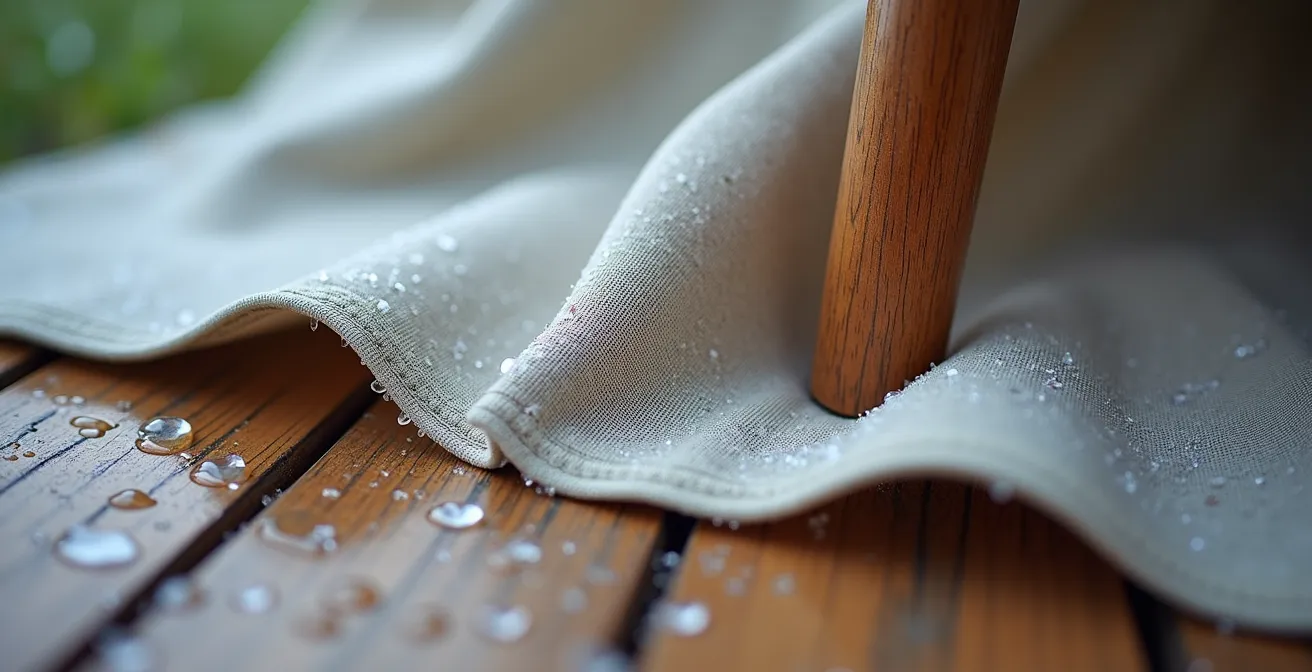
As the image demonstrates, a proper cover is a technical piece of equipment, not just a plastic sheet. This principle of moisture management is the cornerstone of long-term preservation in a coastal setting.
Action Plan: Your 5-Step Coastal Furniture Maintenance Protocol
- Rinse furniture with fresh water monthly to remove abrasive salt deposits that can compromise finishes.
- Use breathable, water-resistant covers with vents when furniture is not in use for extended periods. Avoid non-breathable plastic.
- Elevate furniture legs slightly off the ground with small blocks to prevent moisture buildup and allow for complete drying.
- Store cushions indoors during storms or long periods of high humidity to prevent mildew and fabric saturation.
- Apply a marine-grade wax or specialized protective sealant to metal frames seasonally to add a sacrificial layer of protection against salt.
When to Re-Strap a Vinyl Chair vs. Buying a New One?
The decision to repair or replace a piece of furniture, such as a vinyl-strapped chair, should be driven by an assessment of its core structural integrity, not its surface-level appearance. The vinyl straps are a sacrificial component designed to be replaced. The real question is whether the frame itself is worth saving. In a coastal environment, the answer almost always lies in the quality of the frame material and, most importantly, its hardware.
A high-quality aluminum or steel frame can last for decades, but only if it’s engineered correctly. As Kenneth Dail, President of the high-end furniture maker McKinnon and Harris, notes, “Not all aluminum furniture is created equal.” He points out that using superior raw materials, like bar stock that is three times thicker than standard, is a foundational element of longevity. If the frame is made from thin-walled, low-grade aluminum, it may already be compromised by unseen pitting corrosion or stress fatigue. Re-strapping a failing frame is a poor investment.
Even more critical is the hardware—the nuts, bolts, and screws holding everything together. This is a common point of catastrophic failure due to galvanic corrosion. This occurs when two dissimilar metals (like cheap steel screws in an aluminum frame) are in contact in the presence of an electrolyte (salt water). The less noble metal (the steel screw) corrodes at an accelerated rate, leaving rust stains and eventually failing, compromising the entire structure. The gold standard for coastal furniture is 316 “marine-grade” stainless steel hardware. As a testament to its importance, manufacturers using marine-grade components often offer 20-year warranties, knowing the hardware will not be the point of failure. Before you buy new straps, inspect every weld and every piece of hardware. If you see rust stains, significant pitting on the frame, or any cracks, the chair has reached the end of its functional life. Buying a new, well-engineered chair is the more prudent long-term decision.
When it comes to high-performance materials, aluminum is the strongest, yet it’s lighter weight than other metals like wrought iron. However, not all aluminum furniture is created equal: McKinnon and Harris uses the highest-grade aluminum bar stock, which is three times thicker than the standard.
– Kenneth Dail, President of McKinnon and Harris, Frederic Magazine Interview on Coastal Furniture
How to Stop Your Patio Umbrella from Taking Flight in 30mph Winds?
A patio umbrella becoming a projectile in high winds is not just an inconvenience; it’s a significant safety hazard. Preventing this involves basic physics: you must counteract the immense lift force generated by wind moving over the canopy. This is achieved through a combination of sufficient mass in the base, a low center of gravity, and intelligent canopy design. In a coastal area with frequent strong winds, underestimating these forces is a common and costly mistake.
The standard, water-fillable plastic bases sold at big-box stores are often dangerously inadequate for coastal conditions, especially for larger cantilever (offset) umbrellas. A 50-pound base may feel heavy, but it’s no match for the hundreds of pounds of lift force a 30-mph gust can exert on a 10-foot canopy. For cantilever umbrellas, a base weight of 200-400 pounds is the minimum engineering requirement. This can be achieved with multi-part sand or water-fillable bases, or, more effectively, by integrating the umbrella stand into heavy furniture.
The most stable solution is to anchor the umbrella directly through the center hole of a very heavy dining table, such as one made of solid teak, stone, or concrete. This uses the table’s mass and wide footprint to create an exceptionally stable anchor. Furthermore, look for umbrellas with wind vents in the canopy. These are flaps of fabric at the top that allow gusts of wind to pass through rather than being caught, which dramatically reduces the upward lift force. Finally, always close the umbrella when not in use or when winds are forecast to exceed 25 mph. No base system is a substitute for prudent operation.
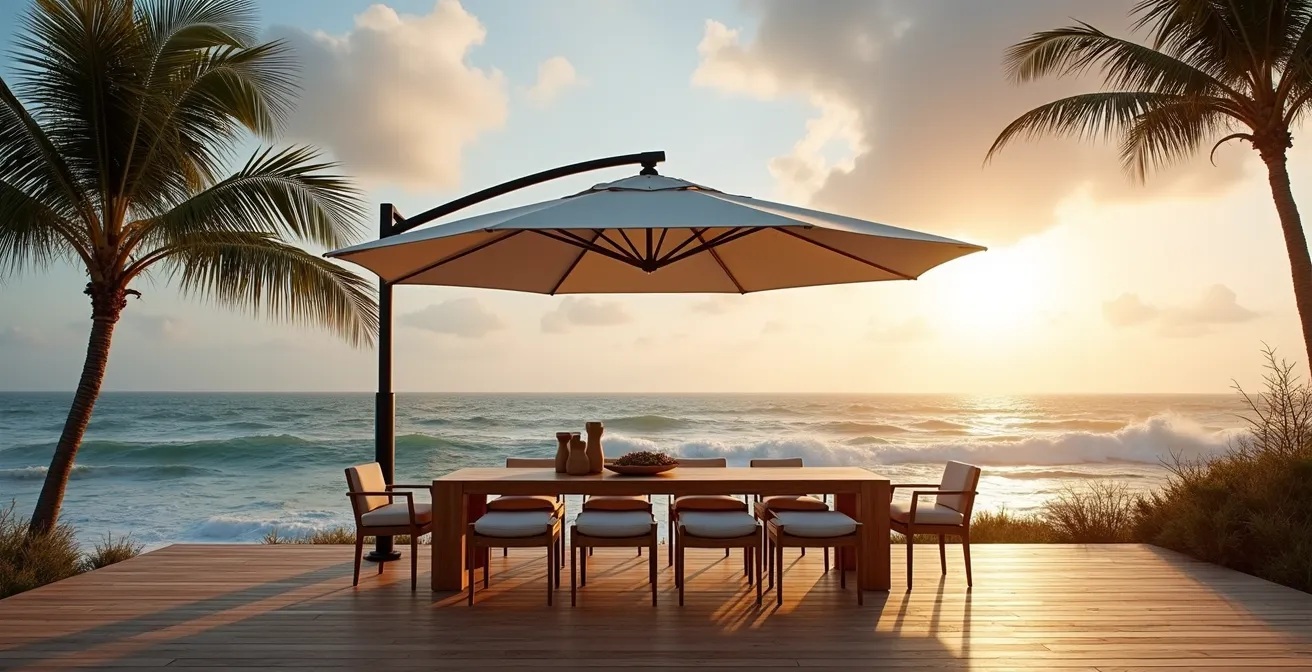
The image above illustrates an ideal setup: a large cantilever umbrella anchored by the substantial mass of a solid teak table, providing stability against the visible coastal winds. This system-based approach is far superior to relying on a standalone base.
The $500 Chair vs. The $50 Chair: Which Is Cheaper over 10 Years?
The initial price tag is the most misleading metric when evaluating outdoor furniture. A true cost assessment requires calculating the Total Cost of Ownership (TCO) over a realistic lifespan, typically a decade. When you factor in replacement cycles, maintenance, and residual value, the expensive $500 chair is almost always significantly cheaper than the “bargain” $50 one, especially in a destructive coastal environment.
Let’s model a simple TCO analysis. The $50 chair, likely made from low-grade steel or thin-walled aluminum with a minimal powder coat and basic polyester fabric, has a realistic coastal lifespan of two years before it becomes a rusty, faded eyesore. Over 10 years, you will buy this chair five times, for a total outlay of $250. At the end of the decade, its value is zero; it is landfill.
Now consider the $500 chair, constructed from Grade-A teak with marine-grade stainless steel hardware. Teak’s natural oils make it highly resistant to rot and insects, and it weathers to a graceful silver patina without compromising its structural integrity. It requires minimal maintenance and is designed to last for decades, not seasons. At the end of 10 years, the chair is not only still functional and beautiful, but it has retained significant value. In fact, industry analysis reveals that premium teak furniture maintains 30-50% of its residual value after a decade. Assuming a conservative 30% retention, your $500 chair is still worth $150. Your net cost over 10 years is therefore $350. In this scenario, the “cheap” chair’s true 10-year cost is $250, while the “expensive” chair’s net cost is $350. If the teak chair lasts just a few more years, or the cheap chair fails even faster, the TCO quickly favors the higher-quality initial investment.
Case Study: Seaside, Florida’s Furniture Replacement Cost Analysis
The community of Seaside, Florida, faced escalating maintenance and replacement costs with their public outdoor furniture. Hardware on their existing pieces rusted, and poly-based materials became brittle and split under the intense coastal conditions. After switching to furniture made from high-quality, marine-grade polyethylene, the new pieces survived a full year of rigorous public use and coastal exposure without any degradation, demonstrating the superior long-term economic value of investing in materials engineered specifically for the environment.
Leather or Performance Fabric: Which Survives Cat Claws Better?
While the title poses a question about cat claws, in the context of coastal furniture, the “claw” is a metaphor for any surface abrasion—a scratch from a dropped tool, a scrape against a concrete planter, or the constant friction of sand and grit. For powder-coated aluminum, any breach in the finish is the starting point for catastrophic failure. The material’s ability to resist the *propagation* of damage from a single scratch is a key indicator of its coastal suitability.
As coastal environment studies show, corrosion begins within 1 inch of scratch points on powder-coated aluminum. Once the protective outer layer is compromised, salt air immediately begins to attack the exposed metal underneath. This corrosion then creeps under the surrounding finish, causing it to lift and blister in a process known as undercutting. A small, insignificant scratch can rapidly evolve into a large area of peeling finish and structural decay.
This is why top-tier manufacturers focus on multi-layer protection systems that go far beyond a simple powder coat. They borrow techniques from the marine and automotive industries, which have long battled corrosion. In an interview, Kenneth Dail explains how his company uses a specialized pre-treatment process to enhance finish adhesion and prevent this very failure mode.
McKinnon and Harris uses Henkel Bonderite EC²—a process traditionally used to protect underwater gear on marine equipment ranging from submarines to yachts—to prevent moisture from penetrating and corroding or damaging the finish.
– Kenneth Dail, Frederic Magazine
This highlights a critical divide: standard furniture relies on a single layer of defense, while high-performance furniture uses a system of them. Materials like solid teak or HDPE are inherently superior in this regard. A scratch on a teak chair is just a scratch; it doesn’t compromise the integrity of the entire piece because the material’s properties are consistent throughout its depth. There is no protective layer to breach. This inherent material integrity is far more resilient to the “cat claws” of daily life than any surface coating.
Key Takeaways
- Material vs. Finish: Judge furniture on the inherent properties of its core material (e.g., solid teak) not its cosmetic finish (e.g., powder coating), which is the first point of failure in coastal environments.
- Hardware is a Critical Weak Link: Galvanic corrosion from cheap steel hardware can destroy an otherwise robust frame. Demand 316 marine-grade stainless steel in any coastal furniture.
- Calculate Total Cost of Ownership (TCO): A $500 chair that lasts 15 years and retains value is cheaper than a $50 chair replaced every 2 years. The initial price is a deceptive metric.
How much Value Does Professional Landscaping Actually Add to Your Appraisal?
Professional landscaping undoubtedly enhances curb appeal, setting a beautiful stage for a property. However, the value it adds can be significantly undermined by the condition of the outdoor furniture that populates that stage. Rusty, faded, and dilapidated furniture signals neglect and cheapness, detracting from the overall impression of a well-maintained, high-value home. Conversely, high-quality, well-maintained furniture acts as a key signifier of quality, reinforcing the investment made in landscaping and potentially boosting an appraiser’s and buyer’s perception of the property’s worth.
In competitive coastal real estate markets, every detail matters. A prospective buyer walking onto a beautifully landscaped patio only to find wobbly, corroded chairs receives a mixed signal. It suggests the owner cuts corners, prompting the question: “What other hidden problems exist?” This is where the choice of furniture transcends mere function and becomes part of the property’s narrative. As one Palm Beach retailer notes, “High-quality aluminum outdoor furniture…brings exceptional value to your Palm Beach patio space. These pieces combine durability with practicality, offering natural resistance to rust and corrosion.” The presence of such furniture communicates a commitment to quality that extends to the entire home.
Materials like teak have become synonymous with luxury and durability in these markets. A weathered teak dining set does not look old or neglected; it looks established and timeless, signaling a wise, long-term investment. This perception can directly influence how a property is valued.
Coastal Property Value Perception and Outdoor Furniture
In Florida’s high-end coastal real estate market, teak wood has become the top choice for luxury properties. Its reputation for durability and its graceful aging process signal a quality investment to potential buyers. The presence of substantial, well-maintained teak furniture on a lanai or deck can positively influence a property’s perceived value and desirability in these competitive markets, implicitly suggesting that the home has been cared for with high-quality materials throughout.
Ultimately, your patio furniture is the final touchpoint in your home’s presentation. Choosing pieces with the material integrity to withstand the coastal environment ensures that the “stage” you’ve set with landscaping is complemented by “actors” that reflect quality, durability, and a sound investment.
Therefore, the next time you evaluate a piece of outdoor furniture, approach it not as a decorator, but as an engineer. Scrutinize the warranty for exclusions, analyze the material’s inherent properties, and calculate its total cost of ownership. By applying this analytical framework, you can make a lasting investment that delivers value and performance for years to come.