
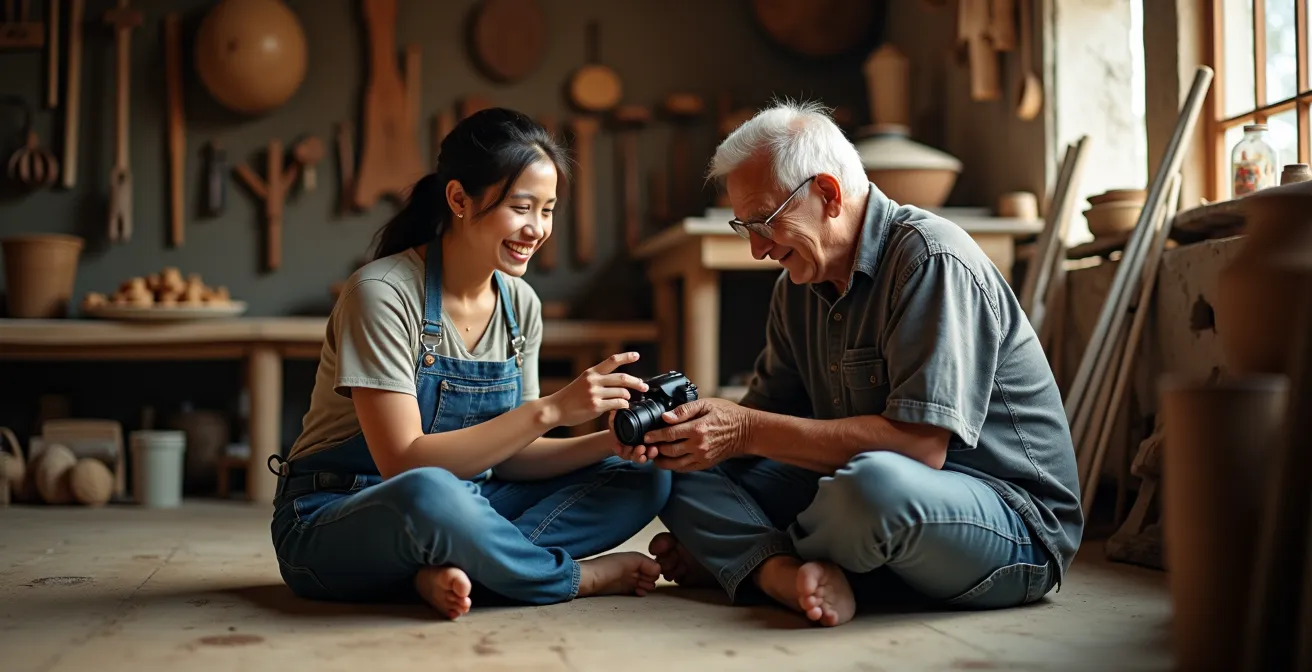
The fear of offending local communities often holds photographers back from capturing authentic portraits. The solution isn’t a rigid list of rules, but a fundamental mindset shift: move from a goal of extraction (taking a photo) to one of genuine exchange (creating a connection). This guide outlines how to foster respectful interactions where a beautiful portrait becomes the natural souvenir of a shared human moment, not a transaction.
As a documentary photographer, the pull is irresistible: to capture the unfiltered story of a place through the faces of its people. Yet, a paralytic fear often accompanies this desire. How do you raise your camera to a stranger without turning them into a stereotype, an exhibit in a human zoo? You carry the weight of countless clumsy tourist encounters, and you’re determined not to be one of them. The goal is connection, not collection.
Common advice revolves around learning a few phrases or simply asking for permission. While well-intentioned, this approach can still feel transactional, reducing a complex human interaction to a ‘yes’ or ‘no’ question. It overlooks the subtler languages of respect spoken through dress, gestures, and an understanding of local economies and customs. A survey even shows that while over 70% of travel photographers aim to capture cultural diversity, the *how* is what separates a respectful documentarian from an intrusive tourist.
This is where the mindset shift becomes crucial. What if the photograph wasn’t the primary objective? What if, instead, the goal was to achieve a moment of genuine exchange, however brief? When you focus on creating a small, shared experience, the portrait ceases to be an act of taking; it becomes a gift, a mutual acknowledgment. This is the essence of documentary empathy.
This guide will walk you through the practical application of this philosophy. We will explore how to build rapport beyond language, navigate the complexities of compensation, dress for access and respect, and understand the deeper economic and cultural impact of your presence. It’s a journey from seeing subjects to meeting people.
Summary: Ethical Photography: A Guide to Respectful Portraits
- Google Translate vs. Phrasebook: Which Wins for Genuine Connection?
- Tipping Rules: Where Is Tipping Considered an Insult?
- Shoulders and Knees: How to Dress for Temples Without Overheating?
- The Color White: Why You Should Never Wrap Gifts in White in Certain Asian Cultures?
- Ramadan Travel: How to Be Respectful When Eating During the Day?
- Airbnb vs. Local Guesthouses: Which Actually Supports the Local Economy?
- Shipping Fragile Crafts: How to Pack Handmade Ornaments so They Don’t Break?
- Beyond the Wallet: The Social & Creative Economy of Your Stay
Google Translate vs. Phrasebook: Which Wins for Genuine Connection?
While technology offers instant translation, it can also create a barrier. Holding up a phone to communicate can feel impersonal, keeping you and the other person at a digital arm’s length. The true currency of connection lies not in perfect grammar, but in demonstrated effort. Learning a few key greetings, and more importantly, the non-verbal gestures that accompany them, signals a deeper level of respect.
This is where observation becomes your most powerful tool. As legendary photographer Robert Caputo advises, “Be sensitive to the scene in your viewfinder. If people are getting nervous, ask permission or move on.” This sensitivity starts before the camera is ever raised. Watch how people greet each other. Is it a nod? A bow? A hand over the heart? Replicating these gestures shows you’ve been paying attention.
The impact of this effort is profound. A study on cultural sensitivity in photography highlights several examples. In Japan, photographers who learned to bow properly saw vastly improved responses. In Thailand, using the traditional ‘wai’ greeting (hands clasped as if in prayer) immediately puts people at ease. For travelers in the Middle East, shaking hands and then touching the heart creates instant rapport. These small acts of cultural fluency transform you from a tourist into a respectful visitor, opening doors to more authentic interactions and, ultimately, more powerful portraits.
Tipping Rules: Where Is Tipping Considered an Insult?
The question of payment is one of the most fraught in travel photography. In some cultures, offering a cash tip for a photo can be perceived as an insult, reducing a shared moment to a crude transaction and creating an uncomfortable power dynamic. In places like Japan, for example, a direct cash payment is often seen as inappropriate. The key is to reframe the concept from “payment” to “reciprocity.” How can you offer something of value that honors the person’s dignity?
Case Study: Reciprocity vs. Payment in Practice
Professional travel photographers have found creative and respectful ways to show appreciation. In Northern India, offering to print and share photos later was seen as far more valuable than a monetary tip. In the bustling medinas of Morocco, photographers found success by first purchasing a small item from a subject’s shop before even mentioning a camera. A photographer in Myanmar discovered that sharing their own story and showing photos of their family created an equal exchange, turning a potentially transactional moment into a genuine cultural connection. These approaches preserve dignity and show appreciation in a culturally resonant way.
This principle of reciprocity requires research and observation. Instead of a one-size-fits-all approach, consider what would be a meaningful gesture in that specific context. The goal is to participate in their world, not to pay for access to it. Supporting local guide services in Peru, for instance, contributes to the community’s economy without creating a culture of dependency on tourist handouts for photos.
The following table, based on a cultural analysis for photographers, offers a starting point for understanding these nuances.
| Region | Appropriate Gesture | What to Avoid |
|---|---|---|
| Japan | Small gift from your country | Direct cash payment |
| Morocco | Buy from their shop/stall | Haggling after photos |
| India | Share printed photos later | Assuming payment expected |
| Peru | Support local guide services | Creating dependency culture |
Shoulders and Knees: How to Dress for Temples Without Overheating?
Your clothing is the first message you send, a non-verbal signal of your awareness and respect for local customs. In many parts of the world, especially when visiting religious sites, covering your shoulders and knees is a fundamental sign of respect. This can seem challenging in hot, humid climates, but it is non-negotiable for any photographer who wishes to be welcomed rather than merely tolerated. As photographer Annapurna Mellor states, “Approaching people in a way that is respectful to their culture is going to make it much easier for them to respect you equally.”
Dressing appropriately is not about sacrificing comfort; it’s about making smart fabric choices. Heavy jeans or synthetic materials will quickly become unbearable. The solution lies in lightweight, breathable fabrics that provide coverage while allowing air to circulate. Think of your wardrobe as part of your camera kit—essential gear for gaining access to authentic scenes.

As seen in the image, respect is conveyed not just through action but through presence. Modest attire allows you to blend into the background, becoming an observer rather than a spectacle. This allows life to unfold naturally around you, presenting the candid moments that make for powerful documentary photography. Prioritizing lightweight merino wool, high-quality linen, and bamboo blends allows you to stay cool and comfortable for a full day of shooting while remaining respectful at all times.
Your Action Plan: Auditing Your Attire for Respectful Photography
- Analyze Fabrics: Review your planned outfits. Prioritize breathable, moisture-wicking materials like lightweight merino, linen, or bamboo blends that offer comfort without sacrificing modesty.
- Verify Coverage: Check all potential outfits for complete shoulder and knee coverage, even when moving, sitting, or raising your arms to take a photo.
- Plan for Adaptability: Pack convertible travel pants or a lightweight tunic/scarf that can be quickly added to an outfit when entering a sacred or conservative space.
- Assess Color Palettes: Research color symbolism for your destination, especially for planned festivals or ceremonies. Pack neutral or appropriate colors to blend in respectfully.
- Support Local Artisans: Leave space to purchase a local item, like a cotton tunic or scarf. This not only ensures appropriateness but also directly supports the economy you are documenting.
The Color White: Why You Should Never Wrap Gifts in White in Certain Asian Cultures?
Beyond the cut and coverage of your clothing, color itself speaks a powerful, silent language. What might be a symbol of purity or celebration in one culture can signify mourning and death in another. For a documentary photographer seeking to blend in and capture authentic moments, understanding local color symbolism is a critical layer of cultural fluency. Wearing or gifting the wrong color can inadvertently broadcast disrespect and close doors before you even raise your camera.
In many East Asian cultures, for example, white is traditionally associated with funerals and mourning. Wrapping a gift in white paper or prominently wearing white to a celebration like Chinese New Year would be a significant cultural misstep. Conversely, the color red often symbolizes luck, joy, and good fortune in the same regions.
A compelling case study illustrates this point perfectly. A photographer documenting a Chinese New Year celebration initially wore white and found themselves treated as an outsider. After learning of the color’s significance and switching to a red shirt, they were warmly welcomed into family celebrations, gaining access to the very moments they had hoped to document. Similarly, photographers in India have found that wearing saffron or orange during religious festivals helps them connect, as the color represents spirituality and renunciation. Understanding these codes is not about mimicry; it’s about showing deference to deeply held traditions and signaling that you are a sensitive observer, not a thoughtless intruder.
Ramadan Travel: How to Be Respectful When Eating During the Day?
Photographing in a Muslim-majority country during the holy month of Ramadan offers a unique opportunity to document profound displays of faith, community, and tradition. However, it also requires the highest level of sensitivity and respect from the visiting photographer. The core of Ramadan is a daylight fast from all food and water. As a non-Muslim visitor, your public behavior during these hours has a significant impact on how you are perceived. A 2024 cultural sensitivity study revealed that 83% of surveyed travelers expressed a strong willingness to adapt their behavior during such observances, a positive sign of growing global awareness.
The most fundamental rule is to avoid eating, drinking, or smoking in public during fasting hours. This is a simple but powerful act of solidarity and respect for those who are fasting. Find a private space, like your hotel room or a designated tourist restaurant, for your meals. Beyond this, a photographer should adjust their entire approach to documenting the day. Instead of focusing on daytime street scenes, which may be quieter, shift your focus to the evenings.
The nightly Iftar, or breaking of the fast, is a moment of immense joy and community. These celebrations are often where you will find the most vibrant, authentic, and photogenic scenes. If you are invited to join an Iftar, it is a tremendous honor. The guiding principle should be participation before documentation. Put your camera down, share in the meal, and engage in conversation. This act builds trust and connection, making any subsequent photography a natural extension of a shared experience.

When photographing prayer or breaking-fast rituals, always ask for permission quietly and respectfully. Use a quiet shutter mode if available, and never use a flash. During this sacred month, dressing more conservatively than usual is also a key sign of respect.
Airbnb vs. Local Guesthouses: Which Actually Supports the Local Economy?
Your choice of accommodation is more than just a place to sleep; it’s an economic and social decision that directly impacts the community you are there to document. In the debate between a global platform like Airbnb and a traditional, family-run guesthouse, the data reveals a stark contrast in where your money goes. The core of ethical travel is ensuring that your presence provides a net benefit to the local population, and your choice of lodging is a major part of that equation.
A locally owned and operated guesthouse is a powerful engine for the community economy. A significant portion of the revenue stays local, supporting the host family and the network of local suppliers they use for everything from food to laundry services. This creates a positive ripple effect. In contrast, a foreign-owned rental on a large platform may see a much smaller percentage of its revenue remain in the local community.
This table, based on data from the World Economic Forum’s 2024 development index, breaks down the impact:
| Factor | Local Guesthouse | Foreign-Owned Airbnb | Local-Owned Airbnb |
|---|---|---|---|
| Money staying local | 85-95% | 20-30% | 70-80% |
| Local employment | 3-5 jobs | 0-1 job | 1-2 jobs |
| Cultural exchange | High – direct host interaction | Low – automated check-in | Medium – occasional host contact |
For a photographer, the benefits go beyond economics. Photographers staying at family-run guesthouses in Vietnam reported gaining exclusive access to local morning markets through their hosts’ connections. In Peru, guesthouse owners introduced photographers to traditional weavers who rarely interact with tourists. These accommodations become gateways to authentic cultural photography, with hosts acting as cultural bridges who can provide context and make introductions that are simply impossible for a traveler in an anonymous rental.
Key Takeaways
- Mindset Over Method: The goal is genuine human exchange, not just getting a photo. The portrait is a souvenir of a connection.
- Reciprocity Before Transaction: Replace the idea of “payment” with “reciprocity.” Offer value through purchasing crafts, sharing printed photos, or contributing to the local economy.
- Observation is Key: Your best tools are your eyes and ears. Observe local customs for greetings, dress, and color before you ever raise your camera.
Shipping Fragile Crafts: How to Pack Handmade Ornaments so They Don’t Break?
A powerful act of reciprocity is purchasing handmade crafts directly from the artisans you meet and photograph. This does more than provide financial support; it honors their skill and preserves a piece of their cultural story. But the journey isn’t over with the purchase. Ensuring that a fragile, one-of-a-kind piece makes it home intact is the final act of respect for the artisan’s work. Moreover, sharing the story of that craft can have a surprisingly large impact; research from 2024 shows that 52% of travelers have been inspired to visit a destination based on images seen on social media.
Your role as a photographer gives you a unique advantage. Before you even discuss packing, document the creation process. Take photos of the artisan at work, the tools they use, and the environment of their workshop. This series of images is not only valuable for your own storytelling but can also serve as crucial documentation for insurance claims should the item be damaged in transit.
When it comes to packing, learn from the master. Offer to pay the artisan a little extra to pack the item for you using their own traditional, time-tested methods. This is often the most effective way to ensure its safety. If you must pack it yourself, adopt the “floating” method: place the craft in a smaller box or wrap it securely, then suspend that package within a larger shipping box using soft, locally sourced materials like market straw, textiles, or old newspapers. This creates a shock-absorbing buffer. Using local materials is also a sustainable choice that adds to the story of the object. By documenting this entire journey—from creation to careful packing—you transform a simple souvenir into a rich narrative that honors the culture and its craftspeople.
Beyond the Wallet: The Social & Creative Economy of Your Stay
While the previous section outlined the clear economic benefits of choosing local guesthouses, the value for a documentary photographer extends far deeper into the social and creative realms. An anonymous rental with a key-code entry offers efficiency but is a black hole for cultural connection. A stay with a local family, however, is an investment in social capital—the currency of trust, relationships, and shared knowledge that is invaluable for your work.
This social capital translates directly into creative opportunities. Your host is not just a landlord; they are your first cultural interpreter. They can explain the nuances of a local festival, advise you on which neighborhoods are safe after dark, and, most importantly, provide warm introductions. A simple, “This is my friend, a photographer who wants to learn about our community,” from a trusted local is more powerful than any phrase you could learn from an app. It instantly reframes your identity from “tourist” to “guest.”
This access is the difference between surface-level travel photography and profound documentary work. It’s the difference between photographing the outside of a temple and being invited to a family ceremony inside. It’s the difference between a transactional portrait on the street and a relaxed, intimate portrait session in someone’s home. By consciously choosing accommodations that foster human interaction, you are actively building the foundation of trust that allows for deeper, more meaningful storytelling. Your stay becomes part of the narrative itself, enriching your understanding and, consequently, the quality of your photographs.
Ultimately, the camera is a passport. It can be used to stamp through a country, collecting images like visas, or it can be used to open doors to genuine human experiences. Adopting a mindset of exchange over extraction is not just an ethical choice; it is a creative one. It is the path to creating images that resonate with truth, dignity, and a shared humanity. The next step is to consciously apply this philosophy on your next journey, turning every photographic opportunity into a moment of connection.
Frequently Asked Questions on Photography and Cultural Etiquette
Should I ask about appropriate colors before photographing ceremonies?
Yes, always ask local guides or hosts about color significance for specific events. What’s appropriate for weddings may differ from religious ceremonies.
How can I learn color meanings quickly when traveling?
Observe local festive decorations and what colors dominate. Ask shopkeepers when buying gifts about appropriate wrapping for different occasions.
What if I accidentally wear the wrong color?
Acknowledge the mistake respectfully, explain you’re learning, and ask for guidance. Most people appreciate the effort to understand their culture.