
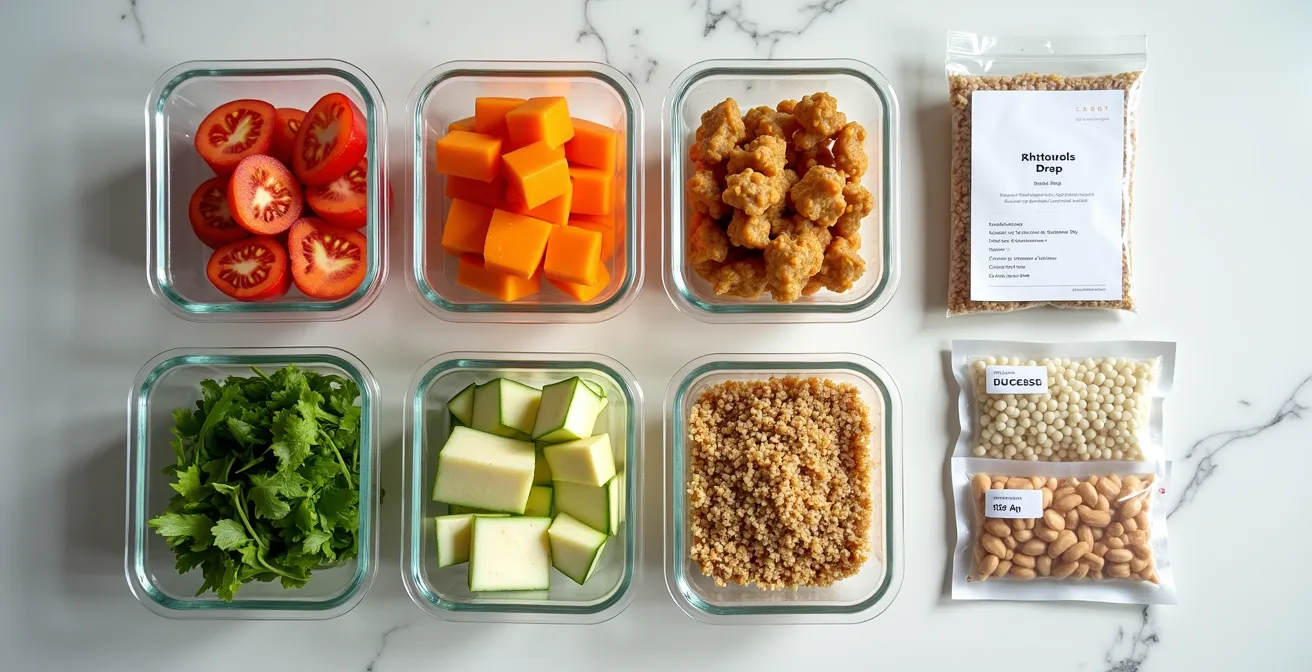
The true cost of feeding your family isn’t about time versus money; it’s a strategic calculation involving food waste, nutritional density, and the hidden economics of your kitchen.
- Meal prep’s primary financial advantage comes from “waste arbitrage”—dramatically cutting the 30% of groceries that typically go uneaten, not just from cheaper ingredients.
- Meal kits sell convenience, but you pay a premium in both dollars and “Nutritional ROI,” often receiving less protein and more sugar per dollar spent.
Recommendation: Meal prep offers superior long-term savings and health benefits for a family, but only if you implement a streamlined system. Meal kits can be a temporary solution for time-poor households but are not a financially sustainable strategy.
It’s the familiar 5 p.m. panic: a hungry family, an empty-looking fridge, and the looming question of “what’s for dinner?”. For busy parents, the modern food landscape offers two competing solutions: the DIY discipline of meal prepping or the plug-and-play convenience of meal kits. The conventional wisdom pits them in a simple trade-off: meal prep saves money but costs time, while meal kits save time but cost money. But this view is dangerously simplistic and misses the bigger picture.
As a home economics strategist, my analysis goes beyond the price per plate. With recent data showing families can spend over $940 per month on groceries, the decision between these two systems becomes a critical component of your household’s financial health. The real question isn’t just about cost, but about building an entire economic ecosystem in your kitchen that minimizes waste, maximizes nutritional value, and aligns with your family’s actual lifestyle.
This guide will deconstruct the meal prep versus meal kit debate through a series of practical, evidence-based lenses. We will move beyond the surface-level arguments to analyze the true “Nutritional Return on Investment” (ROI) of your food choices. Forget the simple time-versus-money dichotomy; we’re here to build a sustainable, cost-effective system for feeding your family well without losing your sanity or your savings.
To help you make the best decision for your household, this article breaks down the key factors to consider, from the building blocks of a healthy breakfast to the critical importance of food safety. Each section acts as a checkpoint to evaluate how meal prep and meal kits perform under real-world family pressures.
Summary: A Strategic Breakdown of Your Family’s Meal System
- Protein at Breakfast: Why It Stops Your 10 AM Sugar Cravings?
- Are Frozen Spinach Bricks Less Nutritious Than Fresh Leaves?
- The “Healthy” Granola Trap: How to Read Labels for Added Sugars?
- Electrolytes: Do You Need Them If You Aren’t Running a Marathon?
- Lentils vs. Meat: How to Cook Legumes That Don’t Cause Bloating?
- The Temperature Danger Zone: How Long Can Potato Salad Sit Out Safely?
- How to Sync Your Smart Scale to Your Nutrition App Without Glitches?
- How to Test Your Soil pH at Home Without a Lab Kit?
Protein at Breakfast: Why It Stops Your 10 AM Sugar Cravings?
The first battle of the day is breakfast. A meal high in protein is scientifically proven to increase satiety and stabilize blood sugar, preventing the dreaded mid-morning energy crash that leads to unhealthy snacking. This is where the economic models of meal prep and meal kits first diverge sharply. A high-protein breakfast is a cornerstone of effective nutritional strategy, but the cost to achieve it varies dramatically.
Meal kits often offer breakfast as a pricey add-on, delivering convenience but a lower protein count for a higher cost. Meal prepping, on the other hand, allows you to leverage bulk purchasing of protein-rich ingredients like eggs and sausage. This front-loads the effort into a single session but dramatically lowers the cost per serving while maximizing the protein content, directly improving your family’s health and focus throughout the day. It’s a clear win for Nutritional ROI.
The following table illustrates the stark difference in cost and nutritional value for a family seeking a protein-packed start to their day. As the data shows, batch-prepping your own breakfasts provides more than double the protein for a fraction of the cost.
| Breakfast Option | Protein per Serving | Cost per Serving | Prep Time |
|---|---|---|---|
| Meal Prep Egg Bowls | 33g | $2-3 | 5 min (batch prep) |
| Meal Kit Breakfast Add-on | 15-20g | $9-12 | 20-30 min |
| Bulk Egg Purchase | 21g (3 eggs) | $1.50 | 10 min |
To effectively implement this strategy, a system is essential. Here is a practical plan to make batch-cooked, high-protein breakfasts a seamless part of your weekly routine.
Action Plan: Batch-Cook High-Protein Breakfasts for the Week
- Dedicate one hour on Sunday for batch cooking egg muffins or breakfast casseroles.
- Prepare 3-4 dozen egg muffins with various protein sources (sausage, cottage cheese).
- Store in airtight containers, separating portions with parchment paper.
- Label containers with protein content (aim for 20-30g per serving).
- Reheat in microwave for 60 seconds or air fryer for 2-4 minutes each morning.
Are Frozen Spinach Bricks Less Nutritious Than Fresh Leaves?
A common misconception that sabotages family food budgets is the belief that “fresh is always best.” In the world of home economics, this is a costly myth. When it comes to produce like spinach, frozen options are not only more affordable but often retain more nutrients. Fresh spinach can lose vitamins over days of transport and storage, while frozen spinach is flash-frozen at peak ripeness, locking in its nutritional value.
This is where the concept of “waste arbitrage” becomes a powerful tool for the meal prepper. Fresh spinach wilts and spoils quickly, contributing to food waste. A bag of fresh leaves bought with good intentions can easily end up as green slime in the crisper drawer. Frozen spinach bricks, however, are perfectly portioned, have a long shelf life, and can be tossed into smoothies, casseroles, or pasta sauces with zero waste. For a family, this translates into significant savings, as research indicates families can save up to 30% simply by reducing food waste through better portioning and storage.
Visually, the difference in texture is apparent, but nutritionally, they are rivals. The key is understanding that the convenience of frozen produce is a strategic asset for budget-conscious meal planning.

As you can see, while the textures differ, the nutritional integrity of the frozen product is preserved. Meal kits almost exclusively use fresh ingredients, passing the cost of potential spoilage and just-in-time logistics onto the consumer. By embracing frozen staples, the home strategist seizes a clear economic advantage that meal kits cannot offer.
The “Healthy” Granola Trap: How to Read Labels for Added Sugars?
Navigating the grocery store requires a defensive strategy, especially in the breakfast aisle. Many products marketed as “healthy,” like commercial granolas, are often loaded with hidden sugars and processed oils, making them a poor nutritional investment. This is the “healthy” granola trap: you pay a premium for a product that undermines your family’s health goals. Meal kits can fall into this same trap, providing small, expensive packets of high-sugar granola as part of a breakfast offering.
The meal prep solution is to take back control. By making your own granola in batches, you control every ingredient—the type of oats, the amount and type of sweetener, and the quantity of nuts and seeds. This not only slashes costs but also dramatically reduces sugar intake, giving you a superior product from both a financial and health perspective. This is a prime example of optimizing your Nutritional ROI.
Case Study: Family of Four Monthly Granola Cost Analysis
A budget meal prep analysis found that homemade granola costs less than $3 per batch, serving a family for a week, compared to $8-12 for single-serving meal kit granola portions. By batch-cooking with bulk oats, nuts, and controlled sweeteners like maple syrup, families can reduce sugar intake by an estimated 60% while saving over $30 monthly on this single breakfast item alone.
To avoid this trap, you must become a label detective. Here are four simple steps to identify hidden sugars and assess the true value of any packaged food:
- Check Total Sugars: Compare the “Total Sugars” per serving to a benchmark of 4 grams, which is equivalent to one teaspoon of sugar.
- Scan the Ingredient List: Look for hidden sugars disguised under other names. Any word ending in “-ose” (like dextrose, fructose), as well as syrups, nectars, and fruit juice concentrates are red flags.
- Calculate Sugar Percentage: A quick mental check is to divide the grams of sugar by the serving size in grams. If the percentage is high (e.g., 15g of sugar in a 30g serving is 50% sugar), it’s a dessert, not a health food.
- Compare Protein vs. Sugar: Assess the ratio of protein to sugar. A good nutritional product will have a significantly higher protein content than sugar content.
Electrolytes: Do You Need Them If You Aren’t Running a Marathon?
The wellness market, often amplified by meal kit add-ons, is expert at creating needs. Fancy electrolyte powders and “hydration” drinks are marketed as daily essentials, but for the average family, they are an unnecessary expense. Unless you’re engaged in intense, prolonged exercise causing significant sweat loss, your family’s electrolyte needs are easily met through a balanced diet of whole foods like bananas, potatoes, and spinach.
This is another area where the economic models clash. Meal kits are a business, and their profit model often relies on upselling you on high-margin, low-necessity items. The home economics strategist, however, operates on a principle of essentialism. You focus on what is nutritionally necessary and cost-effective, bypassing the marketing hype. Water is the best hydrator, and a well-planned meal prep menu provides all the electrolytes your family requires naturally.
The cost of these non-essential extras adds up, contributing to the high price point of meal kit services. A recent industry analysis highlights this very issue, noting that the base price is just the beginning. According to a Meal Prep VS Meal Kits Comparison Study, “Most charge at least $9 per meal, and not every company provides shipping without an additional charge.” This premium price subsidizes the marketing of items your family simply doesn’t need.
By sticking to a meal prep plan centered on whole foods, you avoid these manufactured costs entirely. You are investing your food budget in nutrient-dense calories, not flavored water with a fancy label. This disciplined approach is what separates strategic household management from passive consumerism.
Lentils vs. Meat: How to Cook Legumes That Don’t Cause Bloating?
One of the most powerful levers for reducing a family’s grocery bill is strategically substituting plant-based proteins for meat. Lentils are a nutritional powerhouse, packed with protein, fiber, and iron, at a fraction of the cost of ground beef. For a family of four, incorporating one or two lentil-based meals per week can lead to substantial annual savings.
However, many families are hesitant to embrace legumes due to a common “system friction”: the fear of digestive discomfort. The key isn’t to avoid lentils, but to learn how to prepare them correctly. Soaking dried lentils for a few hours (or overnight) and rinsing them thoroughly before cooking helps break down the complex sugars (oligosaccharides) that can cause bloating. For an even greater digestive advantage, sprouting lentils before cooking makes them incredibly easy to digest.
This is a skill that meal prep empowers you with, while meal kits, which prioritize speed, rarely incorporate these traditional preparation methods. The cost savings are undeniable, as shown in the comparison below.
| Protein Source | Cost per lb | Protein per Serving | Weekly Cost (Family of 4) |
|---|---|---|---|
| Dried Lentils | $1.50 | 18g | $6 |
| Ground Beef | $5.99 | 22g | $24 |
| Canned Lentils | $2.50 | 16g | $10 |
Learning simple preparation techniques transforms lentils from a budget ingredient into a delicious, versatile, and comfortable staple for family meals like tacos, bolognese, or shepherd’s pie.

This small investment in knowledge—how to soak and cook legumes properly—unlocks a major financial advantage that is inaccessible to those who rely solely on the pre-portioned, meat-centric convenience of many meal kits.
The Temperature Danger Zone: How Long Can Potato Salad Sit Out Safely?
The success of any meal prep system hinges on one critical, non-negotiable factor: food safety. Preparing meals in advance is a fantastic strategy for saving time and money, but if not done correctly, it can pose a health risk. The most crucial concept to master is the “Temperature Danger Zone.” This is the temperature range between 40°F and 140°F (4°C to 60°C), where bacteria can multiply rapidly, turning safe food into a source of foodborne illness.
For a family, the stakes are even higher. A classic example is potato salad at a picnic or family gathering. Any perishable food, especially those containing mayonnaise or eggs, should not be left in the danger zone for more than two hours. If the ambient temperature is above 90°F (32°C), that window shrinks to just one hour. This rule is absolute and is a fundamental part of a meal prepper’s knowledge base.
Meal kits inherently minimize this risk by providing ingredients for immediate cooking, shifting the responsibility away from long-term storage. However, this safety comes at a steep price. A meal prepper who masters food safety protocols—rapidly cooling cooked food, using airtight containers, and respecting the temperature danger zone—can achieve the same level of safety while retaining full control over their budget. The financial stakes are significant, as a well-managed food plan operates well below the USDA guidelines suggesting a family of four should budget between $1,038 to $1,782 per month for groceries. Wasting food due to spoilage directly eats into that budget.
How to Sync Your Smart Scale to Your Nutrition App Without Glitches?
In the modern kitchen, technology can be a powerful ally. Smart scales and nutrition apps allow meal preppers to achieve a level of precision and personalization that is impossible with meal kits. You can tailor meals to the specific caloric and macronutrient needs of each family member—a growing teenager, an active parent, or a toddler. This granular control is the pinnacle of home economic strategy.
However, this introduces another point of “system friction”: technology management. Syncing a smart scale via Bluetooth, ensuring the app has the correct food database, and consistently logging meals requires a degree of tech-savviness. This is the trade-off. Meal prep offers ultimate control, but you are the system administrator. As David Weliver of Money Under 30 notes, this can be a significant hurdle for some.
With meal prep, you have the burden of weighing ingredients and logging recipes. With meal kits, you can often scan a barcode for instant nutritional data.
– David Weliver, Money Under 30 Meal Kit Analysis
Meal kits simplify this by providing pre-portioned ingredients and often a scannable barcode for instant nutritional data. It’s a low-friction system, but it’s also a one-size-fits-all solution. For families serious about their nutritional goals, the effort of managing their own tracking system pays dividends.
Case Study: Digital Tracking Impact on Meal Prep Success
A meal prep service analysis found that users who track their macros digitally achieve 40% better consistency with their nutrition goals compared to meal kit users who rely on printed nutrition labels. Smart scale integration allows for precise portioning for family members with different caloric needs, from growing teens needing 2,500+ calories to parents on 1,800-calorie plans.
The choice comes down to your priorities: do you want the effortless but rigid system of a meal kit, or the more demanding but highly customizable system of digitally-tracked meal prep?
Key takeaways
- Meal prep’s primary advantage is cost control through waste reduction and bulk purchasing, not just cheaper ingredients.
- Meal kits sell convenience and time, but at a premium that often includes lower nutritional density per dollar.
- A successful system (prep or kit) depends on minimizing “friction”—the small logistical hurdles in food safety, technology, and preparation that derail your efforts.
How to Test Your Soil pH at Home Without a Lab Kit?
This final question may seem out of place, but it serves as the perfect metaphor for the ultimate decision between meal prep and meal kits. Before a farmer plants a crop, they test the soil to see what will grow best. Similarly, before you commit to a food system, you must “test your own soil”—your family’s unique ecosystem of time, budget, storage space, and personality.
The rising cost of food makes this self-audit more critical than ever. As one parent of a family of five shared, the financial pressure is real and relentless:
We are a family of 5… We don’t have any special dietary needs, have chickens for eggs, and bought a half side of beef recently. I find that our weekly grocery bill is still over $200! Three years ago it was $125-150 a week for five of us.
There is no universal “best” answer. A meal kit might “grow” well in the “acidic soil” of a household with two full-time working parents and zero time for cooking. Meal prep thrives in the “alkaline soil” of a household with a chest freezer, a dedicated Sunday afternoon for cooking, and a desire for granular budget control. Trying to force a system onto the wrong environment will result in failure, wasted money, and frustration.
The most important step is an honest assessment of your resources. Do you have the physical space (a second freezer) and the mental space (the willingness to plan) for meal prep? Or is the convenience of a meal kit a necessary expense to preserve your sanity right now? The goal is not perfection, but sustainability. Choose the system you will actually stick with for the long haul.
Now, it’s time to move from analysis to action. Start by auditing your own kitchen ‘ecosystem’ using these principles to build a meal system that truly serves your family’s financial and nutritional well-being.
Frequently Asked Questions About Meal Prep and Food Safety
How long can meal prepped food stay fresh in the refrigerator?
Properly stored meal prep can last 3-4 days in the fridge in airtight containers. For longer storage, freeze portions for up to 6 months.
What temperature range is the ‘danger zone’ for bacterial growth?
Between 40°F and 140°F (4°C to 60°C). Food should not remain in this range for more than 2 hours, or 1 hour if ambient temperature exceeds 90°F.
How much freezer space does a family of four need for meal prep?
Approximately 5-7 cubic feet of dedicated freezer space for a week’s worth of prepped meals, requiring organized storage systems and proper labeling.