

The key to a stress-reducing office isn’t just adding wood, but orchestrating how it interacts with your environment’s light, sound, and air.
- Raw wood is an active material that buffers humidity, diffuses light, and absorbs sound frequencies, going far beyond simple aesthetics.
- The source (reclaimed vs. FSC-certified) and finish (oil vs. polish) of your wood dramatically impact indoor air quality and your sensory experience.
Recommendation: Shift your focus from treating wood as static decoration to curating a dynamic, sensory-supportive ecosystem in your workspace.
For the stressed professional, the home office has become both a sanctuary and a source of strain. In the quest for calm, many turn to biophilic design, filling their spaces with plants and natural materials. The common advice is to “bring nature indoors,” often by simply adding a wooden desk or shelf. Yet, stress levels remain stubbornly high. The space might *look* natural, but it doesn’t *feel* restorative.
This disconnect arises from a fundamental misunderstanding. We treat wood as a passive, aesthetic element—a visual nod to nature. We discuss its color and grain, but we overlook its active, living properties. We ignore its ability to breathe, to manage humidity, to soften sound, and to play with light. This superficial approach is why so many “natural” offices fail to deliver true wellness benefits.
What if the real power of wood lies not in its appearance, but in its scientific function as an environmental regulator? This guide moves beyond aesthetics to explore the sensory science of raw wood. We will deconstruct how this material actively engages with your home office’s environment to create a space that genuinely lowers stress. We’ll examine its dialogue with light, its capacity to absorb sound, and its role in creating a healthier, more balanced atmosphere.
This article will guide you through the critical, often-overlooked decisions that transform a space from merely looking natural to functioning as a holistic, stress-reducing ecosystem. By understanding the science behind the material, you can finally craft a home office that works for your wellbeing on a deeper, sensory level.
Summary: How to Use Raw Wood to Actively Lower Stress in Your Home Office
- FSC-Certified vs. Reclaimed: Which Wood Is Actually More Eco-Friendly?
- Why Lemon Juice Ruined Your Unsealed Limestone Table in 5 Minutes
- Mirrors or Light Paint: Which Maximizes Natural Light in North-Facing Rooms?
- Cork vs. Synthetic Foam: Which Insulates Sound Better for Home Studios?
- The Humidity Benefit: How Indoor Water Features Combat Winter Dryness
- How to Dampen Echoes in Open-Plan Homes Using Textiles?
- Why Do 80% of DIY Green Walls Die Within the First 6 Months?
- Why Planting Non-Native Flowers Can Starve Local Bees in Your Area?
FSC-Certified vs. Reclaimed: Which Wood Is Actually More Eco-Friendly?
The first step in creating a wellness-focused workspace is understanding the origin of your wood. The choice between reclaimed and FSC-certified timber isn’t just about sustainability; it’s a critical health decision. Reclaimed wood, salvaged from old structures, carries a powerful story and a low carbon footprint. Crucially for indoor air quality, as furniture health research indicates, older pieces have likely already off-gassed the majority of their volatile organic compounds (VOCs), which are chemicals that can cause respiratory irritation and other health issues.
However, “reclaimed” doesn’t automatically mean “healthy.” The wood’s past life matters—was it treated with lead paint or industrial chemicals? Without a clear history, you risk bringing toxins into your sanctuary. This is where FSC (Forest Stewardship Council) certification offers a transparent alternative for new wood. This label guarantees the wood comes from responsibly managed forests. More importantly for wellness, leading brands are now pairing this certification with other health-focused standards.
For instance, a case study of furniture makers like Medley and West Elm shows a holistic approach. They use a combination of FSC-certified solid wood, CARB 2 compliant plywood (which meets strict formaldehyde emission standards), and zero-VOC finishes like linseed oil or beeswax. This strategy proves that new furniture can be both sustainable and a contributor to healthy indoor air, bypassing the off-gassing period and providing peace of mind. The “best” choice, therefore, depends on your ability to verify the history of reclaimed wood versus the certified safety of a new, mindfully manufactured piece.
Why Lemon Juice Ruined Your Unsealed Limestone Table in 5 Minutes
The title’s cautionary tale about limestone—a porous stone easily etched by acid—serves as a powerful metaphor for all raw materials in our homes, especially wood. When we choose unsealed, unfinished wood for its authentic texture and appearance, we are choosing a “living” material. It is porous, responsive, and vulnerable. Far from being a flaw, this is the very essence of its biophilic power. It breathes, ages, and records the story of its use, but it also demands a different kind of care: a mindful maintenance ritual rather than a harsh chemical cleaning.
An unsealed raw wood desk will not be ruined by lemon juice, but it will absorb oils from your skin, darken with sunlight, and collect the faint ring of a forgotten coffee mug. This is not damage; it is patina. It is the visual record of life happening. Embracing this means shifting your mindset from preserving a static, perfect surface to nurturing a dynamic one. The goal is not to prevent change, but to guide it gracefully.

This means developing a gentle, consistent care routine. Instead of abrasive cleaners, use mild, pH-neutral soaps. Instead of a thick polyurethane seal that suffocates the wood, apply natural oils or waxes periodically to nourish it. This interaction becomes a small, grounding ritual that deepens your connection to the object and, by extension, to your space. Here are some principles for this mindful approach:
- Apply zero-VOC natural finishes like linseed oil or beeswax monthly to nourish the wood.
- Use protective surfaces like leather blotters or slate coasters for high-risk items like hot mugs or pens.
- Clean spills immediately with a damp cloth and mild, natural detergents instead of harsh chemicals.
- When bringing a new piece home, allow it to “off-gas” in a well-ventilated space like a garage for several days before placing it in your office.
Mirrors or Light Paint: Which Maximizes Natural Light in North-Facing Rooms?
In the pursuit of a brighter, less stressful workspace, especially in light-starved, north-facing rooms, the common solutions are mirrors and light-colored paint. While effective, they often overlook a more powerful and nuanced tool: the wood itself. Raw wood is not just a passive object; it is an active participant in your room’s “lightscape.” The species of wood, and more importantly its finish, dictates how it interacts with natural light, profoundly affecting the room’s ambiance and your psychological state.
Mirrors create specular, or direct, reflections, which can cause distracting glare. Light paint provides diffuse reflection, scattering light evenly but sometimes creating a flat, sterile feeling. Wood offers a third way. Its natural grain and cellular structure create a complex interplay of absorption and reflection that is both diffuse and warm. This interaction helps to reduce eye strain and screen fatigue by balancing the harsh, cool light from monitors with a softer, warmer ambient glow.
The specific effect depends entirely on the finish. A polished, high-gloss surface will create sharp, energizing highlights, while a natural oil finish diffuses light for a calmer, more serene atmosphere. This table breaks down the relationship between wood finishes, their light interaction properties, and their subsequent impact on stress levels.
| Wood Finish | Light Interaction | Stress Impact |
|---|---|---|
| Matte Oil Finish | Diffuses light, reduces glare | Lower eye strain |
| Satin/Polished | Creates warm highlights | Energizing effect |
| Light Woods (Birch/Maple) | Soft warm glow effect | Psychologically soothing |
| Natural Unfinished | Absorbs/scatters light naturally | Reduces screen fatigue |
By choosing your wood’s finish with the same intention you’d choose a paint color, you can sculpt the light in your home office. You can use a satin-finished maple to create an energizing warm glow or a matte-oiled oak to create a space of deep, calm focus, making the wood an integral part of your lighting strategy.
Cork vs. Synthetic Foam: Which Insulates Sound Better for Home Studios?
A truly calm home office is a quiet one. As we seek to block out external noise and dampen internal echoes, the debate often centers on synthetic acoustic foam versus natural alternatives like cork. On paper, foam seems superior. Its primary job is sound absorption, and its Noise Reduction Coefficient (NRC)—a measure of how much sound a surface absorbs—is high. While dedicated acoustic foam reaches 0.8 to 1.0 (total absorption), cork’s NRC ranges from 0.3 to 0.7, making it a surprisingly effective absorber in its own right.
However, NRC only tells part of the story. A space that is too absorbent can feel “dead” and unnatural, which can be just as unsettling as a room full of echoes. The goal is not silence, but acoustic balance. This is where cork, a form of wood bark, truly excels. It provides a combination of sound absorption (reducing echo) and sound blocking (preventing noise transfer), creating a more natural and clear auditory environment.
A real-world application illustrates this perfectly. In residential installations, a 12mm cork underlayment beneath flooring can reduce sound transmission between floors by a staggering 48 decibels. But its true genius lies in its synergy with other materials. When you combine cork wall panels with a raw wood desk and hardwood floors, you create a balanced acoustic environment. The wood surfaces diffuse mid-to-high frequency sounds (like voice), while the cork absorbs the lower frequencies that cause rumble and distraction. This “hard + soft” pairing, using different natural materials, avoids the deadening effect of foam-only solutions, resulting in a space that is both quiet and acoustically vibrant.
The Humidity Benefit: How Indoor Water Features Combat Winter Dryness
Winter air is notoriously dry, leading to static shocks, irritated sinuses, and a general feeling of discomfort. While humidifiers are a common solution, a more integrated biophilic approach involves the symbiotic relationship between water, plants, and raw wood. A small, quiet tabletop water feature does more than provide a soothing sound; it gently humidifies the air around it, creating a microclimate that benefits both you and your wooden furniture.
This is where the “living” quality of wood becomes a tangible asset. Wood is a hygroscopic material, meaning it naturally absorbs and releases moisture to balance with its surrounding environment. This process is known as hygrothermal regulation. When the air is dry, the wood releases moisture; when the air is humid, it absorbs it. This passive ability helps to stabilize indoor humidity levels, reducing the sharp fluctuations that cause discomfort.
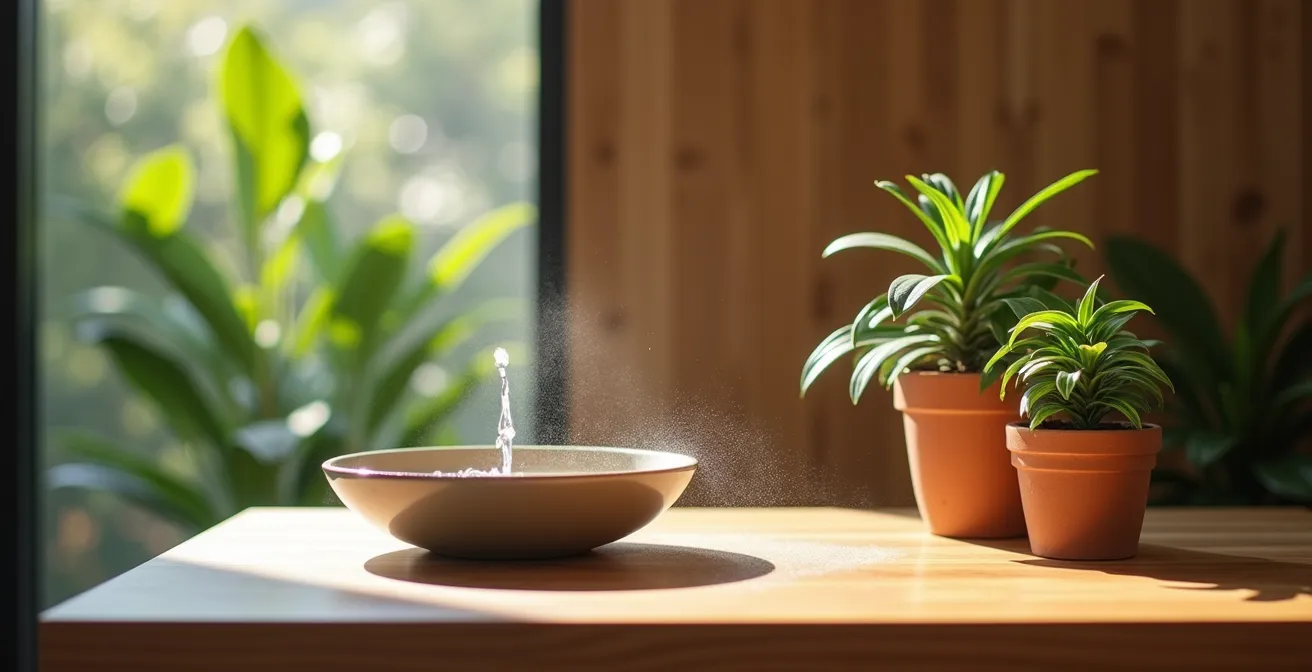
The effect is significant. Research demonstrates that in rooms where wooden surfaces (flooring, panels, furniture) cover about 45% of the total surface area, occupants’ perceptions of comfort are boosted, and the environment feels more balanced. By pairing a large raw wood desk with a small water feature and a few humidity-loving plants like ferns or calatheas, you create a self-regulating ecosystem. The fountain provides the moisture, and the wood acts as a natural buffer, storing and releasing it as needed. This creates a more stable, comfortable, and healthier micro-environment than a simple humidifier could achieve on its own, all while engaging multiple senses.
How to Dampen Echoes in Open-Plan Homes Using Textiles?
Open-plan living spaces and minimalist home offices are aesthetically pleasing but often become acoustic nightmares. Hard surfaces like concrete floors, large windows, and bare walls reflect sound waves, creating harsh echoes and reverberation that increase cognitive load and stress. While raw wood furniture and floors are a great starting point for diffusing some of this sound, they are most effective when paired strategically with soft, absorbent materials like textiles. The secret to acoustic comfort lies in this “hard + soft” pairing strategy.
This isn’t just about throwing a rug on the floor. It’s about a multi-layered approach that targets different sound frequencies at different heights within the room. A thick wool rug absorbs footfalls and low-frequency rumble. Heavy linen curtains absorb the high-frequency reflections bouncing off glass windows. Upholstered furniture breaks up sound waves in the middle of the room. By thoughtfully combining the reflective qualities of wood with the absorptive qualities of textiles, you can sculpt a soundscape that is clear, calm, and focused.
Even better, you can integrate these acoustic solutions as design features. Instead of unsightly foam panels, consider wood-framed textile panels that double as functional art. This approach allows you to layer textures, colors, and materials, enhancing the sensory richness of your space while solving a practical acoustic problem. The following checklist provides a concrete plan for implementing this strategy.
Your Action Plan for Acoustic Harmony: A Checklist for Pairing Wood and Textiles
- Assess your surfaces: Identify the largest hard, reflective surfaces in your office (windows, bare walls, hard floors) as primary targets for textile treatment.
- Layer at floor level: Combine raw wood flooring with a thick, high-pile wool or felt rug. The denser the textile, the more low-frequency sound it will absorb.
- Treat the walls: Install wood-framed textile panels filled with natural wool or cotton batting. These can be beautiful art pieces that absorb voice-frequency echoes. Cork-backed fabric panels are especially effective.
- Soften the windows: Hang heavy, full-length curtains made of linen or velvet near your desk area to absorb sound reflecting off the glass and add textural variety.
- Diffuse with furniture and decor: Use upholstered seating, scatter plush cushions, and even add a woven wall hanging. Every soft object helps break up and absorb sound waves.
Why Do 80% of DIY Green Walls Die Within the First 6 Months?
The allure of a lush, living green wall is powerful, but the reality is often a tragic, withered brown wall. The high failure rate of DIY systems stems from a few common mistakes, chief among them being improper watering and the use of the wrong support materials. Many commercial systems rely on plastic frames and synthetic felt pockets, which can retain too much moisture, leading to root rot, or dry out too quickly. This is another area where the inherent properties of raw wood offer a superior, biophilic solution.
The key is to use a naturally rot-resistant wood like cedar or cypress as the structural element for the green wall. Unlike plastic, wood breathes. It helps to regulate moisture at the root level, wicking away excess water to prevent rot while retaining enough to keep the soil from drying out completely. This creates a healthier and more forgiving environment for the plants’ root systems, significantly increasing their chance of survival.
Furthermore, a wood-based system allows for more flexible and lower-risk designs. Instead of an integrated, all-or-nothing wall, consider a modular wooden shelf or trellis system. This allows you to use individual potted plants. If one plant fails, it can be easily replaced without compromising the entire wall. This approach, as highlighted in biophilic design studies, combines the structural integrity and moisture-regulating benefits of wood with the practical advantages of container gardening. It’s not just a prettier option; it’s a healthier one for the plants, ensuring your living wall remains a source of vitality, not stress.
Key Takeaways
- Shift your view of wood from passive decoration to an active environmental manager that regulates light, sound, and humidity.
- The health and sensory impact of wood is dictated by its source (reclaimed vs. FSC) and its finish (natural oil vs. synthetic sealant).
- Create a holistic sensory system by strategically pairing raw wood with other natural materials like textiles, water features, and living plants.
Why Planting Non-Native Flowers Can Starve Local Bees in Your Area?
The final layer of creating a truly holistic, stress-reducing space is to extend your concept of “natural” beyond your front door. The story of non-native flowers illustrates a crucial principle: what is beautiful is not always beneficial to the local ecosystem. A flower that has not co-evolved with local pollinators may not provide the right kind of nectar, or any at all. This principle of local authenticity can be applied directly to the materials you choose for your home office.
Using wood species that are native to your region creates a subtle but powerful psychological connection to your local environment. An office in the Pacific Northwest featuring Douglas Fir, or one in New England with Maple and Oak, resonates with the landscape outside. This is more than just an aesthetic choice; it has a measurable impact on wellbeing. Research from Forest and Wood Products Australia found that workers in offices with native wood reported 15% higher satisfaction and a stronger sense of connection to place than those in offices with non-native or artificial materials.
This approach represents the pinnacle of biophilic design. It moves beyond the generic idea of “nature” to embrace the specific, authentic nature of your own locale. It aligns your personal sanctuary with the health of the broader ecosystem you inhabit. Choosing a desk made from local, sustainably harvested timber is the ultimate expression of this philosophy—it supports your local economy, reduces the carbon footprint of transportation, and deepens your connection to the place you call home. It’s the final step in transforming your office from an isolated box into a space that is truly, and authentically, alive.
Begin today by evaluating a single element in your office—a desk, a wall—not just for its looks, but for its potential to contribute to your home’s sensory ecosystem and its connection to the local environment.