
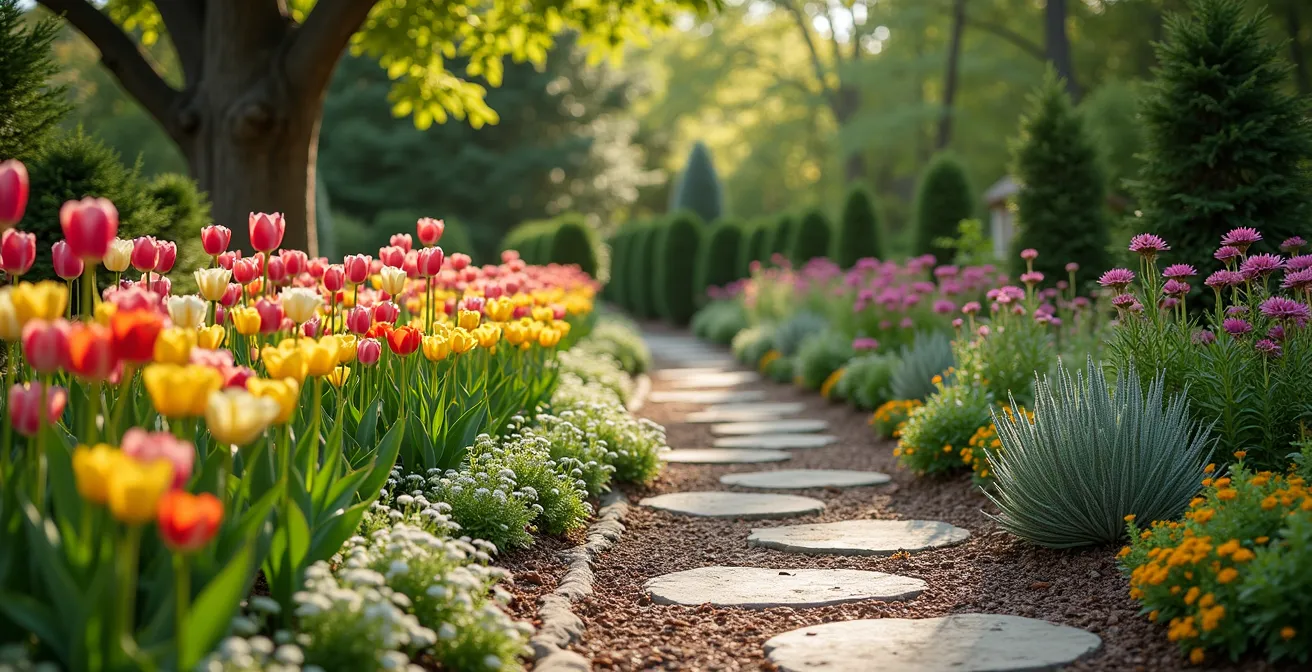
A garden that only shines for one season is a missed opportunity for year-round joy and beauty.
- The solution lies in “floral choreography”—strategically layering plants so one’s peak performance hands off seamlessly to the next.
- This involves combining permanent “structural performers” (like trees and shrubs) with spectacular, short-term “star soloists” (like bulbs and annuals).
Recommendation: Start by auditing your garden’s current “seasonal voids” and then select specific plants to fill those performance gaps, transforming your yard into a continuous show.
There’s a familiar frustration for many gardeners: the May garden is a riot of color, a spectacular performance of tulips, daffodils, and flowering trees. But by August, the show is over. The stage looks empty, brown, and tired, leaving you with a “seasonal void” for the rest of the year. The common advice is to “plant for four seasons” or “mix perennials with annuals,” but these tips often feel like suggesting a chef should “use ingredients.” They state the obvious without revealing the technique—the art—behind a truly magnificent result.
The secret isn’t just a longer plant list; it’s a shift in mindset. You must stop thinking like a plant collector and start acting like a floral choreographer. A garden with year-round interest isn’t a static collection; it’s a dynamic performance with entrances and exits. The key is mastering the handoff, the critical moment when one plant’s peak interest fades and another’s begins. It’s about ensuring there is always a performer, or a combination of performers, holding the spotlight.
But what if the true key to a non-stop show wasn’t just in the flowers, but in the entire production? This includes the stage architecture of trees, the dramatic costumes of winter stems, the mood lighting after dusk, and even the “area rugs” of groundcover. This guide will walk you through the art of floral choreography, showing you how to stage a continuous relay of beauty that ensures your garden never has an off-season.
To orchestrate this year-round performance, we will explore each element of the garden stage, from the foundational structures to the fleeting stars of the show. This summary outlines the key acts in our horticultural play.
Summary: The Art of a Non-Stop Garden Performance
- Red Twig Dogwood vs. Holly: Which Provides Better Color Against Snow?
- The “Lasagna Method”: How to Plant 3 Layers of Bulbs in One Pot?
- Why Buying Annuals Is Worth the Cost for Summer Curb Appeal
- Maples or Oaks: Which Tree Gives the Longest Fall Color Display?
- When to Swap Your Porch Pots: The 4-Season Schedule
- 2700K vs. 5000K: Why Cool White LEDs Ruin the “Cozy” Vibe?
- When to Swap Rugs: Transitioning Your Home from Summer to Winter
- How to Create Privacy in a Fishbowl Backyard Without Building a Fortress?
Red Twig Dogwood vs. Holly: Which Provides Better Color Against Snow?
The winter garden is often seen as a dormant stage, but a true choreographer knows it’s the season for structural performers to shine. When the floral canopy is gone, the garden’s bones are revealed. Red Twig Dogwood and Holly are two classic winter headliners, but they play very different roles. The dogwood offers a burst of fiery, linear color—a modern art installation against the white canvas of snow. Holly, in contrast, provides deep, evergreen structure and the traditional appeal of glossy leaves and crimson berries.
The choice isn’t about one being better, but about the desired effect. Do you want the architectural drama of bare, colorful stems or the classic, dense form of an evergreen? The Dogwood is a minimalist statement, while the Holly is a symbol of lush permanence. The best choreography often uses both, creating a dynamic interplay of texture and form that makes the winter landscape anything but dead.
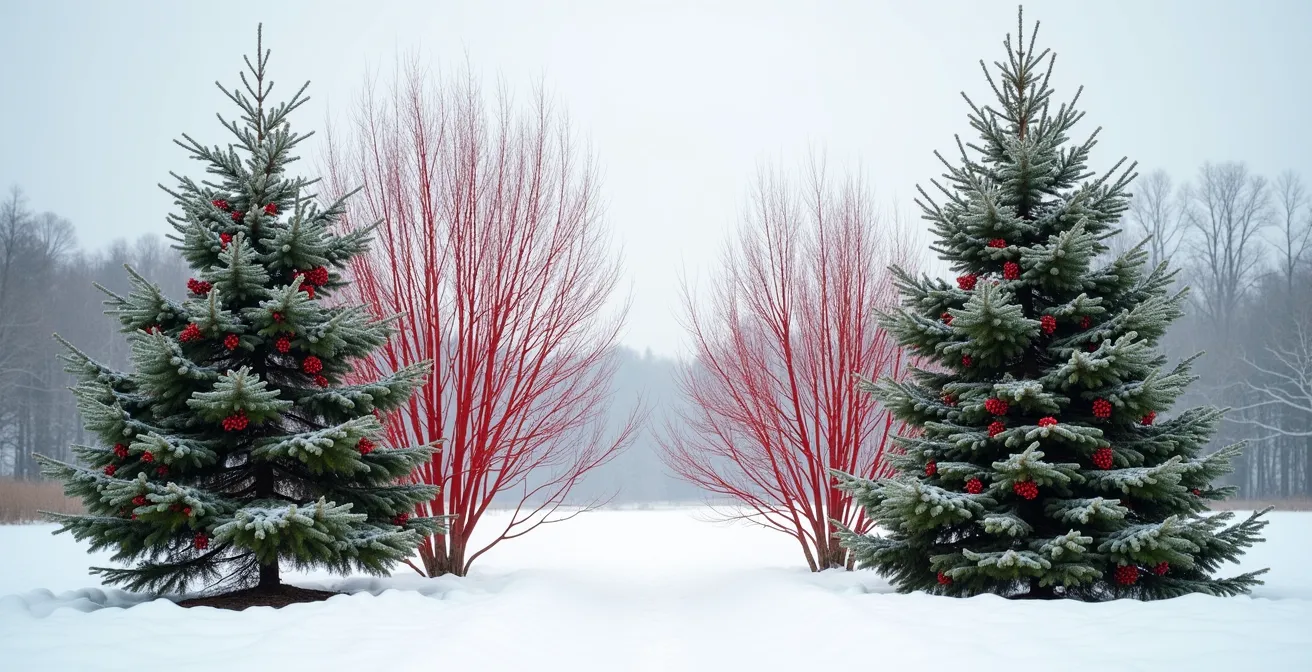
This visual contrast is key to a successful winter act. To ensure these performers don’t stand on a bare stage, a choreographer pairs them with other plants that will take over in the following seasons, ensuring a seamless handoff from one act to the next.
The following table breaks down the year-round contributions of these two winter stars, helping you decide which role is best for your garden’s script.
| Feature | Red Twig Dogwood | Holly |
|---|---|---|
| Winter Color | Bright red/yellow stems | Deep green foliage, red berries |
| Form | Upright, architectural | Dense, pyramidal |
| Spring Interest | Fresh green leaves, white flowers | Inconspicuous flowers |
| Summer Role | Green foliage backdrop | Evergreen structure |
| Fall Display | Purple-red foliage | Berry development |
| Relay Partners | Spring bulbs at base | Shade perennials beneath |
| Maintenance | Annual pruning for best color | Minimal pruning needed |
The “Lasagna Method”: How to Plant 3 Layers of Bulbs in One Pot?
Spring bulbs are the first explosive act of the gardening year, the star soloists that announce winter’s end. However, their performance is often fleeting, leaving a “seasonal void” once they fade. The “Lasagna Method” is a choreographer’s technique for extending this performance, turning a single pot or garden patch into a three-act play. It involves layering bulbs with different bloom times, so as one group of flowers finishes, the next is just beginning to emerge.
This is vertical choreography in its purest form. You are literally stacking the performance schedule. The largest, latest-blooming bulbs (like Alliums or Darwin Hybrid Tulips) form the bottom layer. Mid-season performers (like Daffodils) go in the middle. The earliest, smallest bulbs (like Crocus or Grape Hyacinth) sit near the top. The result is a continuous sequence of blooms from a single spot, lasting for weeks or even months instead of a single, brilliant flash.
Advanced Lasagna Recipes for Specific Goals
Beyond basic sequencing, expert floral choreographers create “lasagna recipes” for specific effects. As noted by garden design professionals, these combinations elevate the concept. For instance, “The Fragrance Relay” layers scented hyacinths, fragrant tulips, and alliums for months of continuous aroma. A “Pollinator Relay” might start with crocus for early bees and end with camassia for summer pollinators. This strategic layering proves that with careful planning, even a small container can host a full season of interest.
Here is the step-by-step process for choreographing your own bulb lasagna, ensuring a seamless handoff from one floral act to the next.
- Layer 1 (Deepest, ~8 inches): Plant your late-spring headliners first. This includes large, late-blooming tulips or architectural alliums.
- Layer 2 (Middle, ~5 inches): Cover the first layer with a few inches of soil. Now add your mid-season performers, such as daffodils or hyacinths.
- Layer 3 (Top, ~3 inches): Add another layer of soil. Place your opening act of early-blooming crocus, scilla, or grape hyacinth near the surface.
- Layer 4 (Surface): To hide the fading foliage of the bulbs, plant a “living mulch” of shallow-rooted annuals (like pansies) or a creeping groundcover on top once the bulbs have sprouted.
- Maintenance: Ensure you use a well-draining potting mix and water thoroughly after planting. After blooming, tuck the dying foliage behind emerging plants to keep the stage looking tidy.
Why Buying Annuals Is Worth the Cost for Summer Curb Appeal
If bulbs are the opening act, annuals are the spectacular, high-energy summer headliners. Perennials form the reliable chorus line of a garden, but they often have a limited bloom window. Annuals, by contrast, are hired for one job: to bloom profusely from the moment they are planted until the first frost. For the floral choreographer aiming to eliminate the summer slump, annuals are an indispensable tool, providing an instant and sustained explosion of color exactly when many perennials are taking a break.
Their cost, an annual expense, can seem like a drawback. However, this should be viewed as the budget for the “special effects” of your summer show. Their non-stop performance fills gaps, energizes borders, and provides the vibrant curb appeal that makes a garden look alive and cared for during the peak of the season. They are the ultimate “relay fillers,” keeping the visual excitement high while young perennials establish themselves. A small investment in annuals can pay huge dividends in overall impact.
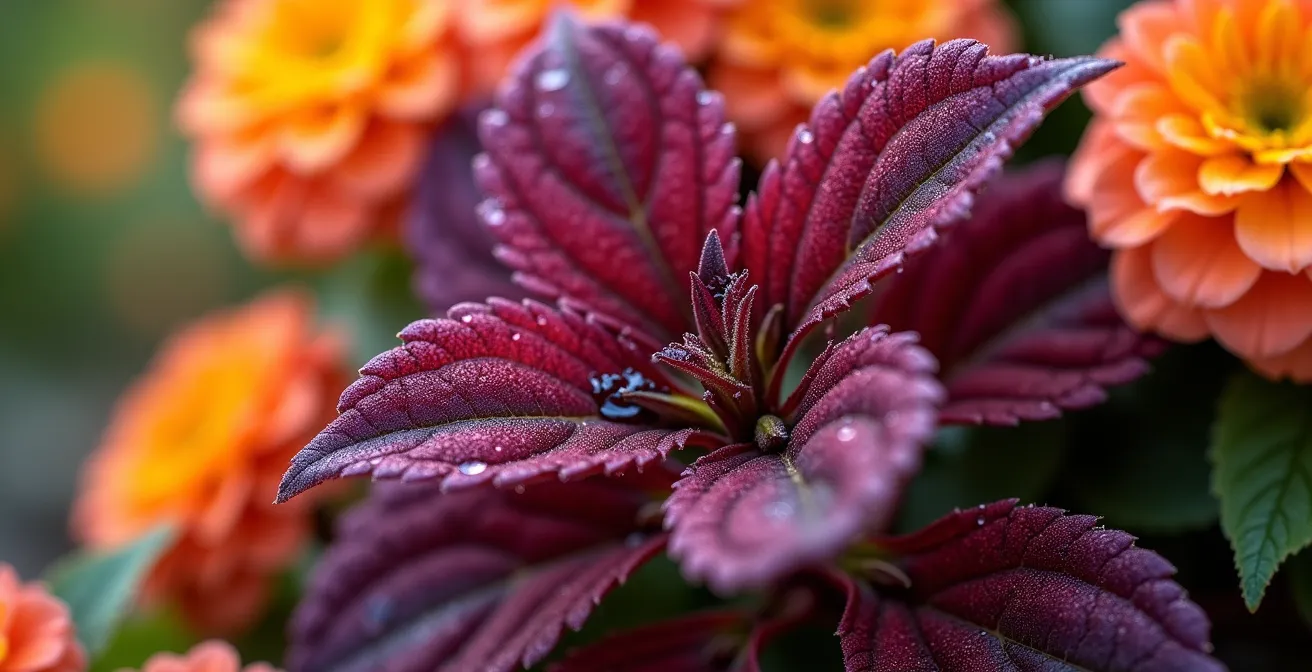
To maximize this investment, a choreographer doesn’t just plant them randomly. They are placed in high-impact zones: entryways, containers, and window boxes, where their performance can be most appreciated. This strategic placement ensures maximum return on a modest budget.
This cost-benefit analysis from data on garden strategies shows that while a perennials-only approach is cheaper long-term, it delivers far fewer weeks of bloom. A hybrid strategy, incorporating annuals, offers a powerful balance of cost and continuous color.
| Strategy | Year 1 Cost | Year 1 Bloom Weeks | 5-Year Total Cost | 5-Year Bloom Weeks | Cost per Bloom Week |
|---|---|---|---|---|---|
| Annuals Only | $150 | 20 weeks | $750 | 100 weeks | $7.50 |
| Perennials Only | $200 | 6 weeks | $250 | 60 weeks | $4.17 |
| Hybrid Strategy | $175 | 18 weeks | $425 | 85 weeks | $5.00 |
Action Plan: Strategic Annual Selection for a Relay Garden
- Identify Points of Impact: List all high-visibility spots (entryway, patio pots, mailbox) where continuous color is non-negotiable.
- Choose ‘Workhorse’ Performers: Inventory your options, focusing on varieties known for non-stop blooming without constant deadheading, like Calibrachoa or Coleus.
- Check for Coherence: Compare your selections to your garden’s overall color palette and style. Do they complement or clash with the perennial “chorus line”?
- Assess for Unique Value: Does the annual provide something your perennials don’t, like airy texture (Verbena bonariensis) or dramatic foliage color (Coleus)?
- Create an Integration Plan: Map out exactly where you will use annuals as “Relay Fillers” to bridge bloom gaps while your perennials mature over the next 1-3 years.
Maples or Oaks: Which Tree Gives the Longest Fall Color Display?
The grand finale of the growing season is the fall color display, and the lead roles are played by the trees. They are the ultimate structural performers, defining the garden’s architecture year-round. However, their fall performance style varies dramatically. A Maple tree is like a firework: it delivers an intensely brilliant, spectacular show of red, orange, or yellow, but it’s often over in two or three weeks. An Oak, on the other hand, is a slow burn. Its color change is more gradual, transitioning through shades of yellow, russet, and brown over a period of four to six weeks, extending the autumn interest significantly.
For the floral choreographer, the choice impacts the entire garden stage. The brief, brilliant show of a maple creates a definitive, dramatic end to the season. The longer, more subtle performance of an oak allows for a more graceful handoff into winter. Furthermore, the type of shade they cast in summer dictates what can be planted beneath them. A dense maple canopy creates a “dry shade” environment, limiting the understudy plants. The dappled light under an oak allows for a much more diverse and successful cast of perennials below.
The Canopy Relay Framework
An analysis of the ‘Canopy Relay’ concept highlights this critical relationship. A study documented by landscape architects found that the extended seasonal transitions and lighter shade of an oak tree created more opportunities for successful relay plantings beneath it. In fact, the study showed that oaks could support up to 40% more plant diversity in their understory compared to maples, making them a superior choice for a complex, layered garden performance.
Your choice of leading tree sets the rules for the rest of the cast. Consider these factors when scripting your fall finale:
- Shade Type: A maple’s dense, dry shade severely limits your options for underplantings to tough performers like hostas and ferns. An oak’s dappled light supports a richer tapestry of woodland phlox, coral bells, and bleeding hearts.
- Leaf Management: Maples drop their leaves in a heavy, sudden blanket, requiring an immediate cleanup strategy to avoid smothering smaller plants. Oaks drop their leaves gradually, acting as a natural mulch that protects plant crowns over winter.
- Root System: Deep-rooted oaks are less competitive with nearby perennials, allowing them to establish more successfully.
- Spring Performance: Don’t forget the opening act! Late-leafing oaks allow spring ephemerals (like Virginia bluebells) to complete their entire life cycle in the sun before the canopy fills in.
When to Swap Your Porch Pots: The 4-Season Schedule
Porch pots and entryway containers are the miniature stages of your garden theater. They are the first thing guests see, setting the tone for the entire property. Leaving a pot of dead summer annuals out until December is like leaving the set for Act I on stage during the intermission. A floral choreographer ensures these high-impact areas follow a strict performance schedule, with seamless transitions that reflect the current season.
Creating a 4-season schedule for your pots is essential. This isn’t about having something in bloom 365 days a year, but about having a composition that is intentionally and beautifully “of the season.” This means four distinct “looks” or plant swaps per year.
- Spring (March-May): The opening act. This is the stage for your bulb “lasagna” topped with cold-tolerant pansies or primroses. The look is fresh, vibrant, and full of the promise of life returning.
- Summer (June-August): The blockbuster performance. Swap out the faded spring plants for a lush mix of heat-loving “thrillers, fillers, and spillers.” This is the time for bold, non-stop blooming annuals like petunias, coleus, and sweet potato vine.
- Autumn (September-November): The rich, textural finale. The summer annuals are replaced with a composition of fall jewel tones: ornamental kale, chrysanthemums, asters, and perhaps a small ornamental grass for texture and movement.
- Winter (December-February): The structural encore. After the first hard frost, the pot is cleared and replanted for architectural interest. This composition relies on dwarf evergreens, branches of Red Twig Dogwood, berried holly stems, and pinecones. It provides color and form against a stark landscape.
This disciplined schedule transforms your porch pots from afterthoughts into a central part of your garden’s continuous performance, ensuring your home’s entrance always offers a beautiful, seasonal welcome.
2700K vs. 5000K: Why Cool White LEDs Ruin the “Cozy” Vibe?
A floral choreographer’s work doesn’t end when the sun goes down. The garden’s evening performance is just as important, and it is directed entirely by lighting. The choice of landscape lighting is akin to a theater’s lighting designer choosing gels for a scene. The color temperature of your lights dramatically alters the mood and the appearance of your plant performers. This is where understanding the Kelvin scale (K) is crucial.
Light at 5000K or higher is a “cool white” or “daylight” bulb. It emits a stark, blue-toned light. While this may seem good for “visibility,” it’s disastrous for atmosphere. It flattens textures, washes out the warm tones in foliage and flowers, and makes the garden feel like a parking lot or a surgical suite. It ruins the “cozy” vibe because it’s activating and analytical, not relaxing and enchanting.
In contrast, light at 2700K is a “warm white” light. It emits a soft, golden-yellow glow, similar to candlelight or the light from a traditional incandescent bulb. This is the secret to a magical evening garden. This warm temperature enhances the greens of foliage, picks out the rich reds and yellows in flowers and bark, and creates deep, soft shadows that add mystery and depth. It turns the garden from a space to be observed into an atmosphere to be experienced. It’s the difference between a harsh interrogation lamp and an inviting fireside glow. For a garden, the choice is clear: warm white light is the only option for creating an enchanting evening performance.
When to Swap Rugs: Transitioning Your Home from Summer to Winter
Just as an interior designer swaps a lightweight sisal rug for a plush wool one to transition a home from summer to winter, a floral choreographer manages the “rugs” of the garden: the groundcovers. These low-growing plants form the living carpet of your garden floor, and their texture and color play a huge role in the seasonal mood. Thinking of them as seasonal rugs helps in choreographing the transitions at ground level.
The “summer rug” is often lush, green, and broad-leafed. Think of the dense, cool carpet of Sweet Woodruff (Galium odoratum) under trees or the vibrant chartreuse of Creeping Jenny (Lysimachia nummularia) in a moist spot. These groundcovers speak of growth, coolness, and abundance. They are the bare-feet-friendly carpets of the summer garden.
The transition to the “winter rug” is a critical handoff. As deciduous groundcovers die back, the stage is set for the evergreen performers. This is where fine-textured, resilient groundcovers take the spotlight. The bronze and purple winter tones of certain Ajuga varieties, the fine, mossy texture of Irish Moss (Sagina subulata), or the silvery sheen of Lamb’s Ear (Stachys byzantina) provide a rich, insulating layer that is beautiful even under a dusting of snow. This isn’t a literal “swap” like an indoor rug, but a planned succession where one recedes as the other comes forward. By interplanting both types, you ensure the garden floor is never bare, choreographing a seamless transition from the cool tiles of summer to the warm carpet of winter.
Key Takeaways
- A four-season garden is achieved through “floral choreography”—planning the handoffs between plants.
- Balance long-term “structural performers” (trees, shrubs) with short-term “star soloists” (annuals, bulbs).
- Every element, from lighting to groundcover, plays a role in the garden’s continuous performance.
How to Create Privacy in a Fishbowl Backyard Without Building a Fortress?
Privacy is a fundamental need in a backyard, but the common solution—a tall, solid fence—is the antithesis of good garden choreography. A “fortress” fence is a hard stop, a visual dead end that often makes a space feel smaller. A floral choreographer creates privacy by building “soft walls” and “green rooms,” using layered plantings that screen views while adding depth, beauty, and habitat. This is about creating a sense of enclosure and seclusion, not isolation.
The key is to use a mix of structural performers of varying heights and textures. Instead of one tall, thin line of Arborvitae, a choreographer uses a deeper border with three or more layers:
- The Backbone: A staggered row of tall, narrow evergreens (like ‘Degroot’s Spire’ Arborvitae or Italian Cypress) at the very back. Staggering them instead of planting in a straight line immediately breaks up the “wall” effect.
- The Mid-Layer: In front of the evergreens, add a layer of deciduous shrubs or broadleaf evergreens that are medium height (6-10 feet). This could be Viburnum, Hydrangea, or Holly. This layer adds seasonal interest and obscures the trunks of the taller trees.
- The Foreground: The front layer consists of lower-growing perennials and small shrubs (3-5 feet). This layer connects the “privacy screen” to the rest of the garden, making it feel like an integrated part of the design, not just a barrier.
This layered approach creates a visual journey. The eye is forced to travel through the layers, which gives the impression of a much larger, more mysterious space. It effectively blocks the sightline of a nosy neighbor without erecting a monolithic barrier, turning a practical need for privacy into another beautiful, year-round performance.
Your journey as a floral choreographer begins not with a total overhaul, but with a single, perfectly timed handoff. Start today by choosing one “seasonal void” in your yard and plan its next performer to take the stage.