

Effective security lighting isn’t about overwhelming brightness; it’s a strategic system that welcomes you and warns intruders.
- Layering different types of light creates depth and eliminates hiding spots without causing glare.
- Sudden, motion-triggered changes in light are a far more powerful psychological deterrent than constant, predictable illumination.
- Smart controls and Dark Sky-compliant fixtures provide superior security, save significant money, and protect your home’s aesthetic.
Recommendation: Combine full cutoff, Dark Sky-compliant fixtures with a smart, multi-layered motion detection plan for a home that is both safe and beautiful.
The classic homeowner dilemma: you pull into your driveway after dark, fumbling for keys in an unnerving blackness, or you’re blinded by floodlights so harsh they make your home look more like a correctional facility than a sanctuary. The common advice is often a blunt instrument—install a powerful motion sensor light and hope for the best. This approach typically results in a yard that’s either a welcoming beacon for your family or a glaring, unwelcoming fortress for everyone, with little nuance in between.
But what if the very premise of “more light equals more security” is flawed? Constantly lit porches can create predictable, deep shadows, giving intruders a perfect place to hide. A single, powerful floodlight creates harsh glare, making it difficult to see what’s actually happening in the shadows it casts. The key to effective driveway security isn’t brute-force brightness. It’s about designing an intelligent, layered system of light that sends the right signals—a warm welcome for you, and a clear warning for unwanted visitors.
This guide moves beyond simple fixtures and into the realm of strategy. We will explore how to choreograph light as a responsive security measure, using a combination of smart sensor technology, carefully selected fixtures, and intelligent scheduling. By thinking like a security designer, you can create a driveway that not only deters threats but also enhances your home’s curb appeal, proving that safety and style can, and should, coexist.
This article provides a comprehensive roadmap for transforming your driveway from a potential vulnerability into a sophisticated line of defense. We will cover everything from the nuances of motion sensor technology to the future of smart home integration.
Summary: A Guide to Strategic Driveway Illumination
- PIR vs. Microwave Sensors: Which Stops False Alarms from Windy Trees?
- How to Choose Outdoor Fixtures That Don’t Pollute the Night Sky?
- Why “Always On” Porch Lights Might Actually Attract Burglars?
- Step Lights vs. Path Lights: Which Is Safer for Elderly Guests?
- Dusk-to-Dawn or Smart Schedule: Which Saves More Electricity?
- IC-Rated vs. Non-IC: The Fire Safety Check You Must Do Before Drilling
- The Default Password Mistake That Opens Your Smart Fridge to Hackers
- Matter Protocol: Will It Finally Make Your Alexa Talk to Your HomeKit?
PIR vs. Microwave Sensors: Which Stops False Alarms from Windy Trees?
The foundation of any smart lighting system is its ability to detect motion accurately. The most common technology is the Passive Infrared (PIR) sensor, which detects changes in heat. While effective and energy-efficient, they are notoriously prone to false alarms from swaying trees on a windy night or a stray animal. In fact, a 2024 market analysis shows that standard infrared sensors hold a 32.4% market share, making their limitations a widespread issue for homeowners seeking reliable security.
The more advanced alternative is the microwave sensor. It works like radar, emitting low-power microwaves and detecting motion by analyzing the “echo” that bounces back. Unlike PIR sensors, they are not affected by temperature changes and can even “see” through thin walls or around corners. This makes them ideal for challenging outdoor environments where temperature swings are common. However, their sensitivity can also be a drawback, as they might be triggered by movement on a public sidewalk beyond your property line.
The ultimate solution for eliminating false alarms is not choosing one over the other, but using them strategically. Dual-technology sensors, which combine both PIR and microwave detection, require both sensors to trigger before activating the lights, virtually eliminating false positives. For a truly sophisticated setup, consider “cross-zoning,” where two separate sensors must be triggered in sequence (e.g., one at the driveway entrance, then one closer to the garage) to confirm a valid threat. This layered approach is the first step in creating a “choreographed” security response rather than just a reactive one.
How to Choose Outdoor Fixtures That Don’t Pollute the Night Sky?
Creating a “prison yard” effect is often the result of poor fixture selection, not just excessive brightness. Unshielded, globe-style lights that cast light upwards and outwards are the primary culprits. This wasted light, known as light trespass, creates glare, annoys neighbors, and obscures the night sky. Beyond the aesthetic cost, there’s a financial one; the International Dark-Sky Association (IDA) estimates that poor outdoor lighting wastes an estimated $3.3 billion annually from unshielded lights in the U.S. alone.
The solution is to exclusively use Dark Sky-compliant fixtures. These are designed with shields that direct all light downward, where it’s needed for safety and security. This focused illumination prevents glare, reduces energy consumption, and preserves the beauty of the night sky. The key is to look for fixtures labeled as “Full Cutoff” or “IDA-Certified.”
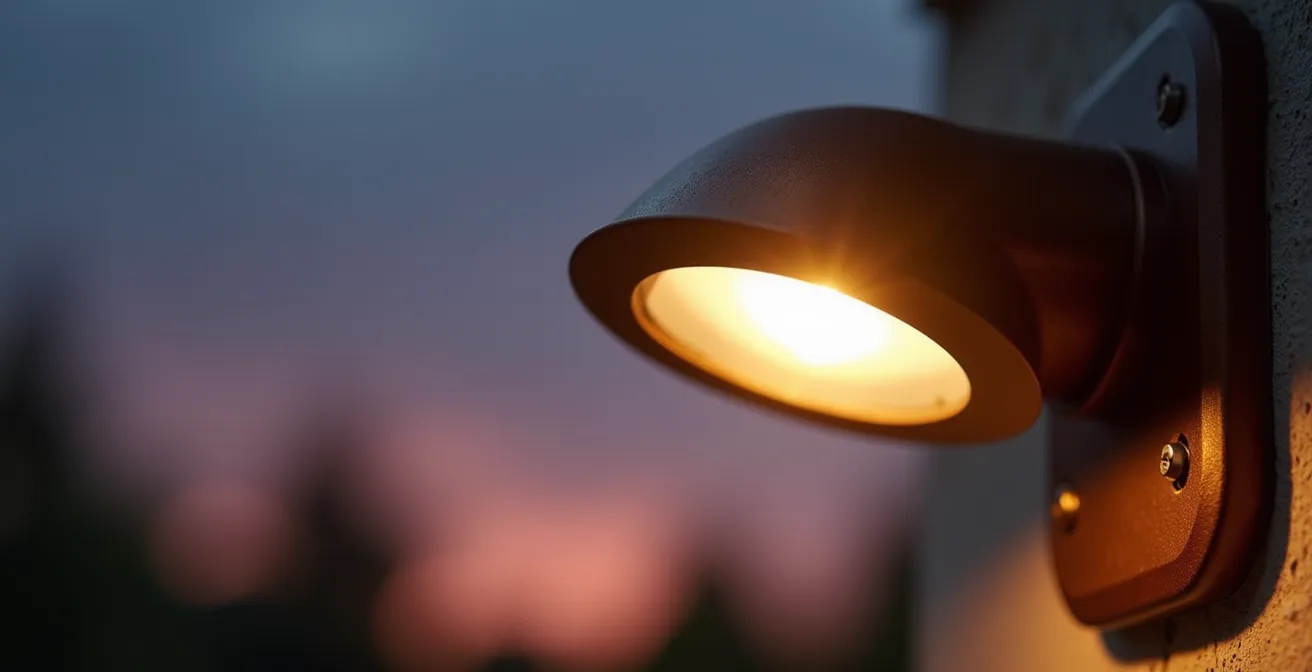
As you can see in the design of a compliant fixture, the light source is recessed, and a shield prevents any light from escaping above the horizontal plane. This precision ensures that every lumen is used effectively for illumination on the ground, not for lighting up the clouds. Choosing the right fixture type is critical for balancing security with aesthetics.
| Fixture Type | Light Distribution | IDA Compliance | Best Use |
|---|---|---|---|
| Full Cutoff | 0% above horizontal | Yes – Certified | Driveways, Security |
| Cutoff | 2.5% above horizontal | Conditionally | Pathways |
| Semi-Cutoff | 5% above horizontal | No | Not Recommended |
| Non-Cutoff | No restriction | Never | Avoid |
Why “Always On” Porch Lights Might Actually Attract Burglars?
The conventional wisdom that a constantly lit porch deters burglars is a dangerous oversimplification. While a lit home can suggest occupancy, an “always on” light creates a highly predictable environment. It casts deep, consistent shadows that an intruder can study from a distance, using them as cover to approach your home undetected. The light that is meant to expose them becomes a tool for concealment.
True psychological deterrence comes from change and unpredictability. A dark driveway that suddenly floods with light when someone enters is far more startling and effective at making an intruder retreat. This principle is a core tenet of professional security strategy.
Case Study: The FBI Agent’s Light Placement Strategy
In interviews, former FBI agents consistently recommend motion-detection floodlights for driveways over static lighting. They state that the sudden, unexpected illumination causes a primal “fight or flight” response in intruders, who will almost always choose to flee rather than risk exposure. Their strategy involves placing lights high above garages, shining directly down to cover blind spots and prevent tampering, maximizing the shock value of activation.
This is the essence of a “Welcome & Warn” system. For everyday use, your driveway can be set to a low, welcoming ambient light (e.g., 15% brightness). This provides enough light to see but maintains a soft aesthetic. When motion is detected, the system instantly jumps to 100% brightness, creating that critical element of surprise. This dual-state approach gives you the best of both worlds: a home that looks inviting but is ready to become an active deterrent at a moment’s notice.
Step Lights vs. Path Lights: Which Is Safer for Elderly Guests?
While driveway security often focuses on intruders, ensuring the safety of family and guests, especially the elderly, is equally important. Falls are a significant risk, and poor lighting on walkways and stairs is a major contributing factor. The choice between path lights and step lights is crucial in this context. Path lights—the mushroom-shaped fixtures on stakes—can create dangerous glare at eye level for someone who is shorter or seated in a wheelchair. They also cast long, sharp shadows that can obscure uneven surfaces or the edge of a step.
For maximum safety, recessed step lights are the superior choice. Installed directly into the vertical face of a stair, they cast light directly across the tread, clearly defining each step without creating any upward glare. Furthermore, the quality of the light itself is critical. Experts in fall prevention recommend using lights with a high Color Rendering Index (CRI). A study confirms that lighting with a CRI of 90+ can significantly reduce trip hazards because it allows the human eye to better distinguish subtle changes in color and texture, improving depth perception.
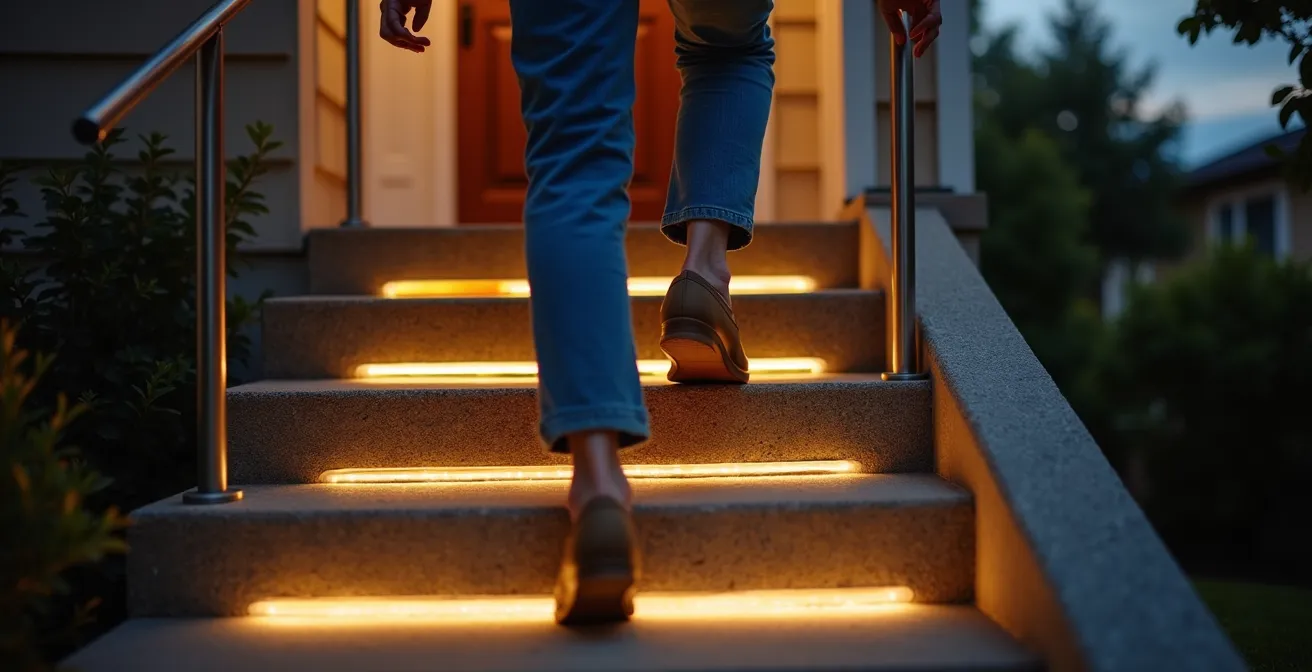
As illustrated here, a well-designed system of step lights creates clear, glare-free zones of safety. The warm light not only illuminates the path but also provides a sense of comfort and dignity. When combined with strip lighting under handrails, you create a completely illuminated, shadow-free path that makes navigating stairs safer for everyone, regardless of age or mobility.
Dusk-to-Dawn or Smart Schedule: Which Saves More Electricity?
Dusk-to-dawn sensors were a major step up from manual switches, offering automated convenience. However, they represent a “dumb” automation, running lights for a fixed duration—typically around 11 hours a day—regardless of actual activity. While better than leaving lights on 24/7, they still waste a significant amount of energy illuminating an empty driveway in the middle of the night.
Smart scheduling offers a far more intelligent and efficient approach. By integrating your lighting system with a smart home hub, you can create nuanced schedules that align with your actual lifestyle. For example, you can program the lights to be on from sunset until 11 p.m., turn off during the quiet hours from midnight to 5 a.m. (while still relying on motion sensors for security), and then turn back on for early departures. This simple adjustment can lead to dramatic energy savings.
The numbers speak for themselves. A smart schedule provides all the security you need while consuming a fraction of the power. The most advanced method, a hybrid “Welcome & Warn” system that uses low-level ambient light overnight and only ramps up to full brightness on motion, offers the greatest savings of all.
| Lighting Strategy | Daily Hours (at full power) | Annual kWh | Annual Cost (at $0.13/kWh) | Energy Savings vs. Always On |
|---|---|---|---|---|
| Always On | 24 | 2,628 | $342 | 0% |
| Dusk-to-Dawn | 11 | 1,205 | $157 | 54% |
| Smart Schedule (off 12-5am) | 7 | 767 | $100 | 71% |
| Hybrid (100%-20%-100%) | Variable | ~584 | ~$76 | ~78% |
IC-Rated vs. Non-IC: The Fire Safety Check You Must Do Before Drilling
While aesthetics and security are primary goals, electrical and fire safety are non-negotiable. This is especially true when installing recessed lights in soffits or overhangs that may contain insulation. The distinction between IC-rated and Non-IC-rated fixtures is critical. IC-rated (Insulation Contact) fixtures are specifically designed to be safely installed in direct contact with insulation. They have a housing that prevents heat from building up to combustible levels.
Using a Non-IC-rated fixture in contact with insulation is a serious fire hazard. These fixtures require a minimum clearance (typically 3 inches) from any insulation to allow heat to dissipate. Burying one in insulation is like putting a hot light bulb in a box of tinder. Before you drill a single hole, you must verify the type of fixture you have and the environment you are installing it into. Beyond the IC rating, ensuring your fixtures are rated for outdoor use (UL Wet or Damp Location) and installed with proper weatherproofing is essential for long-term safety and performance.
Your Essential Outdoor Electrical Safety Checklist
- Verify Fixture Rating: Confirm that every fixture has the appropriate UL Wet Location rating for direct exposure to rain.
- Check Wire Gauge: For long driveway runs (over 100 feet), use a thicker wire (e.g., 12 AWG) to prevent voltage drop, which can dim lights and damage electronics.
- Use Waterproof Junction Boxes: All electrical connections must be made inside junction boxes with weatherproof gaskets and covers.
- Seal All Penetrations: Use a flexible, waterproof putty barrier or caulk around any holes drilled in your home’s exterior for wiring.
- Maintain Material Clearance: Keep hot fixtures at least 6 inches away from combustible materials like vinyl or wood siding unless the manufacturer’s instructions state otherwise.
- Ground Everything: Ensure all metal fixtures, junction boxes, and conduits are properly grounded to prevent electric shock.
The Default Password Mistake That Opens Your Smart Fridge to Hackers
As your driveway lighting becomes “smarter,” it also becomes a potential entry point into your home’s digital network. Many smart devices, including lighting hubs, ship with a default administrator password like “admin” or “password.” Failing to change this immediately upon installation is like leaving your front door wide open with the key in the lock. Hackers run automated scripts that constantly scan for devices with these default credentials.
Once they gain access to your lighting hub, they can do more than just flicker your lights. They can monitor your lighting schedules to learn when you’re away, creating a perfect window for a physical break-in. This is a common tactic in what security experts call a “pivot attack.”
Case Study: The Driveway Pivot Attack
Security researchers have documented cases where hackers compromised an insecure smart lighting system. They used the access not to control the lights directly, but to monitor the homeowner’s “vacation mode” schedule. Once they confirmed the family was away, they remotely disabled all exterior security lights to provide complete darkness for a physical intrusion. The lighting system, intended for security, became a tool for reconnaissance and an accomplice in the crime.
Protecting your smart home starts with basic digital hygiene. Creating a separate Wi-Fi network for your IoT (Internet of Things) devices is a powerful security measure. This isolates your smart lights, cameras, and appliances from your primary network where your computers and personal data reside. Even if a hacker compromises a light, they can’t “pivot” to your sensitive files. Regular firmware updates, strong unique passwords, and enabling two-factor authentication are no longer optional—they are essential components of a modern security plan.
Key Takeaways
- Layer, Don’t Blast: Combine ambient, task, and accent lighting to eliminate shadows and create depth, rather than relying on a single, harsh floodlight.
- Psychology Over Power: Sudden, motion-activated changes in light are a more powerful deterrent than constant, predictable illumination. Design a “Welcome & Warn” system.
- Intelligence is Efficiency: A smart, scheduled lighting system provides superior security, saves up to 78% on energy costs, and adapts to your lifestyle.
Matter Protocol: Will It Finally Make Your Alexa Talk to Your HomeKit?
For years, the biggest frustration of building a smart home has been the “walled gardens” of different ecosystems. Your Ring camera (Amazon) couldn’t easily talk to your Philips Hue lights (Apple HomeKit), which couldn’t integrate with your Google Nest Hub. This forced homeowners to either commit to a single brand or juggle multiple apps and complex workarounds. The Matter protocol is the revolutionary solution to this problem.
Think of Matter as a universal translator for smart devices. It’s a new connectivity standard, backed by all the major tech giants (Apple, Amazon, Google, Samsung), that allows certified devices to work together seamlessly, securely, and reliably, right out of the box. For driveway security, this is a game-changer. It unlocks a new level of “choreographed response” that was previously impossible.
Case Study: Cross-Ecosystem Security Integration with Matter
With Matter, you can create powerful, ecosystem-agnostic automations. For instance: a Ring doorbell (Amazon ecosystem) detects a person at the edge of your driveway. This can instantly trigger your Philips Hue path lights (HomeKit ecosystem) to ramp up to 100% brightness, while simultaneously causing your Google Home-connected garage lights to flash twice as a warning. This sophisticated, multi-brand response future-proofs your investment in expensive outdoor fixtures, ensuring they will work with whatever smart home platform you choose now or in the future.
Investing in Matter-certified devices is the smartest way to build a lighting system that will grow with technology. It allows you to create safety automations that go far beyond simple motion detection, such as having all exterior lights switch to 100% brightness if a smoke alarm is triggered, or flashing your driveway lights to help first responders locate your home in an emergency.
Your driveway is the first impression your home makes and its first line of defense. By moving away from brute-force floodlights and embracing a strategic, layered, and intelligent system, you can design a solution that enhances both security and style. Start by auditing your current setup and begin planning a smart, choreographed lighting system that truly works for you.
Frequently Asked Questions on Driveway Lighting Security
What IP rating do I need for driveway soffit lights?
You need a minimum of an IP65 rating for fixtures in protected areas under eaves. For locations that are fully exposed and may face direct rain or sit in puddles, an IP67 rating is required for complete water and dust protection.
What’s the difference between UL Wet vs. Damp Location ratings?
A “Wet Location” rating means the fixture is built to withstand direct exposure to rain, snow, and water from any direction. A “Damp Location” rating is only sufficient for areas that are protected from direct precipitation but may experience condensation and humidity, such as a covered porch.
How do I prevent heat buildup near flammable siding?
Always maintain a minimum clearance of 6 inches from flammable materials like vinyl or wood siding, unless the fixture manufacturer specifies a different distance. Use fixtures that have visible heat sinks designed to dissipate thermal energy, and ensure there are proper ventilation gaps around the installation.