
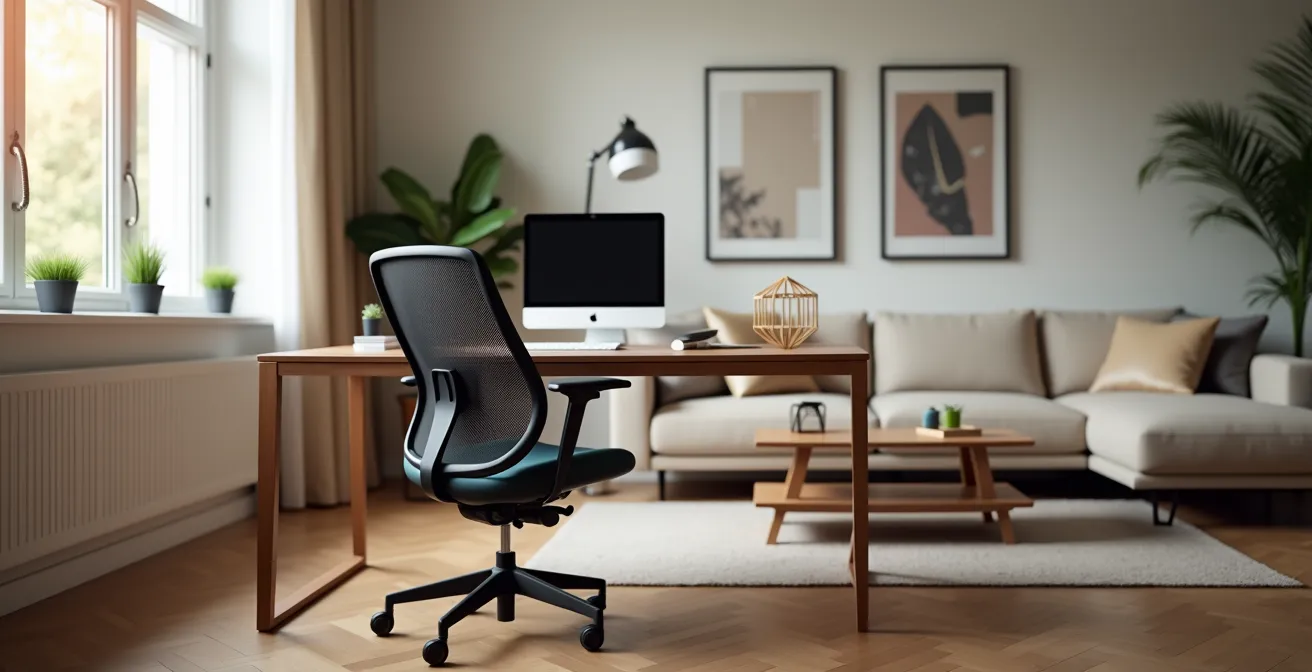
Creating a healthy workspace at home isn’t about hiding ugly office furniture; it’s about making ergonomic principles the invisible foundation of your living room’s style.
- Your sofa’s design is likely the primary source of back pain due to a lack of lumbar support.
- Poor lighting directly impacts posture, and a layered lighting strategy is as crucial as your chair.
- The layout should be designed for movement, not just to hold furniture.
Recommendation: Audit your space not just for looks, but for flow, light, and support. A truly stylish room is one that takes care of you.
That beautiful, low-profile sofa—it looked perfect in the showroom. But two hours into a remote workday, your lower back tells a different story. You’re a professional who values style, but the persistent ache is a constant reminder that your chic living room isn’t designed for an eight-hour shift. This is the modern remote worker’s dilemma: a battle between health and home aesthetics. The common advice is to either buy a clunky, corporate-looking chair and try to hide it, or simply endure the discomfort for the sake of your home’s vibe.
But what if this is a false choice? What if the solution wasn’t a compromise, but a synthesis? True ergonomic design, when done right, can actually enhance your living room’s aesthetic instead of clashing with it. This guide is built on a core principle: your health and your style are not mutually exclusive. As an interior designer specializing in occupational therapy, my approach is uncompromising on health but rooted in sophisticated design. We won’t be hiding anything. Instead, we’ll integrate principles of well-being so seamlessly that they become the secret behind your stylish, comfortable space.
This article will deconstruct the science of comfort and translate it into actionable design strategies. We’ll examine why your stylish furniture might be working against you, explore elegant solutions for workstations, dissect the crucial role of lighting, and even touch on the sustainable materials that contribute to a healthier environment. It’s time to stop choosing between a room that looks good and one that feels good, and start creating a space that does both.
To guide you through this transformation, we will explore each element step-by-step. This structured approach will provide a clear roadmap for turning your living room into a sanctuary of both style and productivity.
Summary: Creating a Healthy and Stylish Living-Work Space
- Why Does Your Stylish Sofa Cause Lower Back Pain After 2 Hours?
- How to Hide a Full Ergonomic Workstation in a Shared Living Space?
- Ball Chair or Ergonomic Mesh: Which Is Better for 8-Hour Shifts?
- The Lighting Mistake That Causes Headaches for 70% of Remote Workers
- When to Move Furniture: 3 Signs Your Layout Is Restricting Your Movement
- How to Layout Spotlights to Avoid “Swiss Cheese” Ceiling Syndrome?
- FSC-Certified vs. Reclaimed: Which Wood Is Actually More Eco-Friendly?
- How to Clean Velvet Upholstery Without Leaving Water Stains?
Why Does Your Stylish Sofa Cause Lower Back Pain After 2 Hours?
The sleek lines and deep cushions of a modern sofa are often an aesthetic dream but a physiological nightmare. The discomfort you feel isn’t just in your head; it’s a direct result of design that prioritizes form over function. In fact, research from the American Chiropractic Association shows that 90% of remote workers experience increased musculoskeletal pain. Your sofa is a primary culprit. Most stylish couches lack adequate lumbar support, causing your lower spine to curve outwards into a “C” shape, placing immense strain on your discs and muscles.
Furthermore, the seat depth is often too great. To sit back fully, you’re forced to slump, or if you perch on the edge, your back is left completely unsupported. The soft, inviting cushions that feel luxurious for a 20-minute chat compress over time, offering zero resistance and allowing your posture to collapse. To turn your seating from a source of pain into a supportive element, you must assess it with an ergonomic eye. Focus on these key checkpoints:
- Spinal Alignment: Your seating should help you maintain the natural “S” curve of your spine, especially your lower back. Sofas with built-in or added lumbar support are crucial.
- Supportive Structure: Look for pieces that encourage a comfortable, upright sitting position rather than a deep slump. Supportive cushions, an appropriate seat depth that allows your feet to rest flat on the floor, and well-placed armrests are non-negotiable features.
- Seat Height and Depth: Your knees should be at roughly a 90-degree angle with your feet on the ground. If a sofa is too deep, you’ll either slump or strain your back by sitting on the edge.
Understanding these ergonomic failures is the first step. You don’t have to replace your sofa, but you may need to augment it with supportive cushions or rethink how you use it for extended periods.
How to Hide a Full Ergonomic Workstation in a Shared Living Space?
The goal isn’t to “hide” your workstation in the traditional sense, but to achieve a seamless aesthetic integration. A well-designed living space shouldn’t have a corner that screams “office.” Instead, it should feature furniture that serves multiple purposes with elegance and ingenuity. Think of your work setup as a transformable element that adapts to the rhythm of your day, rather than a static monument to your job. This is where the concept of dynamic zoning comes into play, using furniture that can transition from work mode to relaxation mode effortlessly.
To achieve this, look for pieces with clever design. A slim-profile desk can double as a console table when not in use. A beautifully upholstered chair with 360-degree swivel functionality can serve as both a comfortable work seat and a chic lounge chair. The key is material and visual continuity. The image below showcases how a closed walnut cabinet conceals a full workstation, blending perfectly with the surrounding bookshelf and decor.
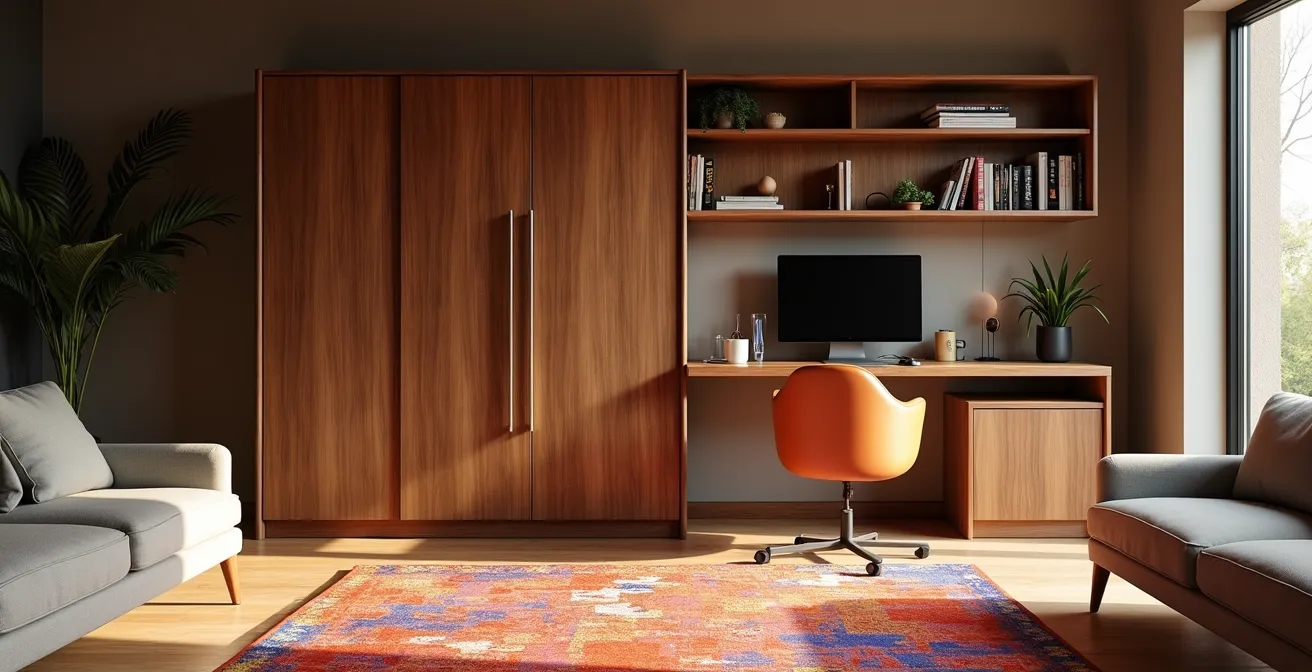
As you can see, the workstation disappears completely, and the space reverts to a pure living area. This is achieved by choosing furniture with dual identities. Consider chairs with premium, home-friendly fabrics like chenille or velvet that offer ergonomic support without the corporate mesh look. Height-adjustable tables or chairs that can transition between lounge height and desk height are also excellent budget-friendly solutions. The ultimate success lies in selecting pieces that don’t look out of place when the laptop is closed.
Ball Chair or Ergonomic Mesh: Which Is Better for 8-Hour Shifts?
The question of the “perfect” work chair in a living room is fraught with an aesthetic-versus-health debate. The playful ball chair seems like a fun, non-corporate solution, while the ergonomic mesh chair often carries the stigma of an office cubicle. However, for anyone working full-time from home, the answer is clear and uncompromising: an ergonomic mesh chair is the only sustainable choice for an 8-hour shift. The reason lies in the difference between active and passive support.
A ball chair requires active engagement; your core muscles must constantly work to keep you stable. While this is great for short bursts of 15-30 minutes to activate your muscles, it leads to muscle fatigue over a full workday, eventually causing you to slump with even worse posture. An ergonomic chair provides passive support, meaning it does the work for you by aligning your spine, supporting your lumbar region, and moving with your body. As Herman Miller research found that seated people move their torso an average of 53 times per hour, a chair that adapts to these micro-movements is essential. The following table breaks down the key differences.
| Feature | Ball Chair | Ergonomic Mesh Chair |
|---|---|---|
| 8-Hour Support | Can lead to muscle fatigue | Designed for extended sitting |
| Core Engagement | Active, requires constant effort | Passive, natural support |
| Lumbar Support | None | Adjustable lumbar support |
| Best Use Duration | 15-30 minute intervals | Full workday suitable |
| Living Room Aesthetic | Playful, doubles as ottoman | Professional, minimalist options available |
Fortunately, the aesthetic compromise is no longer as stark as it once was. Many high-end ergonomic chairs now come in a range of colors and minimalist designs that can complement a modern living room. Choosing a chair in a subtle grey, white, or even a bold color can turn it into a sculptural design element rather than an eyesore.
The Lighting Mistake That Causes Headaches for 70% of Remote Workers
We often blame our chair or desk for our physical discomfort, but one of the most common and overlooked culprits is lighting. Poor lighting doesn’t just cause eye strain and headaches; it directly degrades your posture. When your screen is too bright, too dim, or plagued by glare, you instinctively lean in, crane your neck, and hunch your shoulders to see better. This sustained, unnatural position is a primary driver of neck and shoulder pain. The solution isn’t just a single desk lamp, but a layered, sensory ergonomics approach to illumination.
The biggest mistake is relying on a single, harsh overhead light. This creates shadows and screen glare, forcing your eyes to constantly readjust. A properly lit workspace, as shown below, combines multiple sources of light to create a comfortable and balanced environment. This includes soft ambient light to raise the overall room brightness, natural light from a window when possible, and focused task lighting for your work surface.

As the image demonstrates, a comfortable workspace is softly and evenly lit. To achieve this ergonomic harmony and avoid the common lighting pitfalls, follow these essential guidelines:
- Monitor Positioning: Position the top of your monitor at or slightly below eye level. It should be about an arm’s length (20 to 30 inches) away from you to prevent leaning.
- Layer Your Light: Use natural light when you can, but always supplement it. Desk lamps with adjustable brightness and color temperature are essential for reducing muscle fatigue and encouraging an upright posture.
- Use Focused Task Lighting: An adjustable desk lamp is non-negotiable. It allows you to direct light exactly where you need it, reducing eye strain and providing focused illumination for reading documents or other tasks.
By treating light as a key ergonomic tool, you can dramatically reduce physical strain and create an environment that feels both productive and serene.
When to Move Furniture: 3 Signs Your Layout Is Restricting Your Movement
An ergonomic living room is about more than just the furniture itself; it’s about how that furniture is arranged. A movement-centric layout is one that allows for free, natural flow throughout the space, not just for navigating from the sofa to the kitchen, but for encouraging small changes in posture and position throughout the day. If your layout feels cramped or forces you into awkward paths, it is actively working against your well-being. An unobstructed path contributes not only to visual appeal but also to a more functional and less stressful living environment.
Your body will tell you when the layout is wrong. Pay attention to the subtle, and not-so-subtle, signs that your space is restricting you. Here are three critical indicators that your furniture arrangement needs an immediate adjustment:
- The “Living Room Cha-Cha”: You find yourself constantly sidestepping, shuffling, or weaving through furniture to get from one point to another. Your main pathways should be clear and direct.
- Lack of a “Flex Zone”: There is no clear, open area of at least 5×7 feet where you could comfortably do a few stretches, follow a yoga video, or simply stand and move around without bumping into things.
- Static Space Syndrome: The layout is rigid and only works for a single activity (e.g., watching TV). A good layout is adaptable and can easily accommodate different scenarios, from working at a laptop to hosting friends.
If any of these signs resonate, it’s time to rethink your layout. This doesn’t necessarily mean getting rid of furniture. Sometimes, simply rotating a sofa, moving a coffee table, or repositioning a chair can open up the space and create the pathways your body needs.
Your Ergonomic Vibe-Check: 5 Points to Audit Your Living Space
- Contact Points: List all the surfaces and seats you use for work and relaxation (sofa, desk, dining table).
- Inventory: Make a quick list of your existing furniture. What is essential? What is just taking up space?
- Coherence: Confront each piece. Does it support your health goals? Does it align with your desired style?
- Memorability & Emotion: How does the space make you feel? Is it a joyful, relaxing zone or a stressful, cramped one?
- Integration Plan: Identify one or two priority changes you can make this week to improve flow and support.
How to Layout Spotlights to Avoid “Swiss Cheese” Ceiling Syndrome?
Just as a single harsh overhead light is an ergonomic mistake, so is an army of poorly placed spotlights. This common design flaw, often called “Swiss Cheese Ceiling,” creates a grid of bright hotspots and dark voids. This uneven illumination causes glare on screens and forces your eyes to constantly adjust, contributing to eye strain and neck pain. Indeed, studies show that up to 70% of office workers report neck discomfort, with poor lighting and positioning being major factors. A strategic lighting layout is not about the number of lights, but their purpose and placement.
The solution is to move away from a uniform grid and embrace zone lighting. This interior design strategy involves thinking about your living room as a collection of functional zones—a reading nook, a conversation area, a workspace—and lighting each one appropriately. This creates layers of light that build a rich, comfortable, and visually interesting atmosphere. Instead of flooding the space with light, you paint with it. To implement a zone lighting strategy and banish the Swiss cheese look, follow these professional techniques:
- Wall Washing: Instead of pointing spotlights straight down, angle them to illuminate walls. This technique creates soft, indirect ambient light that makes the entire room feel brighter and larger without creating harsh shadows.
- Zone Grouping: Group your spotlights logically over functional areas. For example, use a cluster of three dimmable spotlights over the sofa area, a single focused one over your desk, and another to highlight a piece of art. This breaks the monotony of a grid.
- Dimmer Control: This is the most critical element. Put each lighting zone on a separate dimmer switch. This gives you complete control to transition your space from a bright, focused workspace during the day to a warm, relaxing lounge in the evening.
This approach transforms lighting from a mere utility into a powerful tool for both ergonomic comfort and sophisticated interior design.
FSC-Certified vs. Reclaimed: Which Wood Is Actually More Eco-Friendly?
As we curate a healthier living space, the materials we choose play a significant role. Wood brings natural warmth and texture, aligning with biophilic design principles that reduce stress. But when it comes to sustainability, a debate often arises between FSC-certified wood and reclaimed wood. FSC (Forest Stewardship Council) certified wood comes from responsibly managed forests, ensuring a renewable lifecycle. Reclaimed wood gives old materials a new life, diverting them from landfills. Neither is definitively “better”—the right choice depends on your priorities for health, aesthetics, and environmental impact.
From an ergonomic and health perspective, the finishes are a primary concern. Reclaimed wood can sometimes harbor lead from old paint or release volatile organic compounds (VOCs) from past treatments, impacting indoor air quality. FSC-certified wood often comes with options for low-VOC finishes, making it a more predictable choice for a healthy home. The aesthetic and functional implications also differ, as detailed in this comparison.
| Factor | FSC-Certified Wood | Reclaimed Wood |
|---|---|---|
| Indoor Air Quality | Low-VOC finishes available | Potential lead paint/VOCs from older finishes |
| Visual Impact | Clean, consistent, minimalist | Character, warmth, visible history |
| Carbon Footprint | Managed renewable lifecycle | Transport/refinishing of heavy beams |
| Ergonomic Integration | Predictable dimensions for furniture | Variable sizes may require adaptation |
| Living Room Vibe | Modern, serene aesthetic | Rustic, biophilic warmth |
Interestingly, the pursuit of ergonomic excellence and sustainability are increasingly intertwined. Many leading manufacturers are proving that you don’t have to choose one over the other. For instance, some of the most advanced modern ergonomic furniture like the Aeron chair uses over 50%+ recycled material, including ocean-bound plastic. This demonstrates a commitment to both human health and planetary health, allowing you to make a choice that feels good in every sense.
Key Takeaways
- Ergonomics is a design principle, not an aesthetic compromise; it’s the foundation of a truly usable space.
- Layered, zoned lighting is as crucial for your posture and well-being as your choice of chair.
- A successful living-work space layout should promote and encourage movement, not just accommodate static furniture.
How to Clean Velvet Upholstery Without Leaving Water Stains?
Once you’ve perfected your ergonomic and stylish setup, maintaining its beauty is paramount. Velvet is a fantastic choice for adding warmth, texture, and a touch of luxury to a living space, softening the harder lines of a desk or task chair. However, many people avoid it due to the fear of cleaning—specifically, the dreaded water stains that can crush the pile and ruin the fabric’s luster. With the right technique and by choosing the right kind of velvet, this fear is unfounded.
The key to caring for velvet is to avoid soaking the fabric and to treat it gently. For high-traffic ergonomic furniture that will see daily use, opting for “performance velvets” is a wise investment. These modern fabrics are engineered with inherent stain-resistance, making them far more durable and easy to care for than traditional velvets. For general maintenance or to tackle a spill, a professional-level approach is required to protect the delicate pile. Follow these steps to clean your velvet upholstery safely:
- Test First, Always: Before applying any cleaning solution, even water, test it on a hidden spot first, like under a cushion or on the back of the furniture, to ensure it doesn’t cause discoloration.
- Use Steam and a Soft Brush: For reviving a flattened pile or dealing with minor dirt, a steamer held several inches away from the fabric can work wonders. Gently brush the pile in its natural direction with a soft-bristled brush afterwards. This lifts the fibers without crushing them.
- Choose Performance Fabrics: For your primary seating, proactively choose performance velvets. Their built-in resistance to stains and crushing makes them the ideal choice for furniture that needs to be both beautiful and functional for daily ergonomic use.
By treating your upholstery with care and making smart material choices from the start, you ensure that your stylish and comfortable living room remains that way for years to come.
Ready to transform your living room into a sanctuary of style and well-being? Start by auditing your current layout with these principles in mind and build a space that truly supports you in every way.