
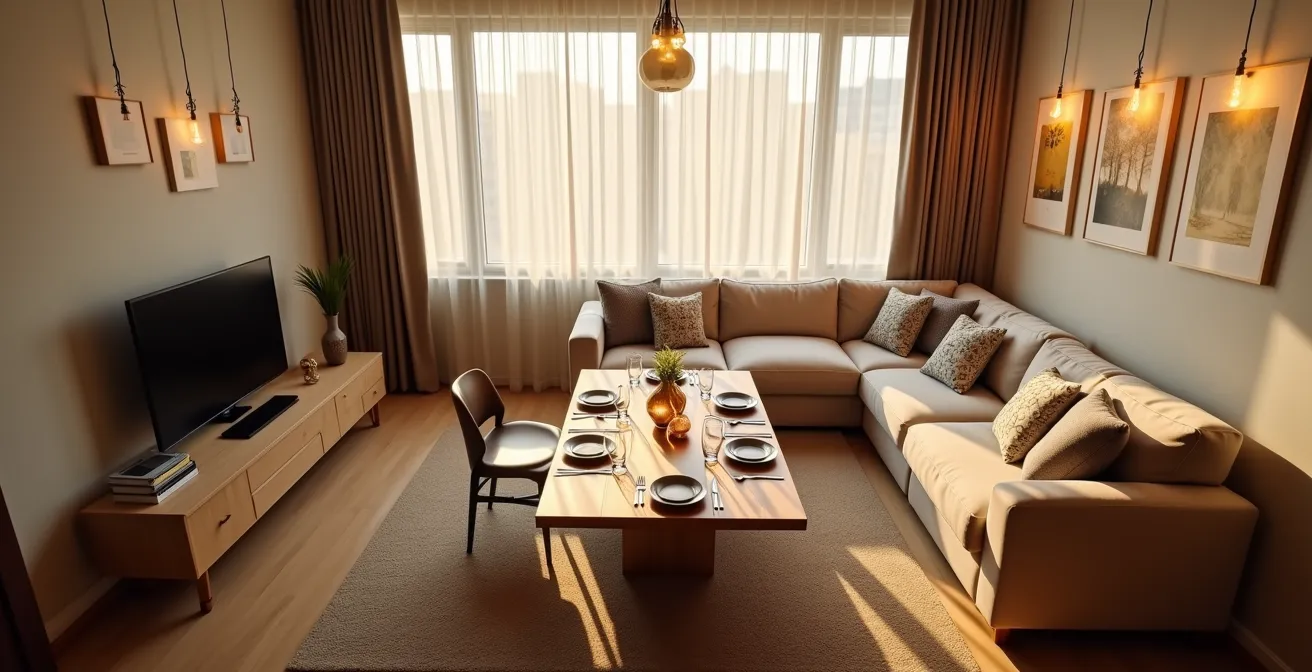
Hosting a large dinner party in a small space isn’t about compromise; it’s about treating your home as a reconfigurable architectural system.
- Static furniture is the enemy of social space. Modular, kinetic pieces create “spatial elasticity,” allowing a room’s function to expand and contract on demand.
- True space optimization is three-dimensional, using vertical lines and hidden storage to maximize “volumetric potential” instead of just floor area.
Recommendation: Stop thinking about buying more furniture and start thinking about investing in an integrated system where every piece serves at least two functions—from working to dining to sleeping.
The dream of a vibrant urban life often clashes with the reality of a 500-square-foot apartment. For those who refuse to let a small floor plan dictate their social life, the challenge is constant: how do you host a proper dinner party for eight when your dining table is also your desk and your living room is also your bedroom? The typical advice feels like a collection of compromises: serve buffet-style, buy flimsy folding chairs, or simply ask guests to cram together on the sofa. These are temporary fixes, not elegant solutions.
These common “hacks” fail to address the core architectural problem. They treat furniture as static obstacles to be worked around rather than as dynamic tools for spatial transformation. We’ve been taught to think about rooms with fixed purposes—a dining room for eating, a living room for relaxing. But in a micro-apartment, this thinking is a luxury we can’t afford. The space must be fluid, capable of shifting its function entirely within minutes.
What if the key isn’t just to hide clutter or buy a smaller coffee table, but to fundamentally rethink the relationship between your space and the objects within it? This guide moves beyond simple tips and introduces an architect’s perspective on micro-living. We will explore how to implement a modular system where your furniture becomes a kinetic, adaptable toolkit. By embracing concepts like programmatic overlap and spatial elasticity, you can unlock your apartment’s true potential, making it a place that effortlessly hosts both your workday and your dinner party.
This article provides a blueprint for transforming your small space. We will dissect the strategic decisions behind choosing and maintaining modular systems, from selecting the right layout to building your own custom components, ensuring your home is always ready for company.
Summary: The Complete Modular Strategy for Small-Space Entertaining
- How to Hide a Full Ergonomic Workstation in a Shared Living Space?
- How to Make 8-Foot Ceilings Look Like 10-Foot Ceilings Using Vertical Lines?
- L-Shape or U-Shape: Which Modular Layout Maximizes Seating in Narrow Rooms?
- How to Build Custom Modular Storage Blocks for Under $150?
- Why Do Cheap Murphy Beds Fail After Only 3 Years of Daily Use?
- The Maintenance Error That Ruins Modular Mechanisms within 12 Months
- Moving Day: How Modular Furniture Saves You 40% on Moving Truck Space
- The “Packing Party” Method: How to Reset Your Home Inventory in One Weekend
How to Hide a Full Ergonomic Workstation in a Shared Living Space?
The primary conflict in any micro-apartment is the battle between professional life and personal life, often fought over the same few square feet. A permanent desk setup devours valuable social real estate, while constantly working from the sofa is an ergonomic nightmare. The solution lies in programmatic overlap: designing a single zone to flawlessly perform multiple functions. This is achieved not by compromise, but by concealment through transformative furniture.

The Murphy desk, a modern descendant of the classic Murphy bed, is a prime example of this principle. When closed, it presents as a slim, elegant wall cabinet, a bookshelf, or a simple decorative surface. Its presence is unobtrusive, returning the visual and physical space to the living area. Yet, with a simple motion, it unfolds into a full-sized, ergonomic workstation. This isn’t just about saving space; it’s about a psychological shift. When the workday is done, the physical act of closing the desk signals a definitive end, allowing the room—and your mindset—to transition fully into a mode of relaxation and entertainment.
This concept extends beyond desks. As one savvy urban dweller noted about their own solution for Apartment Therapy, “I found this gorgeous little expanding console table. I love that this table takes up a tiny footprint while hiding our dinner party potential in plain sight.” Whether it’s a console that expands into a dining table or a desk that vanishes into a wall, the goal is to equip your space with kinetic potential. The furniture itself becomes an active participant in the room’s daily transformation, ensuring no single function permanently dominates your limited square footage.
How to Make 8-Foot Ceilings Look Like 10-Foot Ceilings Using Vertical Lines?
In a small apartment, the sense of confinement often comes from a low ceiling, not a limited floor plan. An 8-foot ceiling can feel oppressive, but this is a perceptual problem that can be solved with architectural illusions. The key is to draw the eye upward, creating a sense of height and airiness that defies the physical measurements of the room. This is achieved by maximizing your volumetric potential through the strategic use of strong vertical lines.
Forget horizontal patterns and low-slung furniture. Instead, think vertically. Tall, narrow bookshelves that reach toward the ceiling, floor-to-ceiling curtains hung just below the ceiling line (not at the top of the window frame), and tall, slender floor lamps all create powerful vertical vectors that trick the brain into perceiving more height. Even the way you arrange art can contribute; a vertical gallery wall of smaller frames is more effective than a single large, wide piece of art. The goal is to create an uninterrupted upward visual journey.
Lighting is a critical tool in this endeavor. Instead of relying on a single overhead fixture that flattens the space, use multiple light sources at different heights. One highly effective and affordable strategy involves using paper lanterns. As noted in a clever small-space hack, “For under $30, you can get a large paper lantern and plug-in socket with ceiling hooks.” By hanging these at varying heights, you create a floating, layered effect that adds depth and breaks up the flat plane of the ceiling. Hanging mirrors strategically can further enhance this by reflecting light and the newly created vertical lines, making the room feel both taller and wider.
L-Shape or U-Shape: Which Modular Layout Maximizes Seating in Narrow Rooms?
The largest piece of furniture in a living area—the sofa—is the anchor of your social space. In a modular system, its configuration is not a permanent decision but a strategic choice that dictates traffic flow and conversation dynamics. For narrow rooms, typically found in urban apartments, the debate between an L-shape and a U-shape layout is critical. The choice directly impacts the room’s ability to feel open versus feeling cramped.
An L-shape configuration is almost always superior for narrow spaces. It keeps one corner of the room open, preserving a natural pathway for movement and preventing the feeling of being “trapped” by furniture. This layout also encourages the formation of multiple, smaller conversation zones, which is ideal for a party where guests mingle. A U-shape, by contrast, tends to close off the room, creating a single, rigid focal point and blocking central movement. While it may technically offer one more seat, it does so at the cost of the room’s perceived size and flexibility.
The following table breaks down the spatial logic for modular sofa configurations in small apartments, highlighting why the L-shape offers greater adaptability.
| Configuration | Best Room Size | Traffic Flow | Social Dynamic | Flexibility Score |
|---|---|---|---|---|
| L-Shape | 400-600 sq ft | Preserves corner pathway | Multiple conversation zones | 8/10 |
| U-Shape | 600+ sq ft | Blocks central movement | Single focal point | 5/10 |
The power of smart layout was demonstrated by Noah, who successfully hosted 28 people in his 475-square-foot Chicago studio. His key move was removing the central coffee table entirely, proving that creating open congregation space is more valuable than providing extra surfaces. A modular L-shape sofa allows for this kind of dynamic reconfiguration; pieces can be separated to create even more seating or pushed to the walls to maximize standing room.
How to Build Custom Modular Storage Blocks for Under $150?
Off-the-shelf modular furniture provides a great starting point, but a truly integrated system often requires custom-built elements to perfectly fit the unique constraints of your space. Building your own modular storage blocks is not only cost-effective but allows you to create pieces with precise, multi-functional capabilities. These blocks can serve as ottomans, extra seating, side tables, or be grouped together to form a coffee table, then be reconfigured or stored away during a party.
The design principle is simple: create a set of standardized, lightweight cubes that can be endlessly rearranged. Using lightweight plywood is essential, as it allows for easy reconfiguration even during a party. The key is to design them to a standard ottoman height of 16-18 inches, making them instantly useful as comfortable seating. For a professional finish, applying iron-on veneer edge banding conceals the raw plywood edges, elevating the look from a DIY project to a piece of custom furniture.
Inspiration from a Barcelona Micro-Apartment
A family in a 215-square-foot Barcelona apartment utilized a built-in wooden modular system to create a livable, social space. The system included hidden storage compartments above a balcony where extra dining chairs and table sections could be stored, allowing them to host up to eight dinner guests. This demonstrates the power of integrating custom storage designed specifically for your entertaining needs.
To maximize their utility, these custom blocks should be designed for mobility and hidden storage. Adding hidden casters on two sides (not all four, to prevent them from rolling away too easily) allows for quick repositioning. Including internal dividers turns each block into an organized storage unit for party supplies like napkins, coasters, or even extra glassware. This approach embodies the spirit of programmatic overlap: your seating is also your storage, and your table is also your ottoman.
Why Do Cheap Murphy Beds Fail After Only 3 Years of Daily Use?
A Murphy bed is the ultimate expression of spatial transformation, turning a bedroom into a living room with a single movement. However, this kinetic power depends entirely on the quality and integrity of its mechanical system. Choosing a cheap Murphy bed is a critical, and often dangerous, mistake. The constant stress of daily use exposes weaknesses in low-grade materials and engineering, leading to catastrophic failures long before they should.
The core of the problem lies in the lifting mechanism—either pistons or springs—and the mounting hardware. In cheaper models, these components are built with inferior metals and weaker seals. The pistons lose pressure, the springs warp, and the frame itself can detach from the wall. This isn’t just an inconvenience; it’s a significant safety hazard. In fact, CPSC recall data from 2022 documented 146 bed failures that resulted in 62 injuries, including crushing and impact hazards. These failures often occur because the mechanism is not properly balanced for the weight of the mattress or the anchoring hardware is insufficient for the forces exerted during operation.
Investing in a high-quality Murphy bed means investing in a precisely engineered counter-balance system and robust steel components. A well-made mechanism should feel almost weightless during operation and be able to hold the bed securely at any angle without drifting up or down. To ensure the longevity and safety of any wall bed, a regular inspection is non-negotiable.
Action Plan: 5-Point Murphy Bed Mechanism Inspection
- Wall Mounting Security: Confirm the bed is securely anchored into wall studs, not just drywall, by attempting to gently rock the cabinet. There should be zero movement.
- Piston/Spring Condition: Visually inspect gas piston seals for any signs of oil leaks or physical damage. For spring systems, check for visible corrosion or over-stretching.
- Balance Test: Lower the bed halfway and let go. It should remain in position without drifting up or down, indicating the tension is correctly balanced for your mattress weight.
- Weight Limit Verification: Double-check the manufacturer’s specified weight limit and compare it to the weight of your mattress. An overweight mattress is the leading cause of mechanism strain.
- Safety Lock Function: If your bed has a safety lock to prevent accidental closure, engage and disengage it to ensure it operates smoothly and locks securely.
The Maintenance Error That Ruins Modular Mechanisms within 12 Months
Modular and transforming furniture is a system of moving parts, and like any mechanical system, it is susceptible to failure from neglect. The single most common maintenance error is not dramatic abuse, but the slow, insidious buildup of dust and debris within the joints, hinges, and pivots. Homeowners often focus on visible surfaces, forgetting that the true functionality of their investment lies in these hidden mechanisms.
Over a period of just 12 months, household dust, pet hair, and microscopic particles can accumulate inside these tight-tolerance components. This debris acts like sandpaper, causing abrasive wear every time the furniture is transformed. It grinds away at protective coatings, accelerates corrosion, and can eventually cause joints to seize or misalign. A squeaking hinge is not a minor annoyance; it’s an audible warning that the mechanism is operating under strain and without proper lubrication.

As the Sleepopolis review team notes, “Torsion springs may squeak after some time and usually have to be tightened once every several years.” This highlights that even high-quality systems require periodic attention. The solution is simple but requires discipline: a quarterly maintenance routine. This involves using a can of compressed air to blow out all visible joints and pivot points, followed by wiping them down with a dry microfiber cloth. For mechanisms specified by the manufacturer, a small application of the recommended lubricant (often silicone-based) will keep the motion smooth and prevent wear.
Key Takeaways
- Your apartment’s potential is defined by the adaptability of its contents, not its square footage.
- Every piece of furniture should serve at least two functions; if it only does one thing, it’s taking up too much space.
- Longevity and safety in modular systems come from quality engineering and disciplined maintenance, not a low price tag.
Moving Day: How Modular Furniture Saves You 40% on Moving Truck Space
A significant, often overlooked, benefit of committing to a modular furniture system is its profound impact on mobility. For the modern urban dweller, moving is a frequent reality. Traditional, monolithic furniture—heavy sofas, solid wood dressers, and large bed frames—are the bane of moving day. They are awkward to maneuver through tight hallways, require larger moving trucks, and are often damaged in transit. Modular furniture, by its very nature, solves this logistical nightmare through systemic deconstruction.
Instead of a single, massive sofa, you have a collection of manageable blocks. A large shelving unit breaks down into individual components. A bed frame can be disassembled into compact pieces. This allows for a much denser, more efficient packing strategy in a moving truck, akin to a real-life game of Tetris. By eliminating the empty, un-fillable voids created by bulky furniture, it’s possible to reduce the required truck size significantly, often saving up to 40% on truck rental and moving costs. This trend is a key driver of market growth, as the global Murphy bed market forecast shows an increasing demand for space-saving, and by extension, mobile-friendly solutions.
This advantage extends beyond cost savings. It reduces the risk of damage to both the furniture and the buildings you’re moving in and out of. Each component is lighter and easier for one or two people to carry, decreasing the likelihood of drops, scraped walls, and personal injury. In essence, choosing modular furniture is a long-term investment in a more agile and less stressful lifestyle. You are not just buying furniture for your current apartment; you are investing in a flexible system that can adapt and move with you to your next one.
The “Packing Party” Method: How to Reset Your Home Inventory in One Weekend
Before you can reconfigure your modular space for a dinner party, you must first reclaim it from daily clutter. The “Packing Party” method, a concept popularized by minimalist thinkers, is a radical but highly effective way to quickly audit and reset your home’s inventory. It’s not about tidying up; it’s a systematic purge designed to prepare your space for its transformation into an entertainment venue. The principle is simple: you pack up everything as if you were moving.
About 48 hours before your event, take every non-essential item from every surface—books, decorative objects, mail, knick-knacks—and put them into boxes. Label each box with a “6-month review date.” This creates an immediate, clean slate. The visual and physical “noise” of your daily life is gone, revealing the pure architectural volume you have to work with. Anything you find you truly need over the next few days can be unpacked. Anything still in the box after six months can likely be donated or discarded.
This process is crucial for maximizing your modular setup. With all surfaces cleared, you can see the space’s true potential. It’s the perfect time to test your planned party layout. Move the modular sofa pieces, set up the expandable table, and arrange your custom storage blocks to ensure traffic flows smoothly. It’s far better to discover a layout is awkward or impractical now than when your guests are arriving. This pre-party protocol ensures that on the day of the event, your only task is final setup, not a frantic last-minute decluttering.
Now that you have a complete system—from selecting the right pieces to preparing the space—you are no longer limited by your square footage. You have an architectural toolkit that allows your home to expand and contract with your social life. The next step is to put this plan into action and send out those dinner invitations.
Frequently Asked Questions on Small Space Design
How do mirrors create the illusion of height?
Hanging mirrors strategically can create the illusion of more space. Aim to place them where they will reflect a light source or a window. This bounces light around the room and reflects the view, making the space feel more airy, open, and taller than it actually is.
What’s the ideal furniture arrangement for vertical emphasis?
The ideal arrangement creates open, unobstructed pathways. Avoid placing furniture in a way that blocks movement through the room. For social events, arranging seating in a semi-circle or in small, distinct groups helps facilitate conversation far better than a single, large block of seating.
How can I use vertical storage during parties?
Leverage your vertical space for guest needs. Clear a few shelves on a bookshelf to create a designated spot for bags. Install stylish, high-quality wall-mounted hooks in an entryway for coats. This keeps guest belongings organized and off your precious seating and floor space.