
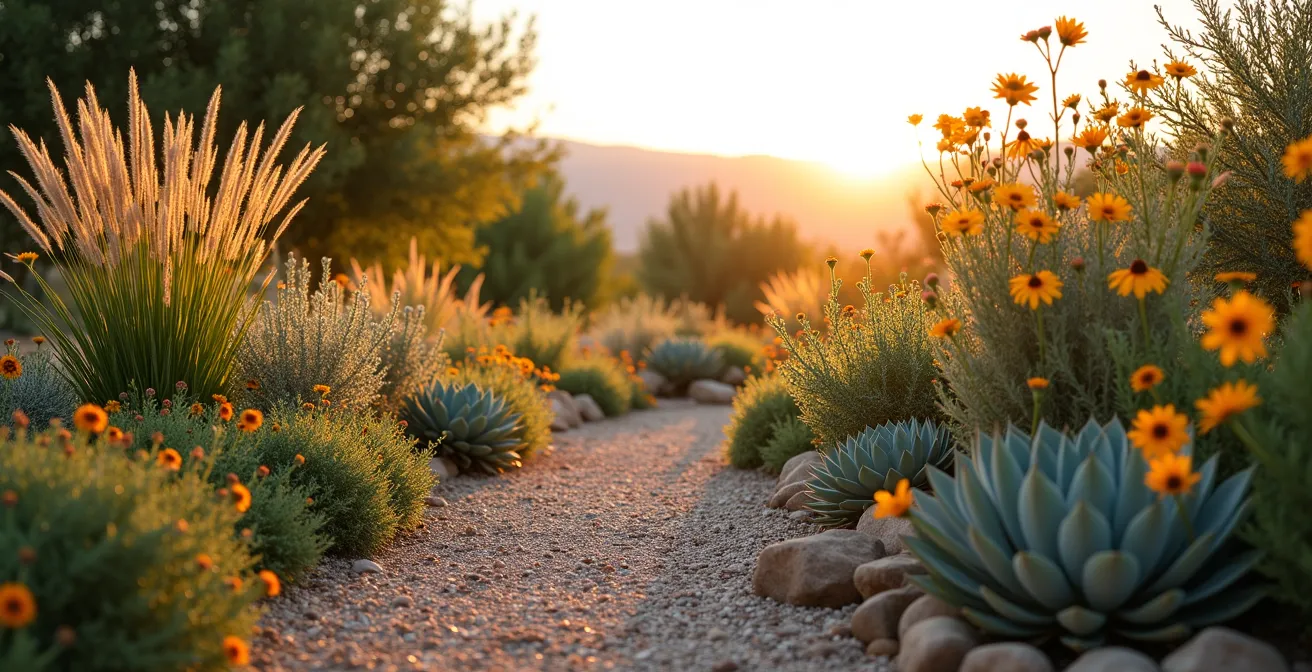
The common belief that a drought-proof garden is just a collection of hardy plants is fundamentally flawed; true resilience comes from engineering a self-sufficient ecosystem.
- Your soil’s ability to act as a natural “sponge” is more critical than your watering schedule.
- Strategic design, like mass planting and greywater recycling, can automate maintenance and drastically cut water needs.
Recommendation: Stop fighting the climate and start thinking like an ecosystem engineer. Focus on building deep, living soil first, and the rest of your garden’s resilience will follow.
For any homeowner in a dry climate, the cycle is painfully familiar: you invest time and money into a beautiful lawn and garden, only to watch it wither under the relentless summer sun. The water bills skyrocket, and the landscape still looks stressed and barren. The common advice is to plant succulents, add some mulch, and water less frequently. But these are just patches on a leaky system. What if you could create a garden that not only survives but actually thrives through a three-week heatwave with little to no watering?
The secret isn’t in finding a magical, unkillable plant. It lies in a radical shift in perspective. Instead of treating your garden as a collection of individual plants to be kept alive, you must approach it as an interconnected, self-sufficient ecosystem. The key is not just to tolerate drought but to actively engineer resilience from the ground up. This means transforming your soil into a massive water reservoir, designing plant communities that support each other, and integrating your garden into your home’s entire water cycle.
This guide moves beyond the generic tips. We will deconstruct the common mistakes that sabotage water-wise efforts, explore the science behind truly efficient watering, and provide actionable strategies to build a lush, beautiful, and profoundly resilient landscape. We will delve into plant selection, soil chemistry, and automated systems that work with nature, not against it, to create a garden that frees you from the tyranny of the hose.
This article provides a complete roadmap to re-engineering your landscape for extreme climate resilience. Follow along as we dissect each component of a truly water-free garden, from the soil foundation to automated maintenance strategies.
Summary: How to Create a Lush Garden That Survives a 3-Week Heat Wave Without Water?
- Aloes or Agaves: Which Succulent Survives Freezing Winter Temps?
- Drip Line vs. Soaker Hose: Which Saves More Water for Vegetable Beds?
- Why Adding Sand to Clay Soil Is a Concrete Mistake (And What to Use Instead)
- The “Defensible Space” Strategy: Plants to Avoid Near Your House in Wildfire Zones
- How to Design a Xeriscape That Doesn’t Look Like a Desert Wasteland
- Aerators: How to Save 30% on Water Without Losing Shower Pressure?
- How to Test Your Soil pH at Home Without a Lab Kit?
- How to Automate Your Garden Maintenance to Save 5 Hours a Week?
Aloes or Agaves: Which Succulent Survives Freezing Winter Temps?
The first step in ecosystem engineering is strategic plant selection, and for succulents, it’s about more than just aesthetics. Aloes and Agaves are both xeriscaping cornerstones, but they play vastly different roles in a resilient garden, especially when facing temperature extremes. While both handle heat, their winter hardiness is a critical differentiator. Most common Aloes are sensitive to hard freezes, tolerating temperatures down to about 20-25°F. In contrast, many Agave species, particularly those from high-altitude deserts, are incredibly robust, surviving dips to 10-15°F or even lower.
This difference dictates their placement and function. An Agave can serve as a bold, permanent sculptural element in an exposed part of the garden, while an Aloe may need the protection of a south-facing wall or overhang to survive the winter. Furthermore, their life cycles diverge dramatically. Agaves are monocarpic, meaning they die after a single, spectacular bloom, requiring removal and succession planning. Aloes are perennials that clump and spread, providing stable, long-term ground cover. Choosing between them is a strategic decision based on your specific microclimates and long-term design goals.
To make the most informed choice, a direct comparison is invaluable, as detailed in a recent analysis of xeriscaping succulents.
| Feature | Aloes | Agaves |
|---|---|---|
| Minimum Temperature Tolerance | 20-25°F (-6 to -4°C) | 10-15°F (-12 to -9°C) |
| Life Cycle | Perennial, clumping growth | Monocarpic (terminal bloom) |
| Maintenance After Bloom | Continues growing, produces offsets | Dies after flowering, requires removal |
| Best Microclimate Placement | Protected areas, near walls | Open areas with good drainage |
| Architectural Impact | Soft, flowing forms | Bold, sculptural statements |
Drip Line vs. Soaker Hose: Which Saves More Water for Vegetable Beds?
Efficient water delivery is the circulatory system of your garden ecosystem. While both drip lines and soaker hoses are improvements over wasteful sprinklers, they are not created equal, especially for maximizing water use in vegetable beds. A soaker hose, made of porous material, “weeps” water along its entire length. This is inefficient as it waters the gaps between plants and loses significant moisture to surface evaporation. A drip line, by contrast, uses precisely placed emitters to deliver water directly to the root zone of each plant. This eliminates surface evaporation and ensures every drop is available to the plant.
The real game-changer is Subsurface Drip Irrigation (SDI), where the drip line is buried 4-6 inches deep. This method encourages roots to grow deeper in search of water, creating a more extensive and drought-resilient root system. As a case study in Texas demonstrated, SDI systems can create gardens that survive extended heatwaves by delivering water directly to the deep soil, making plants profoundly more resilient. This technique turns your watering system from a simple life-support tool into an active driver of plant resilience.
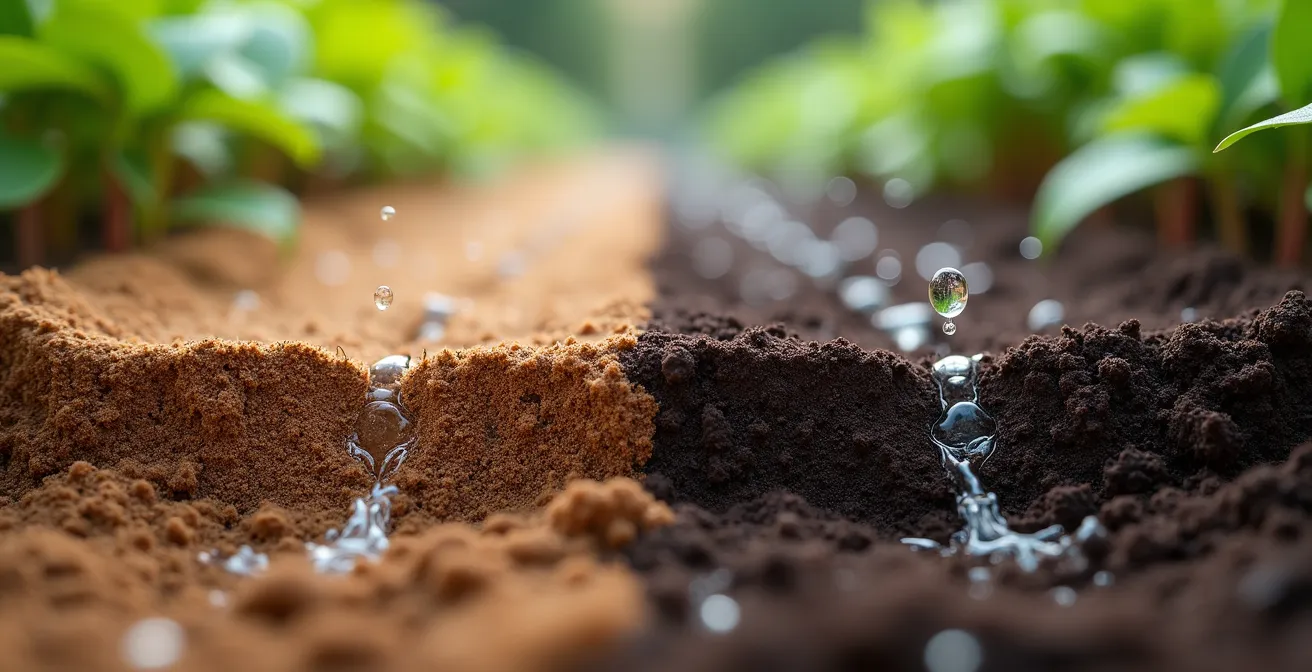
As this visualization shows, the way water penetrates the soil is critical. In sandy soil, water from a drip emitter moves downward quickly, requiring slower flow rates to prevent waste. In heavy clay, water spreads laterally, allowing for wider emitter spacing. Understanding this interaction is key to designing an efficient system.
Why Adding Sand to Clay Soil Is a Concrete Mistake (And What to Use Instead)
The foundation of a water-resilient garden is the soil. Many gardeners with heavy, dense clay soil make a critical error: they add sand, hoping to improve drainage. This is a recipe for disaster. Mixing fine clay particles with coarse sand particles creates a substance akin to low-grade concrete, worsening compaction and drainage. You cannot fix a mineral problem (particle size) by adding another mineral. The solution is biological.
The only way to transform clay into a rich, absorbent “soil sponge” is by adding massive amounts of organic matter. This feeds microbial life, which in turn builds soil structure, creating air pockets for drainage and spongy humus that retains moisture. The most effective method is “sheet mulching” or lasagna gardening. By layering materials like cardboard, wood chips, and compost directly on top of the clay, you create a slow-motion compost pile that earthworms and microbes will incorporate into the soil below, building structure and fertility over time without any tilling.
Case Study: Bio-Drilling with Cover Crops
Another powerful, low-effort technique is using “bio-drilling” cover crops. Plants like daikon radishes grow massive taproots that mechanically break up compacted clay. When they die back in winter, the roots decompose in place, leaving behind deep channels for water and future plant roots. As research from Pennsylvania State Extension highlights, even drought-tolerant plants need a season to establish deep roots. Bio-drilling creates the ideal conditions for this deep root establishment, dramatically improving drainage and water access without any physical soil disturbance.
The “Defensible Space” Strategy: Plants to Avoid Near Your House in Wildfire Zones
In many dry climates, engineering a resilient ecosystem includes planning for wildfire. The “Defensible Space” concept is a non-negotiable layer of garden design, especially in the 0-5 foot zone immediately surrounding your home, known as the Home Ignition Zone. In this critical area, plant choice is dictated by fire resistance, not aesthetics. The goal is to eliminate any “fuel ladders” that could carry a ground fire to your walls or eaves.
This means you must avoid highly flammable plants. These typically include plants with high contents of oils or resins (like juniper, cypress, and rosemary), fine, twiggy growth, or a tendency to accumulate dead leaves and needles. Instead, this zone should be dominated by hardscaping (pavers, gravel) and carefully selected, high-moisture plants. Low-growing succulents like Sedum or ice plant are excellent choices, as their fleshy leaves retain water and resist ignition. Any plants in this zone must be impeccably maintained, kept well-hydrated, and spaced far apart.
Proper hydration is key, and mulch plays a dual role. While a 2-3 inch layer of organic mulch is excellent for retaining soil moisture and keeping plants hydrated (and thus less flammable), combustible mulches like pine needles or fine bark should never be used directly against a structure. In the immediate 0-18 inch zone, non-combustible gravel or pavers are the only safe choice.
How to Design a Xeriscape That Doesn’t Look Like a Desert Wasteland
A common fear holding people back from xeriscaping is the image of a barren, rocky landscape with a few lonely cacti. This is a failure of design, not a limitation of the method. A well-designed xeriscape can be lush, vibrant, and full of texture and color. The key is to abandon the “one of everything” planting style and embrace mass planting and layering.
Instead of dotting single plants around, group them in large drifts of 5, 7, or more of the same species. This creates a powerful visual impact and a cohesive look. More importantly, it’s a water-saving strategy. As a California demonstration garden showed, placing plants closer together helps shade the soil, creating a living mulch that can reduce water evaporation and weed growth by up to 30%. This mutual support system is a core principle of ecosystem engineering.
The second principle is to use dramatic texture and color contrasts. Pair the bold, architectural forms of Agaves with the soft, flowing plumes of ornamental grasses. Use the fine, silvery foliage of Artemisia to highlight the deep green of a succulent. Repeat a single color—like the vibrant purple of a Salvia or the yellow of a Coreopsis—in drifts throughout the garden to create rhythm and unity. This thoughtful combination of form, texture, and color is what transforms a collection of drought-tolerant plants into a stunning, resilient landscape.

Aerators: How to Save 30% on Water Without Losing Shower Pressure?
A truly resilient landscape is part of a whole-property water conservation strategy. The water you save indoors can directly translate to resources for your garden. While the title mentions aerators, the larger concept is conducting a whole-property water audit to identify savings that can fund your garden’s water budget. Installing low-flow aerators on faucets and showerheads is the easiest first step, often saving thousands of gallons per month without a noticeable change in pressure.
This saved water represents a “resource” you can re-allocate. For example, a Colorado State University study found that comprehensive xeriscaping can lower outdoor water use by 30-50% or more. The money saved on your water bill from indoor conservation can be used to purchase compost or smart irrigation controllers, while the saved water itself can be harvested. The most powerful strategy for this is a greywater system, which redirects gently used water from your laundry machine to your landscape.
A simple laundry-to-landscape system is a prime example of resourceful ecosystem engineering. It turns a waste stream into a valuable asset, providing consistent moisture to establish fruit trees and large shrubs, further drought-proofing your landscape at no additional cost. This is a practical, high-impact project for any resilient homeowner.
Your Action Plan: Simple Laundry-to-Landscape Greywater System Setup
- Check local codes: Many areas allow laundry greywater diversion without permits for volumes under 250 gallons per day.
- Install a 3-way diverter valve: Place this on your washing machine’s discharge pipe to easily switch between the sewer and your new landscape line.
- Run tubing to mulch basins: Use 1-inch polyethylene tubing to direct the water to mulch basins around fruit trees or large shrubs (never on root vegetables or leafy greens).
- Create mulch basins: Dig basins 6-8 inches deep and 3-4 feet wide around each plant to contain, distribute, and filter the greywater.
- Use plant-safe detergents: Switch to plant-based, low-sodium, and boron-free laundry detergents to protect soil health and plant roots.
How to Test Your Soil pH at Home Without a Lab Kit?
Beyond its structure, your soil’s chemistry profoundly impacts your garden’s resilience. Soil pH, the measure of acidity or alkalinity, is a master variable that controls nutrient availability. If the pH is wrong for a particular plant, it can’t access essential nutrients no matter how much you fertilize, leading to stress and weakness. During a heatwave, this stress is amplified. Research shows that plant growth slows dramatically when temperatures exceed 86°F, and a plant struggling with nutrient lockout due to improper pH is far more likely to fail.
While lab tests are precise, you can get a good reading of your soil’s pH using low-tech, resourceful methods. The first is to become a “weed reader.” Certain plants thrive in specific pH ranges and can act as natural indicators. The presence of sorrel or plantain often points to acidic, compacted soil, while chickweed suggests rich, neutral soil. Learning to read these signals is a key skill for the ecosystem-minded gardener.
This table of common indicator plants can help you decode your soil’s messages without any equipment.
| Weed/Plant Present | Soil Condition Indicated | pH Range | Action Needed |
|---|---|---|---|
| Plantain | Compacted soil | 6.0-7.0 | Deep aeration, add organic matter |
| Sorrel | Acidic soil | Below 5.5 | Add lime or wood ash gradually |
| Chickweed | High nitrogen, neutral pH | 6.5-7.5 | Reduce nitrogen inputs |
| Dandelions | Compacted, acidic | 5.5-6.5 | Aerate and amend pH |
| Clover | Low nitrogen | 6.0-7.0 | Natural nitrogen fixer – beneficial |
For a more direct test, you can use common household items. Simply mix a soil sample with distilled water and vinegar. If it fizzes, your soil is alkaline. If it fizzes when mixed with baking soda, it’s acidic. No reaction in either test suggests a neutral pH.
Key Takeaways
- A garden’s heatwave survival depends on a deep, living “soil sponge,” not just drought-tolerant plants.
- Targeted water delivery (drip) and recycling (greywater) are more effective than simply reducing water volume.
- Smart design—using mass plantings, hydrozones, and fire-resistant principles—creates a resilient ecosystem that is also beautiful.
How to Automate Your Garden Maintenance to Save 5 Hours a Week?
The ultimate goal of ecosystem engineering is to create a garden that largely maintains itself. This is “passive automation,” where smart design choices do the work for you, saving hours of weekly maintenance. This isn’t about high-tech robots; it’s about aligning with natural processes so that weeding, watering, and deadheading become nearly obsolete.
The first step is heavy mulching. A 4-6 inch layer of arborist wood chips is the single best tool for passive automation. It suppresses up to 95% of weeds, eliminating the need for constant pulling. It also retains massive amounts of soil moisture, drastically reducing the need to water mature plants. The second is plant selection. Choosing “self-cleaning” perennials like Salvia, Catmint, or ornamental grasses that don’t require deadheading saves hours of tedious work. As one demonstration garden showed, combining these plants with passive water harvesting features like swales can nearly eliminate active maintenance tasks.
Finally, intelligent design like hydrozoning—grouping plants with similar water needs together—simplifies irrigation dramatically. Instead of a complex system with a dozen zones, you might only need one or two for your entire landscape. Once established (typically after 1-2 seasons), many of these zones can be taken off irrigation entirely, relying solely on rainfall and the moisture stored in your healthy soil sponge. This is the pinnacle of a resilient system: a beautiful garden that thrives on its own intelligent design.
By shifting your thinking from a plant collector to an ecosystem engineer, you can create a vibrant, lush garden that not only survives extreme heat but thrives with minimal intervention. Start by assessing your soil and commit to building its capacity to hold water; every other element of your resilient garden will grow from there.