
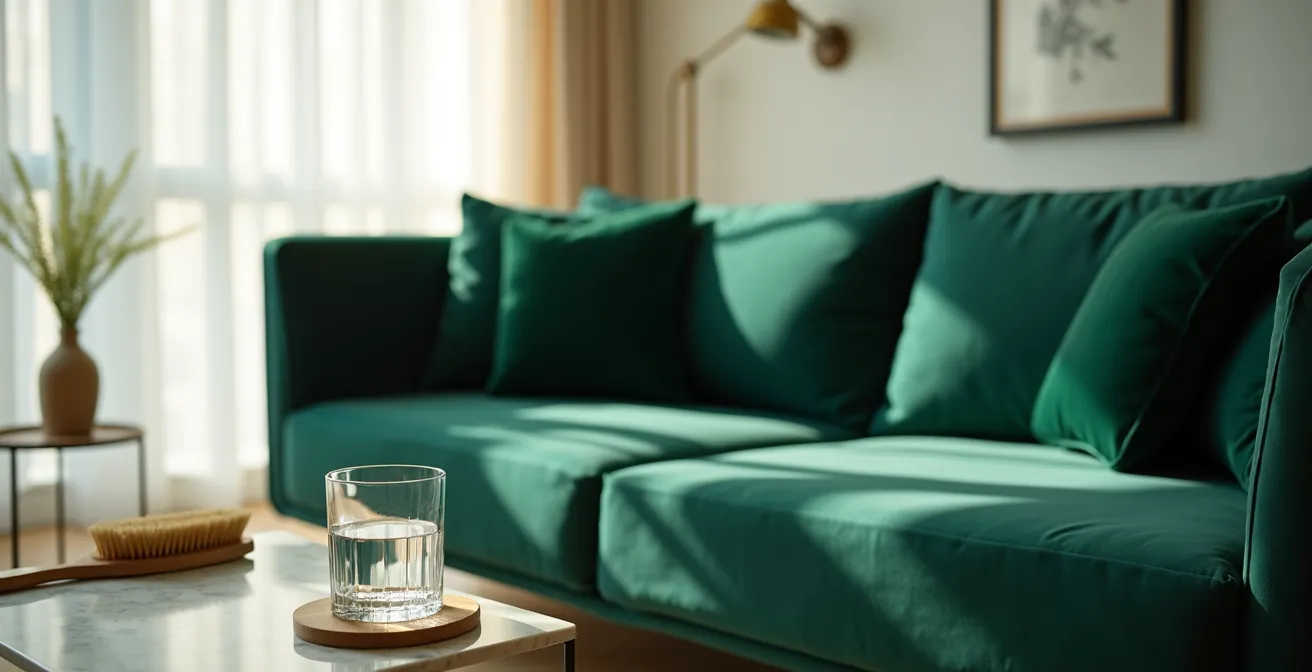
Effective velvet care isn’t about finding a magic cleaning product; it’s about preventing damage by understanding the fabric’s structural vulnerability to water.
- Natural velvet fibers are highly absorbent and can be permanently altered by water, unlike synthetics.
- The correct response is immediate, precise blotting and controlled drying, never aggressive rubbing or saturation.
Recommendation: Before any cleaning, always perform a colorfastness and pH test in an inconspicuous area. This is the cardinal rule of professional upholstery maintenance.
The moment a drop of liquid lands on your new velvet sofa, a sense of panic can set in. You have likely heard the standard advice: “blot, don’t rub.” While correct, this instruction is dangerously incomplete. For the discerning homeowner, managing fine furnishings is not about memorizing generic tips; it is about establishing a professional system of care. The fear of causing irreparable damage—a water ring on silk velvet, an etch mark on a marble countertop—is justified, but it can be replaced with the confidence that comes from knowledge.
The principles of a five-star hotel’s housekeeping are not based on frantic reactions, but on a deep understanding of material integrity. This guide moves beyond simple cleaning recipes to establish a system of professional-grade preventative care and precise intervention. The goal is to preserve the beauty, feel, and value of your most delicate investments, not merely to clean them. We view each material not as a surface to be scrubbed, but as a complex structure to be understood and maintained with precision.
We will begin with the immediate challenge of velvet and its unique relationship with water. From there, we will broaden our scope to establish the core principles for managing a range of other high-value surfaces, from stone and leather to brass and performance fabrics. You will learn not just *what* to do, but *why* you are doing it—the foundational knowledge that separates amateur cleaning from professional preservation.
This article provides a comprehensive overview of the protocols required to maintain a luxury home. The following sections break down the essential knowledge, from understanding material science to making cost-effective decisions for long-term care.
Summary: How to Clean Velvet Upholstery Without Leaving Water Stains?
- Why Marble Etches: The Chemistry Lesson That Saves Your Countertops
- Leather or Performance Fabric: Which Survives Cat Claws Better?
- The 15-Minute “Fake Clean” Protocol Before Guests Arrive
- Scratched Brass: When to Polish It and When to Leave It Alone?
- How to Reduce Household Dust by 50% With One HVAC Change?
- Solution-Dyed Acrylic vs. Polyester: Is Sunbrella Worth the Extra Cost?
- Why Lemon Juice Ruined Your Unsealed Limestone Table in 5 Minutes
- How to Build a “Capsule Home Collection” That Saves You $1,000 a Year?
Why Marble Etches: The Chemistry Lesson That Saves Your Countertops
To understand why a simple water drop can ruin velvet, we must first grasp a universal principle of luxury material care: chemical reactivity. Your marble countertop provides the perfect object lesson. Marble is primarily calcium carbonate, a base. When it comes into contact with an acid—even a mild one like lemon juice or wine—a chemical reaction occurs that dissolves the calcium carbonate, leaving a dull, whitish mark known as an “etch.” This is not a stain that can be cleaned; it is physical damage to the stone’s surface.
This same principle of inherent vulnerability applies directly to velvet. The threat is not acid, but water itself. According to fabric research, natural velvet, made from silk or cotton, faces a 75% higher risk of water damage compared to synthetic blends. The natural fibers are exceptionally absorbent and their delicate pile structure can be crushed or distorted when wet, creating permanent marks or “matting.” The problem is not that the fabric is dirty; it’s that its structure has been compromised. Therefore, any cleaning attempt must be approached with the precision of a chemist, prioritizing the preservation of the material’s structural and chemical integrity over simple stain removal.
Action plan: 5-step velvet pH testing protocol for safe cleaning
- Test fabric colorfastness: Dampen a clean, white cloth with your intended cleaning solution and gently blot a hidden area (like a seam allowance or under a cushion) for 10 seconds.
- Check for dye transfer: Examine the white cloth. If any color from the velvet has transferred onto it, stop immediately. Your fabric is not colorfast, and you must consult a professional.
- Apply minimal moisture: If the fabric is colorfast, proceed with a “foam-only” method. Whisk a mixture of water and a pH-neutral dish soap to create bubbles, and apply only the foam with a cloth. Never saturate the fabric with liquid.
- Dab gently, do not rub: Press the cloth onto the stain gently. Rubbing can abrade the delicate velvet fibers, causing permanent damage to the pile and texture.
- Allow for complete air drying: Let the area air dry completely. Once dry, use a soft-bristled brush to gently lift the pile and restore its original direction and sheen.
Leather or Performance Fabric: Which Survives Cat Claws Better?
Understanding a material’s inherent weakness, as discussed with marble and velvet, naturally leads to the next strategic consideration: proactive selection. A significant part of luxury home maintenance is choosing materials that align with your lifestyle. For a household with pets, the choice between traditional luxury materials like natural velvet or leather and modern performance fabrics becomes a crucial decision point affecting long-term satisfaction and maintenance workload.
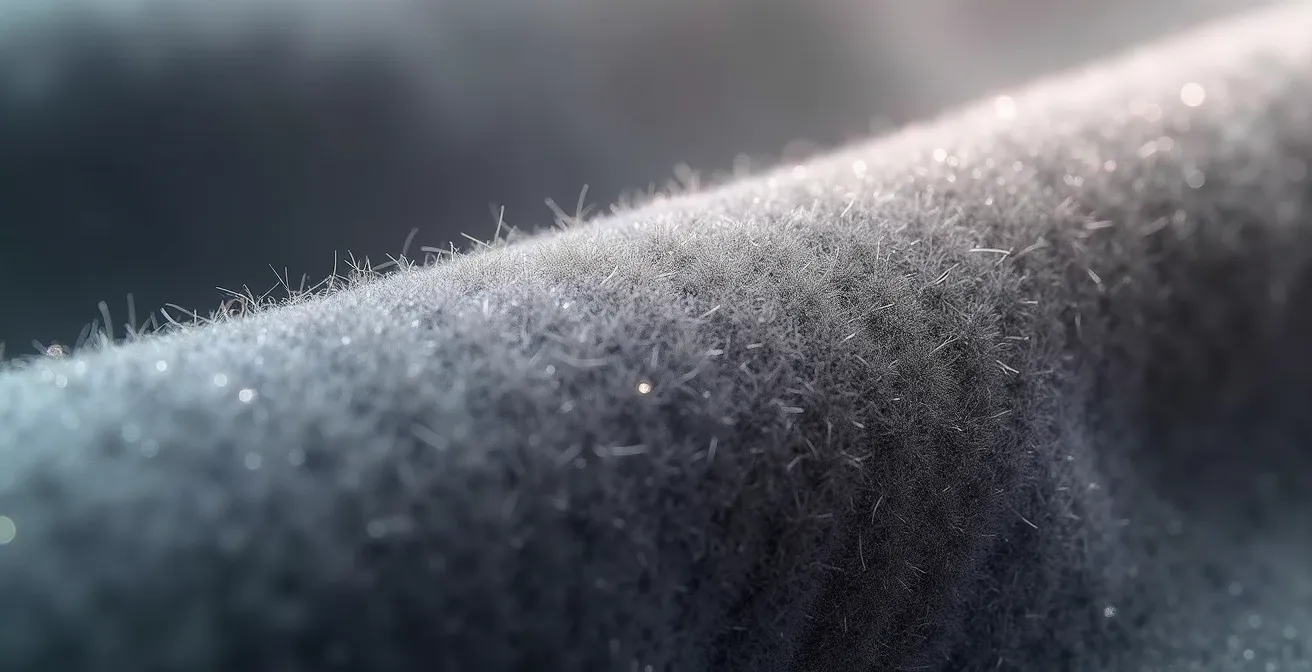
While top-grain leather is durable, it is not immune to punctures and scratches from claws. Natural velvet, with its looped pile, is exceptionally vulnerable to snagging. This is where performance fabrics, such as those made by Crypton or Revolution, offer a superior solution. These velvets are engineered with a dense, tightly-woven structure that resists snagging. The fibers themselves are often solution-dyed and treated to repel stains, making them far more resilient to the realities of daily life involving pets and children. The choice is not merely aesthetic; it is a calculated investment in peace of mind and reduced maintenance.
The following table provides a clear comparison of how different materials stand up to the challenges of a pet-friendly home, based on an analysis of fabric durability.
| Fabric Type | Snag Resistance | Stain Resistance | Cleaning Difficulty | Longevity with Pets |
|---|---|---|---|---|
| Performance Velvet | High (Crypton/Revolution) | 95% with treatment | Easy | 10-15 years |
| Natural Velvet | Low | 30% | Difficult | 3-5 years |
| Top-Grain Leather | Moderate | 80% | Moderate | 15-20 years |
| Polyester Velvet | Moderate-High | 70% | Easy-Moderate | 7-10 years |
The 15-Minute “Fake Clean” Protocol Before Guests Arrive
Even in the most meticulously maintained home, unexpected guests can prompt the need for a rapid refresh. This is not a deep clean, but a strategic, time-efficient protocol designed to restore visual and sensory order. For velvet upholstery, which can easily show pressure marks or look “crushed,” this quick-touch procedure is essential. The objective is to revive the pile, remove surface dust, and ensure the fabric presents its best self in under 15 minutes.
The protocol relies on light-touch tools and avoids moisture, which is too high-risk for a quick turnaround. The core steps are as follows:
- Vacuum (3 minutes): Using a vacuum with a soft brush attachment, gently pass over the velvet in the direction of the nap. This removes surface dust and lint without abrading the fibers.
- Brush (4 minutes): Employ a soft-bristled upholstery brush to gently lift any crushed areas and restore the pile’s uniform direction. This step is critical for restoring the fabric’s signature sheen.
- Steam (5 minutes): As noted by professional cleaners, a handheld garment steamer is a powerful tool for this task. Hold the steamer at least six inches away from the fabric and move it continuously while brushing in the direction of the nap. This combination effectively removes pressure marks and revives the velvet’s softness without the risk of water damage.
- Freshen (1 minute): If necessary, apply a light mist of a high-quality fabric freshener from a distance of at least 12 inches to avoid creating damp spots.
- Final Brush (2 minutes): A final pass with the brush ensures a perfectly uniform sheen and direction of the nap, leaving the furniture looking pristine.
This is not a substitute for proper cleaning, but an effective triage method used by professionals to quickly enhance a room’s presentation. It demonstrates the principle that frequent, gentle maintenance is often more effective than infrequent, aggressive cleaning.
Scratched Brass: When to Polish It and When to Leave It Alone?
As the RAFT Furniture Design Team notes, “Velvet is a statement fabric that commands attention due to the way that the light catches on the dense pile.” This appreciation for a material’s inherent character is the key to a sophisticated maintenance philosophy. This philosophy extends beyond fabrics to metals like brass, forcing us to ask a critical question: is a mark “damage” or is it “patina”? The decision to intervene—to polish a scratch on a brass fixture or to leave it alone—is an aesthetic and curatorial one.
Unlacquered brass, for example, is a “living finish.” It is designed to oxidize and darken over time, developing a unique patina that tells a story of its use and environment. Aggressively polishing this away can erase the very character that makes the piece valuable. A deep, unsightly scratch might warrant professional polishing, but minor signs of age are often best embraced. Similarly, with vintage velvet, slight variations in the pile or subtle wear patterns can be seen as part of its history and charm, rather than as flaws to be corrected. The housekeeper’s role is also that of a curator, judging when to preserve a material’s story and when to restore its original state. The rule is to intervene only when the mark detracts from the overall beauty of the piece, rather than adding to its character.
How to Reduce Household Dust by 50% With One HVAC Change?
While the title points to a critical macro-level solution—upgrading to a high-MERV filter in your HVAC system can indeed drastically cut airborne dust—it addresses only half of the equation. A comprehensive dust reduction strategy must combine environmental control with targeted surface management. Dust that isn’t airborne will inevitably settle, and fabrics like velvet, with their dense pile, act as highly effective dust magnets. Overlooking regular fabric maintenance can undermine even the best air filtration system.
A disciplined, preventative protocol for your upholstery is therefore not optional, but imperative for maintaining a low-dust environment. Maintenance research demonstrates that up to 85% of dust accumulation in upholstery can be prevented with simple, bi-weekly vacuuming. Establishing a weekly routine is the most effective approach. For example, a light vacuuming with a soft brush on Monday, followed by a comprehensive brushing on Friday to dislodge settled particles, can make a significant difference. On synthetic velvets, a monthly application of an anti-static spray can further reduce dust cling.
This micro-level management works in tandem with the macro-level HVAC solution. The filter traps airborne particles, while the upholstery protocol removes what has settled before it can be kicked back into the air. This two-pronged approach—addressing both air and surfaces—is the only way to achieve a meaningful and lasting reduction in household dust.
Solution-Dyed Acrylic vs. Polyester: Is Sunbrella Worth the Extra Cost?
The conversation about preventative care and material selection inevitably leads to a discussion of modern textile technology. Brands like Sunbrella have built a reputation on durability, but understanding the science behind them is key to judging their value. The primary distinction lies in the dyeing process. Standard polyester fabrics are “piece-dyed,” meaning the yarn is woven first and then dyed in a vat. The color sits on the surface of the fibers, making it susceptible to fading from UV exposure and harsh cleaning.
In contrast, solution-dyed acrylics or polyesters, like those used by Sunbrella and FibreGuard, are colored at the liquid polymer stage, before the fiber is even extruded. The pigment becomes an integral part of the fiber itself, not just a coating. This results in vastly superior colorfastness against sun, wear, and cleaning. Long-term studies on performance fabrics show they can maintain their appearance even after a decade of heavy family use. For applications exposed to direct sunlight or requiring frequent cleaning, the higher initial cost of a solution-dyed fabric is a sound investment.
Furthermore, professional cleaning studies confirm that these advanced fabrics boast remarkable durability. For example, it has been shown that there is up to 95% color uniformity retention on performance fabrics even after professional cleaning cycles. This ensures that the upholstery not only resists initial stains but also withstands the maintenance required to keep it looking pristine for years, justifying the premium price tag through superior longevity and lower replacement costs.
Why Lemon Juice Ruined Your Unsealed Limestone Table in 5 Minutes
The principle of chemical reactivity, introduced with marble, has a time-sensitive corollary that is critical in emergency situations. The damage to an unsealed limestone or marble surface from an acidic substance like lemon juice is nearly instantaneous. The same is true for water on certain types of velvet. Expert upholstery advice confirms that water stains can become permanent on cotton velvet if not addressed within 5 minutes. This is not a task that can be postponed; immediate and correct action is the only protocol.

When a water spill occurs on delicate velvet, you are in a race against absorption. The following emergency protocol must be executed with speed and precision:
- Blot Immediately: Use a clean, white, highly absorbent cloth to blot the spill. Press down firmly but do not rub. The goal is to lift the liquid out of the fibers, not to push it further in or spread it.
- Apply Foam, Not Liquid: If a cleaning agent is needed, use only the foam from a pH-neutral soap and water mixture. Applying liquid directly will over-saturate the area and guarantee a water mark.
- Work from Outside-In: Gently dab the affected area starting from the outside edge of the stain and moving inward. This prevents the stain from spreading.
- Dry and Brush Simultaneously: Use a hairdryer on its lowest heat and speed setting. Keep it moving and hold it several inches from the fabric. As you dry the area, simultaneously brush the pile with a soft-bristled brush. This crucial step prevents the fibers from drying in a crushed or matted position, which is the primary cause of water marks.
In luxury material care, a five-minute delay can be the difference between a minor incident and permanent damage. Knowing and practicing this emergency response is non-negotiable.
Key takeaways
- Material science is paramount: Understand the chemical and structural vulnerabilities of each material before you clean it.
- Test, always: Before applying any product, test for colorfastness and fabric reaction in a hidden area.
- Prevention is the best policy: Choose materials appropriate for your lifestyle and establish regular, gentle maintenance routines.
- Act with precision and speed: In an emergency like a water spill, immediate and correct action is the only way to prevent permanent damage.
How to Build a “Capsule Home Collection” That Saves You $1,000 a Year?
The ultimate expression of a professional maintenance philosophy is not a cupboard overflowing with specialized cleaners, but a thoughtfully curated “capsule collection” of high-quality materials and a few versatile, effective tools. This minimalist approach saves money, reduces clutter, and simplifies your entire maintenance routine. It begins with investing in durable, low-maintenance materials upfront—like the performance fabrics and properly sealed stones we have discussed. As the data shows, this initial investment pays dividends by eliminating future cleaning and replacement costs.
This principle is clearly illustrated by comparing the total cost of ownership between standard and performance velvet. An analysis shows that while the initial purchase price is higher for performance fabric, the savings on professional cleaning and eventual replacement lead to a significant net benefit over time.
| Cost Factor | Performance Velvet | Standard Velvet | 5-Year Difference |
|---|---|---|---|
| Initial Purchase | $1,500 | $800 | +$700 |
| Professional Cleaning (5 years) | $0 | $600 | -$600 |
| Cleaning Products | $50 | $200 | -$150 |
| Replacement Cost | $0 | $800 | -$800 |
| Total 5-Year Cost | $1,550 | $2,400 | -$850 savings |
Case Study: The Minimalist Cleaning Kit
Many experienced homeowners report successfully maintaining an entire house of varied upholstery, including velvet, with a simple, three-part kit. This “capsule” consists of a pH-neutral detergent for creating cleaning foam, a diluted white vinegar solution for specific stains and odors, and a high-quality, soft-bristled velvet brush. By pairing this minimal toolkit with the correct protocols, they avoid the expense and confusion of countless specialized products, proving that expertise lies in knowledge, not in the quantity of supplies.
By investing wisely in materials and mastering a few core techniques, you transform home maintenance from a reactive, costly chore into a streamlined, cost-effective system of preservation.
Adopt these protocols not as chores, but as the framework for preserving the value and beauty of your home. Begin today by auditing your materials and establishing your preventative maintenance schedule.