
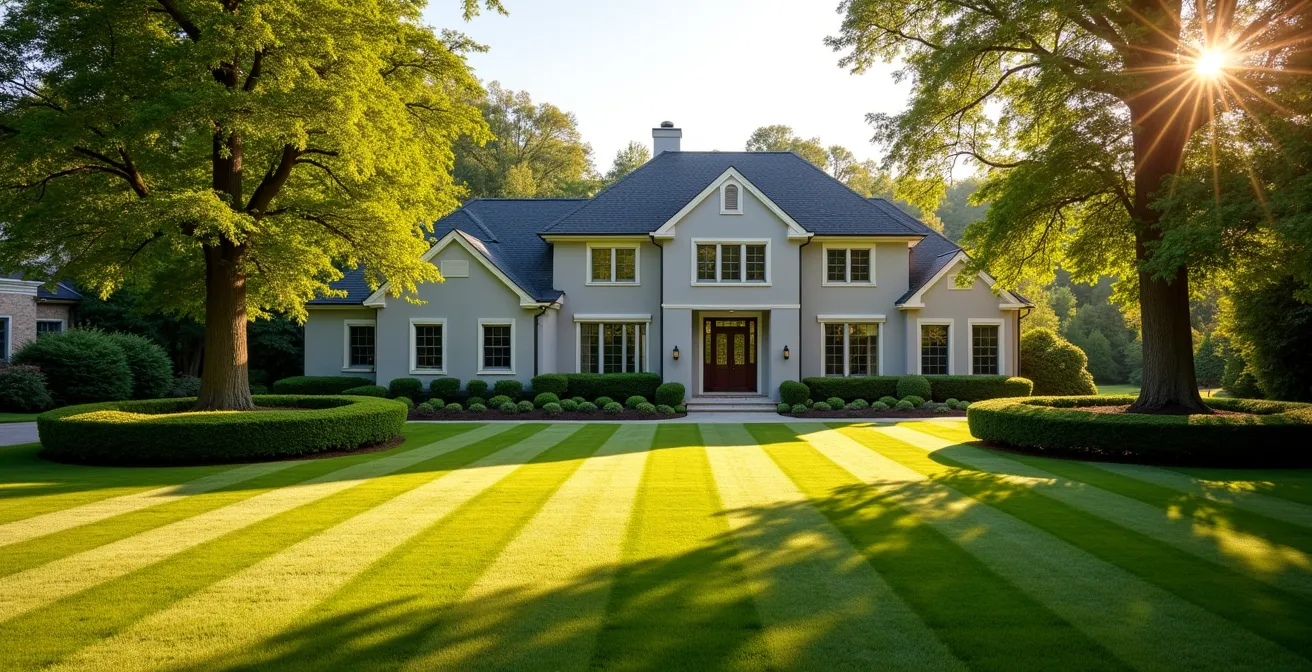
Maximizing your home’s appraisal value isn’t about expensive additions; it’s about systematically eliminating hidden landscaping liabilities first.
- An appraiser’s primary concern is risk, meaning issues like poor drainage or destructive tree roots can negate the value of aesthetic upgrades.
- Strategic investments in the backyard “living space” and smart, layered security lighting often yield a higher return than generic curb appeal projects.
Recommendation: Before allocating a budget for new plants or patios, conduct a thorough audit of your property for these value-destroying issues to ensure your investment truly pays off.
As a homeowner with an eye on selling in the next two years, the question isn’t *if* you should invest in landscaping, but *where* that investment will generate the highest possible return on your appraisal. The common advice is to focus on curb appeal: plant some colorful annuals, maintain a lush green lawn, and hope for the best. This approach is rooted in the idea that a pretty picture translates directly into a higher property value. But from a strategic, market-focused perspective, this is a dangerously incomplete picture.
The truth is, a professional appraiser is trained to look past the surface-level beauty. They view your property through an “appraiser’s lens,” where the primary focus is on structure, safety, and potential risks. That charming willow tree could be a sewer line disaster waiting to happen. The immaculate lawn might hide a serious foundation-damaging water issue. These are the “value liabilities” that can quietly sabotage your property’s worth, no matter how beautiful the flower beds are.
This guide moves beyond the platitudes of simple curb appeal. We will dissect your landscape from a real estate agent’s perspective, focusing on the critical factors that directly impact an appraisal. We will identify the hidden pitfalls that can decrease value and pinpoint the strategic upgrades that deliver a measurable return on investment. It’s time to stop thinking like a gardener and start thinking like an investor. By understanding and addressing these key areas, you can build a landscaping plan that not only looks great but actively works to maximize your final sale price.
To navigate this strategic approach, we’ve broken down the eight most crucial landscaping considerations that influence an appraiser’s valuation. This structure will guide you from identifying foundational risks to making smart, ROI-driven decisions on aesthetic and security enhancements.
Summary: A Strategic Guide to Landscaping for Maximum Appraisal Value
- Negative Grade: How to Spot if Your Garden Is Funneling Water to Your Foundation?
- Retaining Walls Over 4 Feet: Why You Need a Structural Engineer
- Willow or Oak: Which Tree Roots Are Most Likely to Crush Your Sewer Line?
- The “Sore Thumb” Risk: Why Over-Landscaping Can Hurt Resale in Modest Areas?
- Where to Spend $5,000: Curb Appeal or Backyard Oasis?
- Lawn Service vs. Robot Mower: Which Pays Off Faster Over 2 Years?
- Why “Always On” Porch Lights Might Actually Attract Burglars?
- How to Light Your Driveway for Security Without looking like a Prison Yard?
Negative Grade: How to Spot if Your Garden Is Funneling Water to Your Foundation?
Before you invest a single dollar in plants or patios, you must address the single most significant landscaping liability: water. A negative grade—where the ground slopes toward your home instead of away from it—is a massive red flag for any appraiser. It signals a high risk of water intrusion, which can lead to foundation cracks, basement flooding, and costly structural damage. This isn’t just an aesthetic issue; it’s a direct threat to the building’s integrity. In fact, FEMA data shows that 85% of all home damage claims involve water intrusion, making proper drainage a non-negotiable priority.
Spotting a negative grade doesn’t always require an expert. You can perform a preliminary check yourself. Look for telltale signs like soil pulling away from the foundation, pooling water near the house after rain, or persistent dampness in your basement or crawlspace. For a more precise measurement, use a long level and a tape measure. The ground should drop at least six inches over the first ten feet away from your foundation. Anything less, and you have a problem that needs to be solved.
Correcting a negative grade, often by adding dense, compacted soil to build up the slope, is what we call “defensive landscaping.” It’s not glamorous, but the return on this mitigation is enormous. By eliminating a primary risk factor, you are protecting your home’s core value and removing a major objection for both appraisers and potential buyers. It is the foundational first step in any ROI-driven landscaping strategy.
Retaining Walls Over 4 Feet: Why You Need a Structural Engineer
Retaining walls are often seen as functional solutions for sloped yards, but from an appraiser’s perspective, they can be either a valuable asset or a significant liability. The dividing line is often just four feet high. A professionally built, permitted wall demonstrates a high-quality, stable property. An improperly constructed one, however, represents a major safety hazard and a future expense that will be deducted from your home’s value. The key is understanding that once a wall surpasses a certain height, it’s no longer a simple garden feature; it’s a structural engineering project.
Most building codes, like those from the Baltimore County Government, specify that retaining walls “not over 4 feet in height measured from the bottom of the footing to the top of the wall” may not require a permit. However, this comes with a crucial caveat: “unless supporting a surcharge.” A surcharge is any additional weight behind the wall, such as a driveway, a steep slope, or even a swimming pool. In these cases, even a short wall requires professional engineering to ensure it can handle the immense hydrostatic pressure.
Ignoring these requirements is a costly mistake. An appraiser will immediately question the integrity of a tall, unpermitted wall, and a home inspector will flag it as a safety concern. The cost difference between doing it right the first time and fixing it later is stark. Investing in a stamped engineering plan and proper permits for any wall over four feet or supporting a surcharge isn’t just about compliance; it’s about converting a potential liability into a documented, value-adding feature.
This table illustrates how quickly the requirements and costs escalate, making it clear why a DIY approach to tall walls is a poor investment. As a comparative analysis of municipal requirements shows, the stakes rise dramatically with height.
| Wall Height | Permit Required | Engineering Required | Typical Cost |
|---|---|---|---|
| Under 4 feet | No (unless supporting surcharge) | No | $50-$100/sq ft |
| 4 feet and over | Yes | Yes – stamped by registered engineer | $150-$300/sq ft |
| Any height with surcharge | Yes | Yes – full structural analysis | $200-$400/sq ft |
Willow or Oak: Which Tree Roots Are Most Likely to Crush Your Sewer Line?
Mature trees add undeniable character and value to a property, but the wrong tree in the wrong place is a ticking time bomb for an appraiser. Below the surface, an aggressive root system can be silently wreaking havoc on your home’s most critical infrastructure: your foundation and sewer lines. This hidden liability can lead to thousands of dollars in repairs, a cost a savvy buyer will want to negotiate off the asking price. Research from the USDA Forest Service confirms the scale of the problem, finding that tree roots cause over 50% of all sewer blockages.
The primary culprits are fast-growing, water-seeking trees. Species like Willows, Silver Maples, and Poplars have notoriously invasive root systems that can travel far from the trunk in search of moisture, often finding it in older, porous sewer pipes. They can infiltrate and crush pipes, leading to chronic backups and eventual replacement. In contrast, trees like many species of Oak tend to have deeper, less aggressive taproot systems, making them a safer choice when planted at a proper distance from infrastructure.
This is a perfect example of a hidden value liability. The cost of inaction can be staggering. A detailed analysis of root damage costs reveals that while patching minor foundation cracks might be a few hundred dollars, replacing a compromised sewer line can easily cost $3,000 or more, and large-scale foundation repairs can run into the tens of thousands. An appraiser is aware of these risks and will view a large, problematic tree species close to the home with suspicion. Removing such a tree before it causes damage, or installing a root barrier, is a defensive investment that protects your property’s value.

As this visualization shows, the underground battle between nature and infrastructure is real. Proactively managing this risk by choosing appropriate species and planting locations is a core part of a smart landscaping investment strategy, preventing costly repairs down the line.
The “Sore Thumb” Risk: Why Over-Landscaping Can Hurt Resale in Modest Areas?
In real estate, “more” is not always “better.” This is especially true with landscaping. While a certain level of quality and care is expected, going overboard can create a “sore thumb” effect—a property so elaborately landscaped that it no longer fits the character of the neighborhood. This concept of strategic over-improvement is a critical mistake for homeowners looking to maximize ROI. An appraiser values conformity and market expectations. A home that drastically deviates from the neighborhood norm, even in a positive way, can be difficult to value and may even see its appraisal come in lower than expected.
The key is to match your landscaping investment to your property’s price point and the surrounding community. As Sacramento appraiser Tom Horn notes, “A certain level of landscaping is expected by the market depending on neighborhoods and price points. An estate property priced above $3 million would be expected to have privacy buffers, expansive lawns, gardens, and mature trees. This would be overkill for even a $1 million property.” Pouring $50,000 into a tropical paradise with waterfalls and koi ponds in a neighborhood of modest $400,000 homes is a poor investment. You will never recoup that cost because the target buyer for that area isn’t looking for, and won’t pay a premium for, such high-maintenance extravagance.
Instead of aiming for the most spectacular yard on the block, aim for the best-executed version of the neighborhood standard. Focus on impeccable maintenance, healthy and mature plantings that are appropriate for the home’s scale, and clean, well-defined hardscaping. The goal is to signal quality and care, not opulence. A clean, healthy, and well-designed landscape that feels harmonious with its surroundings will always be valued more highly by an appraiser than one that feels out of place, regardless of how much money was spent on it.
Where to Spend $5,000: Curb Appeal or Backyard Oasis?
With a finite budget, the strategic question becomes one of allocation. Should you invest your $5,000 in creating breathtaking curb appeal to wow buyers from the street, or in crafting a private backyard oasis? The conventional wisdom screams “curb appeal,” but from an appraisal and buyer experience perspective, the answer is more nuanced. While first impressions matter, the highest ROI is often found in the backyard, where homeowners actually live.
Data consistently shows that foundational landscaping maintenance provides an incredible return. A 2018 report from the National Association of Realtors revealed a staggering 267% return on investment for standard lawn care services, which includes fertilization, weed control, and mowing. This foundational health is the canvas for everything else. Once that’s established, the focus should shift. While the front yard makes the first impression, it’s the backyard that clinches the deal. It’s an extension of the home’s living space, and buyers are willing to pay a premium for a functional, inviting private retreat.
A compelling case study highlights this point perfectly. An appraiser noted that while front yard landscaping is important, “the rear yard tends to make a much more significant impact on value since people spend more time there.” In a direct comparison, homes with exceptional backyards sold for approximately 10% more than comparable homes with basic yards. So, how do you spend your $5,000? First, ensure the front is clean, healthy, and tidy. Then, invest the majority of your budget in the back. This could mean a new paver patio, a well-placed fire pit, or creating defined “zones” for dining and relaxing. You are selling a lifestyle, and that lifestyle is lived in the backyard.
Lawn Service vs. Robot Mower: Which Pays Off Faster Over 2 Years?
For a homeowner planning to sell in two years, every landscaping decision must be viewed through a cost-benefit lens. A pristine lawn is non-negotiable for appraisal value, but the method you use to maintain it has significant financial implications. The choice between hiring a professional lawn service and investing in a robotic mower is a classic “spend now vs. spend over time” dilemma. A clear-eyed look at the numbers shows that for a two-year horizon, the initial investment in automation often pays for itself and delivers superior results.
A professional service offers convenience with zero time investment but comes with a recurring cost that adds up quickly. Over 24 months, a service costing $150 per month will total $3,600. A high-quality robotic mower, on the other hand, represents a significant upfront cost but has minimal ongoing expenses. The result is not only a lower total cost over two years but also a healthier, more consistently manicured lawn, as the robot mows more frequently, leaving fine clippings that act as natural fertilizer.
The following cost comparison, based on data from home service experts, breaks down the investment over your two-year selling timeline. This analysis of smart landscaping options makes the financial trade-off clear.
| Factor | Professional Lawn Service | Robot Mower |
|---|---|---|
| Initial Investment | $0 | $1,000-$3,000 |
| Monthly Cost | $100-$200 | $10-20 (electricity/maintenance) |
| 2-Year Total | $2,400-$4,800 | $1,240-$3,480 |
| Time Investment | 0 hours | 5-10 hours setup/maintenance |
| Consistency | Weekly/bi-weekly | Daily if desired |
| Noise Impact | Loud during service | Quiet operation |

Beyond the cost savings, the image of a perfectly manicured lawn maintained with modern, quiet technology adds a subtle but powerful element of sophistication to your property. It signals a well-cared-for, up-to-date home, which is an attractive narrative for any potential buyer and a positive signal for an appraiser.
Why “Always On” Porch Lights Might Actually Attract Burglars?
Effective landscape lighting is a dual-purpose feature: it enhances curb appeal at night and provides security. However, a common mistake homeowners make is assuming that more light equals more security. Leaving a porch light on 24/7 can, counterintuitively, signal to potential burglars that no one is home. It suggests a static, “set it and forget it” approach to security, which is less effective than dynamic, responsive lighting. An appraiser will note the presence of outdoor lighting, but a strategic, smart lighting system will be viewed as a more valuable and modern feature than a single, constantly burning bulb.
The modern approach to security lighting is about intelligence, not just brightness. Motion-activated lights are far more effective deterrents. A sudden flood of light is startling and draws attention, sending a clear message that someone or something has been detected. This is a much stronger deterrent than a constant, unchanging light that provides a steady, predictable environment for a criminal to work in. Furthermore, smart systems that can be controlled remotely allow you to create the illusion of occupancy, which is a powerful security tool.
Upgrading to a smart lighting system is a relatively low-cost, high-impact investment. It enhances both the actual security and the perceived value of your home. It shows a level of care and technological sophistication that appeals to modern buyers. By moving away from the “always on” mentality, you create a safer and more valuable property.
Your 5-Point Security Lighting Audit: From Liability to Asset
- Points of Contact: Walk your property at dusk and identify all entry points (doors, windows, gates) and dark zones that could hide an intruder.
- Collecte: Inventory your current fixtures. Are they harsh, glaring floodlights or welcoming path lights? Note which are “always on” versus sensor-based.
- Cohérence: Evaluate if the current lighting creates harsh shadows or blinding glare, which can hinder visibility, rather than providing safe, even illumination.
- Mémorabilité/Émotion: Does your home’s night profile look like a “prison yard” with a single, harsh light, or does it feel like a premium, thoughtfully layered design?
- Plan d’Intégration: Create a priority list to replace static “always on” fixtures with motion-activated or dusk-to-dawn models at key entry points and walkways.
Key Takeaways
- Prioritize Mitigation Over Aesthetics: The highest ROI comes from fixing foundational risks like poor drainage and structural issues before spending on cosmetic upgrades.
- Invest in the Backyard Lifestyle: While curb appeal is important, functional and inviting backyard spaces often have a greater impact on appraisal value because it’s where homeowners live.
- Embrace Strategic Lighting: A layered, smart lighting system that enhances security and ambiance is valued more highly than harsh, basic floodlights and can be a significant differentiator.
How to Light Your Driveway for Security Without looking like a Prison Yard?
The final touchpoint in a strategic landscaping plan is lighting, and the driveway is a perfect example of where homeowners often get it wrong. The default solution is often a pair of powerful, glaring floodlights mounted on the garage. While functional, this “prison yard” approach detracts from your home’s aesthetic and signals a basic, utilitarian mindset to an appraiser. True value is found in a sophisticated, layered approach that provides security while simultaneously enhancing the architectural beauty of your home.
Strategic lighting is about artistry and subtlety. As one analysis of appraising outdoor spaces notes, professionals use a three-layer design. The first is path lighting, using low-level fixtures to safely guide visitors along walkways and the driveway. The second is accent lighting, or “uplighting,” which highlights architectural features of the home or the texture of mature trees, adding depth and drama. The final layer is subtle security lighting, often motion-activated and positioned to wash walls with light rather than creating harsh, isolated bright spots.
This layered technique transforms lighting from a mere utility into a high-end design feature. It creates a welcoming, premium ambiance that is immediately recognizable to appraisers and buyers as a mark of a professionally considered property. It demonstrates that every detail of the home has been thoughtfully executed. This is an investment that pays dividends in both curb appeal and perceived value, elevating your entire property profile long after the sun goes down.
Now that you understand how to view your property through an appraiser’s lens, the next logical step is to perform a professional audit of your own landscape. Start by identifying these potential liabilities to build a landscaping plan that delivers maximum ROI when you sell.