

True home efficiency isn’t about one big project, but a system-wide audit of interconnected, often-overlooked components.
- Runoff from common asphalt shingles is often unsafe for edible gardens due to leached chemical contaminants, making it a compliance risk.
- Small, targeted upgrades like high-efficiency faucet aerators and the elimination of phantom loads can offer a faster and more significant return on investment than many large-scale projects.
Recommendation: Before investing in a major upgrade like a complex greywater system, conduct a full home audit to identify your specific points of energy and water loss for maximum, code-compliant ROI.
As a homeowner looking to optimize your property, the question of reusing bathwater for your garden is an excellent one. It demonstrates a commitment to conservation that is both financially and environmentally responsible. Many resources will offer generic advice: “check with your local authority” or “avoid ‘blackwater’ from toilets.” While correct, this advice barely scratches the surface of a true home efficiency and safety audit. From a regulatory perspective, the question is not just *if* you can reuse water, but *what* water, for *what* purpose, and what other systemic vulnerabilities exist within your home’s infrastructure.
While your query about reusing bath water is a critical starting point, a professional assessment reveals it’s just one node in a much larger network of home efficiency. A home’s performance is an ecosystem of systemic dependencies, where insulation affects heating costs, appliance choice impacts phantom electrical loads, and even the type of roof you have determines the safety of your collected rainwater. The most significant and fastest returns on investment are often found not in the single, ambitious project, but in identifying and correcting a series of smaller, overlooked inefficiencies.
This mindset—thinking like an inspector—is the key to unlocking real, compliant savings. It involves moving beyond simple payback calculations to consider factors like Total Cost of Ownership (TCO), real-world usage patterns, and, most importantly, safety and regulatory compliance. This audit will guide you through eight critical checkpoints, applying a regulatory and technical lens to each. We will address your initial greywater question head-on and then expand the inspection to other areas where your home is likely losing money and resources without you even realizing it.
To navigate this comprehensive home efficiency audit, we will examine eight distinct but interconnected systems. This table of contents outlines each inspection point, from water-saving fixtures to the hidden costs of your daily commute.
Summary: A Homeowner’s Guide to Systemic Efficiency and Savings
- Aerators: How to Save 30% on Water Without Losing Shower Pressure?
- Spray Foam vs. Fiberglass: Which Pays for Itself Faster in an Old House?
- Asphalt Shingles: Is Runoff Water Safe for Edible Vegetables?
- The “Setback” Myth: Does Turning Off Heat During the Day Actually Save Money?
- Energy Star vs. Standard: When Is the Premium Price Not Worth It?
- Drip Line vs. Soaker Hose: Which Saves More Water for Vegetable Beds?
- Phantom Load: How Much Is Your Gaming Console Costing You in Standby Mode?
- E-Bike vs. Public Transit: Which Is Cheaper for a 10km Commute?
Aerators: How to Save 30% on Water Without Losing Shower Pressure?
The concept of “micro-leaks” applies as much to water as it does to energy. A standard bathroom faucet flows at 2.2 gallons per minute (GPM), a rate far exceeding what’s needed for tasks like handwashing. Installing a WaterSense-labeled faucet aerator is one of the most cost-effective water conservation measures a homeowner can take. These devices work by mixing air into the water stream, which maintains a feeling of strong pressure while significantly reducing the volume of water used. This is a classic example of a small upgrade with a disproportionately large impact.
The efficiency gains are substantial. A high-efficiency 1.5 GPM aerator can reduce a faucet’s water flow by 30% or more. For an average family, this simple change can result in a savings of 700 gallons of water per year, according to EPA WaterSense data. However, a regulatory mindset requires looking at the systemic dependency. A study on aerator efficiency highlights that while low-flow (e.g., 0.5 GPM) aerators are excellent for flow-based tasks, they significantly increase the time required for volume-based tasks, like filling a pot. This is a crucial consideration; the right aerator depends on the faucet’s primary function.
Furthermore, the Total Cost of Ownership for water is threefold: the cost to purchase it, the cost to heat it, and the cost to dispose of it as wastewater. By reducing hot water consumption, high-efficiency aerators also save a significant amount of energy, compounding the financial return and making it a foundational step in any home efficiency audit.
Spray Foam vs. Fiberglass: Which Pays for Itself Faster in an Old House?
When insulating an older home, the choice between spray foam and traditional fiberglass batts goes far beyond a simple comparison of R-value per inch. From a building science perspective, the primary advantage of closed-cell spray foam is its function as an air and vapor barrier. Older homes are notoriously leaky, and a significant portion of heat loss is due to air convection through countless gaps and cracks in the building envelope. Fiberglass insulation only slows heat transfer through conduction; it does not stop air movement.
This air-sealing capability is why spray foam has a much faster return on investment, particularly in drafty historic houses. While the initial cost is two to three times higher than fiberglass, the energy savings are exponentially greater because it addresses both conduction and convection. For this reason, spray foam typically sees a return on investment within 3 to 7 years, compared to 10-15 years for fiberglass in the same application. The foam expands to fill every cavity, creating a monolithic barrier that drastically reduces drafts and improves indoor comfort.
The image below demonstrates this critical application, showing how the expanding foam creates a perfect seal against aged wood, something impossible to achieve with pre-cut batts.
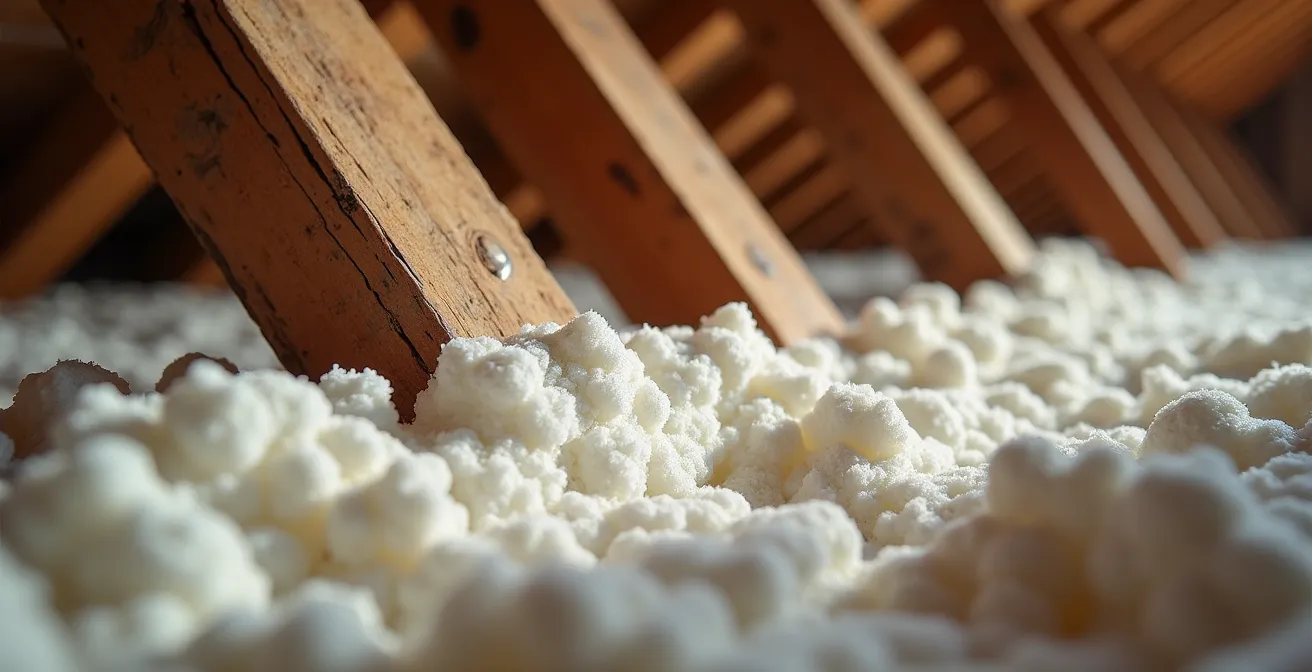
This visual underscores the key difference: fiberglass just sits between the studs, while spray foam becomes an integral part of the structure. This holistic approach to sealing the building envelope is a core principle of modern building codes and is essential for achieving significant energy reductions in older construction. It is a prime example of addressing the root cause of inefficiency, not just treating a symptom.
Asphalt Shingles: Is Runoff Water Safe for Edible Vegetables?
This question brings us back to the core of your initial query about greywater, but with a critical twist: the source of the water. While rainwater harvesting is often encouraged, a regulatory and safety-conscious approach demands a close examination of the collection surface. The vast majority of residential roofs in North America use asphalt shingles, which are not an inert material. Over time, they leach a variety of chemicals, including polycyclic aromatic hydrocarbons (PAHs), which are known carcinogens.
Scientific analysis is unequivocal on this point. For instance, recent research shows asphalt shingle runoff contains significant levels of contaminants, including Benzo(k)fluoranthene. These chemicals can accumulate in soil and be absorbed by plants. Therefore, from a compliance and safety standpoint, water collected from an asphalt shingle roof should never be used on edible vegetables, especially root crops (carrots, potatoes) or leafy greens that are eaten raw (lettuce, spinach). The risk of long-term toxicant accumulation outweighs the benefits of water conservation in this specific application.
This principle of separating water sources based on contamination risk is fundamental to all greywater and water reuse regulations. As the Water Wise Group notes in its guide, there is a clear hierarchy of use:
Greywater should only be used on fruit trees, berry bushes, or above-ground crops like tomatoes and corn — never on root vegetables or raw-eaten leafy greens due to contamination risks
– Water Wise Group, Greywater Systems & How You Can Use Them
This guidance is not arbitrary; it is based on a scientific understanding of contamination pathways. An inspector’s primary duty is to prevent such health risks, making source water quality a non-negotiable first step in system design.
The “Setback” Myth: Does Turning Off Heat During the Day Actually Save Money?
A common misconception, or “ROI fallacy,” in home heating is the idea that it takes more energy to reheat a cold house than to maintain a constant, lower temperature. This is fundamentally incorrect. The rate of heat loss from a building is directly proportional to the temperature difference between the inside and the outside. The warmer your house is, the faster it loses heat to the cold exterior. Therefore, any period where you lower the indoor temperature (a “setback”) results in net energy savings.
A programmable or smart thermostat is the tool that automates this principle. By setting back the temperature by 7°-10°F for 8 hours a day (e.g., while at work or asleep), you are reducing the period of maximum heat loss. The energy required to bring the house back up to a comfortable temperature is less than the energy saved during the extended setback period. In fact, the Department of Energy confirms you can save as much as 10% a year on heating and cooling by simply using a setback schedule.
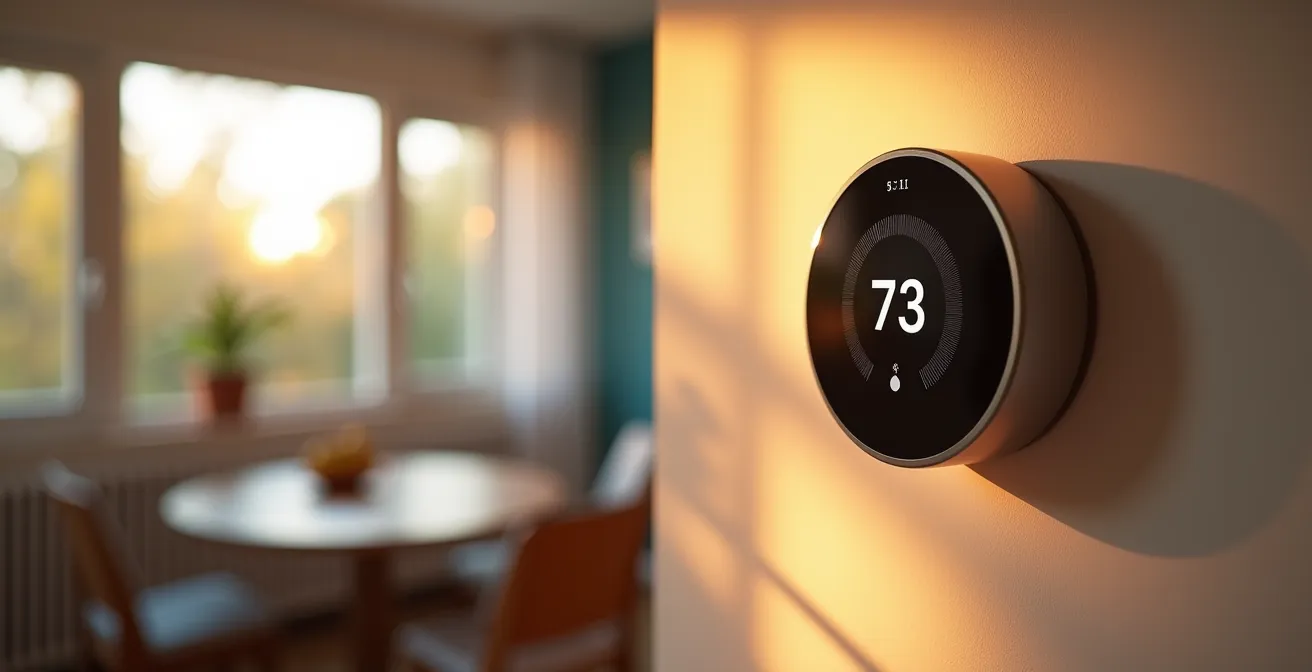
The effectiveness of this strategy depends on the home’s thermal mass—its ability to store heat. Homes with high thermal mass (e.g., concrete floors, thick plaster walls) will cool down more slowly, making setbacks even more effective. The visualization below conceptualizes how a smart thermostat manages these temperature zones within a home’s thermal envelope.
Ultimately, the “setback myth” stems from a misunderstanding of thermodynamics. By reducing the average temperature inside your home over a 24-hour period, you will always reduce the total amount of heat that escapes. A programmable thermostat is not just a convenience; it’s a critical tool for implementing a compliant and effective energy-saving strategy.
Energy Star vs. Standard: When Is the Premium Price Not Worth It?
The Energy Star label is a trusted indicator of energy efficiency, but from a purely financial and regulatory standpoint, it is not an automatic “buy.” The decision to pay the premium for an Energy Star appliance requires a more nuanced audit that goes beyond the yellow EnergyGuide label. The primary factor is your specific usage pattern. The standardized tests used for certification may not reflect your household’s reality. For instance, a large family doing daily laundry will see a much faster payback on an efficient washing machine than a single person living alone.
Another critical point is systemic dependency. An ultra-efficient dishwasher won’t save you much money if it’s connected to an old, inefficient water heater located on the other side of the house, as much of the energy savings will be lost through heat dissipation in the pipes. The ROI of one component is directly tied to the efficiency of the entire system it operates within. Utility rebates can significantly alter the calculation, often reducing the upfront cost difference to a negligible amount, which makes the Energy Star model the clear winner.
However, there are scenarios where the premium is not justified. For intermittently used appliances, a simpler solution is often more cost-effective. A “dumb” coffee maker or space heater combined with a $25 smart plug that eliminates phantom load can provide 99% of the benefit of a “smart” appliance that costs $200 more. A true efficiency audit involves this kind of practical, cost-benefit analysis rather than blindly following a label.
Drip Line vs. Soaker Hose: Which Saves More Water for Vegetable Beds?
For garden irrigation, both drip lines and soaker hoses are vastly more efficient than overhead sprinklers, as they deliver water directly to the root zone, minimizing evaporative loss. However, the choice between them depends heavily on two factors: soil type and water source. This is another clear case of systemic dependency. Drip systems with individual emitters are ideal for heavy clay soils. They release water very slowly (e.g., 1 gallon per hour), allowing the dense soil to absorb it without runoff, achieving efficiency rates of 90-95%.
Soaker hoses, which are porous and weep water along their entire length, are better suited for sandy or loamy soils. These soils require a wider wetting pattern to adequately irrigate the root zone, which a soaker hose provides more effectively than discrete drip emitters. While slightly less efficient (80-85%), they ensure better water distribution in lighter soils.
Case Study: Greywater Compatibility with Irrigation
The selection becomes even more critical when using greywater. Greywater Action, a leading advocacy group, reports that greywater from sources like washing machines contains lint, hair, and other particulates. These particles will inevitably clog the small orifices of drip emitters, causing system failure and requiring constant maintenance. For greywater applications, the recommended approach is to bypass filters and use larger-diameter distribution tubing (like a soaker hose or a “mulch basin” outlet) that is not susceptible to clogging. This ensures the long-term viability and low maintenance of the system, a key consideration for regulatory compliance and user satisfaction.
Therefore, a compliance-minded recommendation cannot declare one system universally superior. For a standard municipal water source in clay soil, a drip line is the most efficient choice. For a laundry-to-landscape greywater system, a soaker hose or similar clog-resistant method is the only viable, long-term solution. The “best” system is the one correctly matched to its inputs (water source) and environment (soil type).
Phantom Load: How Much Is Your Gaming Console Costing You in Standby Mode?
Phantom load, also known as standby power or vampire power, refers to the electricity consumed by electronic devices while they are turned “off” or in standby mode. These “micro-leaks” of energy are a significant and often completely ignored source of household electrical waste. While a single device may only draw a few watts, the cumulative effect of dozens of devices drawing power 24/7 can be substantial. From an inspector’s viewpoint, this is low-hanging fruit for efficiency gains, as it requires no expensive retrofits, only behavioral or minor technological changes.
The scale of the problem is well-documented. According to the Department of Energy, these phantom loads account for 5-10% of total residential electricity use in the United States. The primary culprits are devices with remote controls (TVs, cable boxes), continuous digital displays (microwaves, coffee makers), or “instant-on” features (gaming consoles, printers). A modern gaming console, for example, can draw 10-15 watts continuously just to be ready to download updates, costing $10-20 per year on its own.
Identifying and mitigating these loads is a core task in any home energy audit. The only way to know for sure is to measure. A simple plug-in watt meter allows a homeowner to test each device and quantify the waste. Once identified, the solutions are simple: unplugging devices when not in use or, more practically, grouping them onto smart power strips that automatically cut power to peripherals when the main device (like a TV or computer) is turned off.
Your 5-Step Phantom Load Audit Plan
- Identify & Equip: List all suspect device clusters (entertainment center, home office, kitchen) and acquire a plug-in watt meter to begin your inspection.
- Collect Data: Systematically measure the standby (phantom) draw in watts for each device while it is in its “off” or standby state.
- Analyze & Quantify: Calculate the annual cost for each device using the formula: (Watts × 8760 hours/year) ÷ 1000 × your local electricity rate per kWh.
- Prioritize for Impact: Rank the devices from highest to lowest phantom load cost. This will reveal your primary targets for mitigation.
- Implement Control Plan: Deploy smart power strips or establish unplugging routines for all devices with a significant standby draw, focusing on the worst offenders first.
Key Takeaways
- Systemic Impact: A home’s efficiency is a network; the performance of one component (e.g., an appliance) is always dependent on others (e.g., water heater, insulation).
- Safety First: Water reuse is governed by safety. The source of the water (e.g., asphalt roof vs. shower) dictates its legal and safe applications, especially for edible gardens.
- Micro-Gains, Macro-Results: The fastest and most cost-effective savings often come from addressing “micro-leaks” like phantom loads and inefficient fixtures, not from large, singular projects.
E-Bike vs. Public Transit: Which Is Cheaper for a 10km Commute?
Extending the efficiency audit beyond the four walls of the house, transportation is a major component of a household’s energy footprint and budget. For a common 10km (approx. 6.2 miles) urban commute, the choice between an e-bike and a public transit pass requires a Total Cost of Ownership (TCO) analysis, not just a comparison of monthly costs.
A public transit pass has a straightforward, predictable monthly cost and zero initial investment. An e-bike, conversely, requires a significant upfront cost but has very low ongoing operating expenses, primarily for charging and maintenance. The choice is not simply about which is cheaper, but over what time horizon one becomes more economical than the other. Weather also introduces a critical variable; an e-bike’s utility can be limited during days of heavy rain or snow, potentially forcing the rider to pay for alternative transport.
The following table provides a clear TCO breakdown for a typical 10km commute scenario, illustrating the financial trade-offs over a five-year period. It highlights how the high initial cost of an e-bike is amortized over time, eventually making it a cheaper option than a continuous transit pass subscription, assuming the rider can tolerate weather-related disruptions.
| Transport Mode | Initial Cost | Annual Operating Cost | 5-Year TCO | Weather Days Lost |
|---|---|---|---|---|
| E-Bike | $1,500-3,000 | $200 (maintenance + charging) | $2,500-4,000 | 30-60 days |
| Public Transit Pass | $0 | $1,200-1,800 | $6,000-9,000 | 0 days |
| E-Bike + Transit Combo | $1,500 | $600 | $4,500 | 0 days |
This data reveals that the hybrid “E-Bike + Transit” approach often represents the optimal balance of cost and reliability. Furthermore, the analysis must also include non-financial, systemic factors. As noted by transportation experts, the availability of secure bike parking and dedicated, safe cycling lanes can dramatically shift the cost-benefit equation in favor of e-bike commuting. A true audit accounts for these external dependencies.
By adopting a systemic, inspector’s mindset, you can move beyond simple fixes and make truly informed decisions that enhance your home’s safety, compliance, and long-term financial performance. The next logical step is to begin your own structured audit, starting with the low-cost, high-impact areas identified in this guide.
Frequently Asked Questions About Home Efficiency Standards
For which household sizes do Energy Star appliances typically pay off fastest?
Families of 4+ people see the fastest payback (2-3 years) due to high usage, while single-person households may take 5-7 years to recover the premium cost of an Energy Star appliance.
How do standardized test conditions differ from real-world usage?
Energy Star tests use specific water temperatures, load sizes, and cycle selections that may not match your personal habits. Because of this, actual savings can vary by 20-30% from what is stated on the EnergyGuide label.
When might a smart plug with a standard appliance be better than an integrated smart appliance?
For appliances that are used intermittently, such as coffee makers or space heaters, a $25 smart plug that eliminates phantom loads often provides a better return on investment than paying a $200 premium for an integrated “smart” model.