

The debate over digital photobooks versus physical scrapbooks completely misses the point of creating a lasting family legacy.
- Both physical albums (acid, light) and digital files (bit rot, obsolescence) are vulnerable to decay without active, ongoing preservation.
- The true value for future generations lies not in the medium, but in the intentional curation of photos and the rich, contextual stories you attach to them.
Recommendation: Choose the system—physical or digital—where you are most committed to actively curating, contextualizing, and maintaining your family’s story for the long term.
As a family historian, you stand at a crossroads familiar to many: the sleek convenience of a digital photobook from a service like Shutterfly, versus the tactile, glue-and-paper nostalgia of a traditional scrapbook. The common wisdom frames this as a choice between ease and emotion, between the shareable and the sentimental. We’re told digital is for convenience and physical is for the heart. But this is a dangerously simplistic view that overlooks the one question that truly matters: fifty years from now, which of these will your grandchildren actually be able to find, understand, and cherish?
The truth, from an archivist’s perspective, is that both paths are fraught with peril. A dusty album in the attic and a forgotten folder on an old hard drive are two sides of the same coin—they are both tickets to what we call a “digital dark age,” a future where our descendants have fewer tangible records of our lives than we have of our own ancestors. The problem isn’t the format; it’s the lack of an archival discipline. Without intentional curation and contextual storytelling, your precious memories are destined to become either yellowed, anonymous faces or a string of corrupted, inaccessible data.
This guide isn’t about choosing a product. It’s about adopting a mindset. We will move beyond the superficial debate and explore the fundamental principles of personal archiving. We will examine the real threats to both physical and digital memories, learn how to curate with purpose, and discover how to infuse your collection with the stories that give it life. The goal is to build an archive, not just a collection—a legacy that is resilient, meaningful, and truly built to last for generations.
This article will guide you through the essential considerations for building a family archive that endures, from understanding the science of decay to mastering the art of storytelling. Follow along to make a choice based not on today’s convenience, but on tomorrow’s legacy.
Summary: Digital Photobooks vs. Physical Scrapbooks: Which Will Your Grandkids Actually Look At?
- Why Your Old Photo Albums Are Turning Yellow (And How to Stop the Decay)
- The “Visual Triangle”: How to Arrange Photos so the Page Doesn’t Look Cluttered?
- Writer’s Block: What to Write Next to the Photo When You Forget the Date?
- The “ABC” Sorting Method: How to Tackle a Box of 500 Unsorted Photos?
- Pockets and Flaps: How to Include Ticket Stubs Without Gluing Them Down?
- Fixative Spray: How to Stop Your Charcoal Drawings from Smudging?
- Open Shelving vs. Closed Cabinets: Which Is Better for Dust-Prone Collectibles?
- Cardstock vs. Crepe: Which Paper Holds Its Shape for Large Flowers?
Why Your Old Photo Albums Are Turning Yellow (And How to Stop the Decay)
That faint yellowing you see in your parents’ wedding album isn’t nostalgia—it’s a chemical process called acid hydrolysis, the slow, inevitable breakdown of paper fibers. Older, acidic papers and glues release compounds that discolor photos and make the pages brittle. This physical decay is the most visible threat to your family’s history, but its digital equivalent is far more insidious. Digital files suffer from “bit rot,” a silent form of data degradation where the ones and zeros that make up your image slowly corrupt over time. You often won’t know it’s happened until you try to open a file and find it unreadable.
The critical takeaway is that neither medium is permanent. Preservation is not a one-time act but an ongoing process requiring archival discipline. For physical photos, this means using acid-free, archival-quality albums and storing them in a stable environment, away from light, heat, and humidity. For digital photos, it’s an even more active commitment. As the UCSF Library notes in its preservation strategy, professionals recommend “media refreshing” once or twice a year—powering on hard drives to ensure they still work and migrating data to newer formats as old ones become obsolete. Preservation is not passive.
This table breaks down the parallel challenges of preserving physical versus digital memories, highlighting that both require active management to survive long-term.
| Preservation Type | Physical Photos | Digital Photos |
|---|---|---|
| Main Threat | Acid hydrolysis, oxidation | Bit rot, format obsolescence |
| Environmental Control | 15-25°C, 30-50% humidity | Same, plus regular migration |
| Maintenance | Passive (one-time setup) | Active (ongoing management) |
| Detection | Visible yellowing/fading | Silent corruption until access |
Whether you choose paper or pixels, you are committing to a long-term maintenance plan. The right choice is the one whose maintenance routine you are most likely to follow diligently for decades to come.
The “Visual Triangle”: How to Arrange Photos so the Page Doesn’t Look Cluttered?
Once you’ve committed to preservation, the next step is presentation. A cluttered page, whether physical or digital, overwhelms the eye and obscures the story. The goal of an archivist isn’t just to save items, but to make them understandable. In visual design, one of the most powerful and simple principles is the “visual triangle.” This technique involves arranging three elements—typically a main focal point photo and two smaller supporting images—into a triangular shape. This creates a natural path for the viewer’s eye, guiding them through the images in a way that feels balanced and intentional.
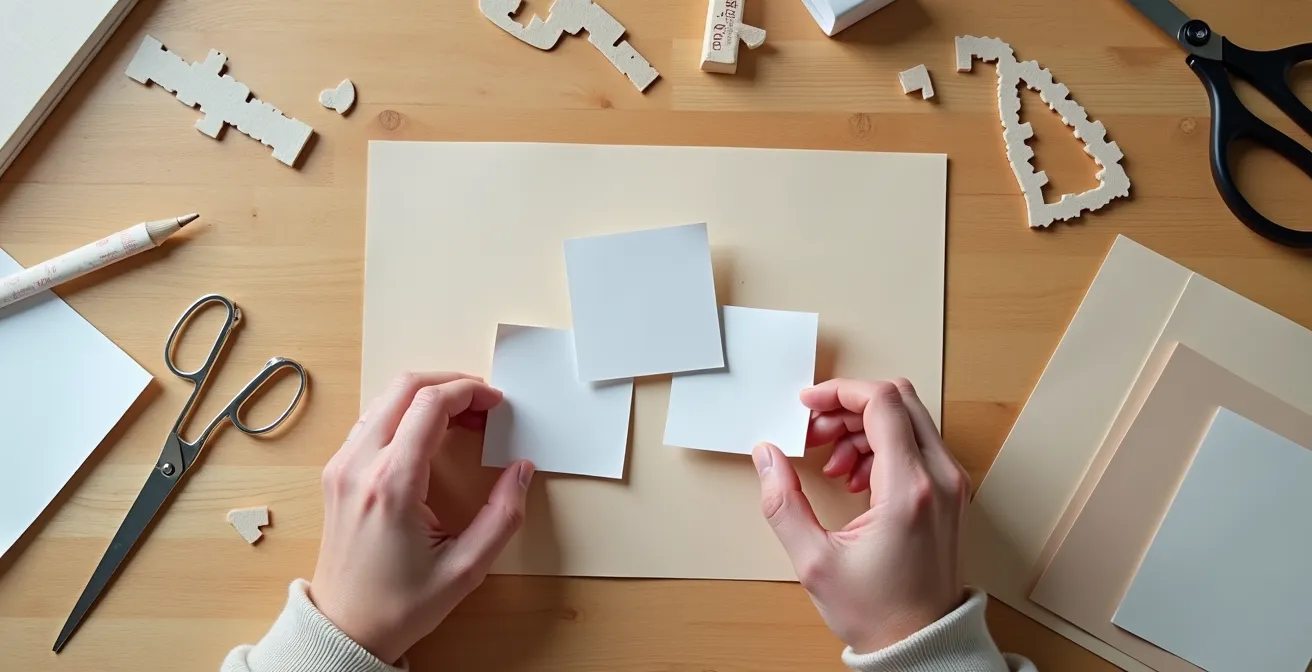
As the image above demonstrates, the arrangement feels harmonious and draws you in, rather than pushing you away. This isn’t just about aesthetics; it’s about communication. You’re using layout to establish a visual hierarchy, telling your future grandchild, “Look here first, this is the most important part of the memory.” The same principle applies to digital layouts. Using the rule of odds—grouping images in threes or fives—and leaving adequate “white space” or breathing room around them prevents the cognitive overload that makes people quickly swipe past a digital gallery.
A great way to test your layout is the “squint test.” Step back from your page or screen and squint your eyes until the images blur. Can you still make out a clear, balanced structure? Or is it a chaotic mess? This simple test reveals whether you’ve created a focused visual narrative or just a pile of pictures. Effective curation starts with making conscious choices about what to show and how to show it.
By thoughtfully arranging your photos, you transform a simple collection into a guided experience, ensuring the emotional weight of each memory is fully communicated across generations.
Writer’s Block: What to Write Next to the Photo When You Forget the Date?
You’ve selected the photos and arranged them beautifully. Now comes the caption, and your mind goes blank. You can’t recall the exact date, the name of the beach, or who else was there. This is a common roadblock, but it stems from a misconception about what makes a caption valuable. For future generations, the precise date is far less important than the emotional provenance of the image. Why did this moment matter? How did it feel? This is the context that brings a photo to life.
Instead of facts, focus on feelings and senses. What do you remember hearing, smelling, or tasting? What was the joke that made everyone laugh just before the photo was taken? As licensed psychologist Dr. David Krauss emphasizes, the underlying purpose of these artifacts is emotional. He notes, “I think it is really important to show a child he or she is valued and appreciated. It says we love you and care about you. You’re important.” Your captions are a direct line to that feeling. Research from the University of Sheffield confirms this, showing that looking at family photos evokes positive emotions and enhances a sense of belonging and security.
If you’re truly stuck, try these approaches:
- Label by Era: Instead of “July 1992,” use “The Summer We Lived on Elm Street” or “Before Your Aunt Sarah Moved Away.” This provides a rich, narrative context.
- Pose a Question: “I’ll never forget the feeling of the sun that day. I wonder if this is where you got your love for the ocean?” This invites your descendant into a conversation.
- Quote a Song or Poem: If a piece of music or literature captures the mood of the photo, use it. It adds another layer of cultural and emotional context.
Remember, you are not writing a history textbook. You are leaving a trail of love letters for the future. The most important details are the ones that only you can provide: the feeling behind the smile.
The “ABC” Sorting Method: How to Tackle a Box of 500 Unsorted Photos?
Facing a shoebox brimming with hundreds, or even thousands, of unsorted photos can feel paralyzing. The traditional approach of sorting chronologically is often the reason people give up. It’s tedious, and a strict timeline can break up important narrative threads. An archivist would suggest a different approach, one focused on intentional curation before organization. It’s a method you can remember as “ABC”: Archive By Chapter.
Instead of starting with the oldest photo, you start with the most important stories. The goal isn’t to create a perfect timeline, but to build a collection that reflects the narrative of your family. This “Story-First” method turns an overwhelming task into a meaningful journey of remembrance. It ensures that the final collection—whether a physical scrapbook or a digital album—is not just a sequence of events, but a curated anthology of what made your family unique. The process is far more engaging and results in a more compelling legacy for your grandchildren.
By starting with the “why” (the stories) before the “what” (the photos), you transform the daunting task of sorting into a purposeful act of storytelling. This ensures your final archive is not just organized, but deeply meaningful.
Your Action Plan: The Story-First Curation Method
- Define 5-10 essential family stories you want to preserve before sorting any photos.
- Create story categories rather than chronological folders (e.g., ‘Adventures’, ‘Celebrations’, ‘Everyday Magic’).
- Sort photos into these narrative themes, not by date or alphabetically.
- Identify photos that serve multiple stories—these are your ‘cornerstone’ images.
- Involve family members in voting on the most meaningful photos to ensure investment in the final collection.
This process of intentional selection is what separates a meaningful archive from a simple pile of pictures. You are not just a record-keeper; you are the first editor of your family’s history.
Pockets and Flaps: How to Include Ticket Stubs Without Gluing Them Down?
A family’s history is told through more than just photographs. It’s in the crinkled concert ticket, the postcard from a first trip, the delicate drawing a child brought home from school. These pieces of ephemera are tangible links to a memory, but incorporating them into an archive presents a challenge. Gluing them down is often destructive, as the adhesive can damage the item over time and permanently hides any information on the back.
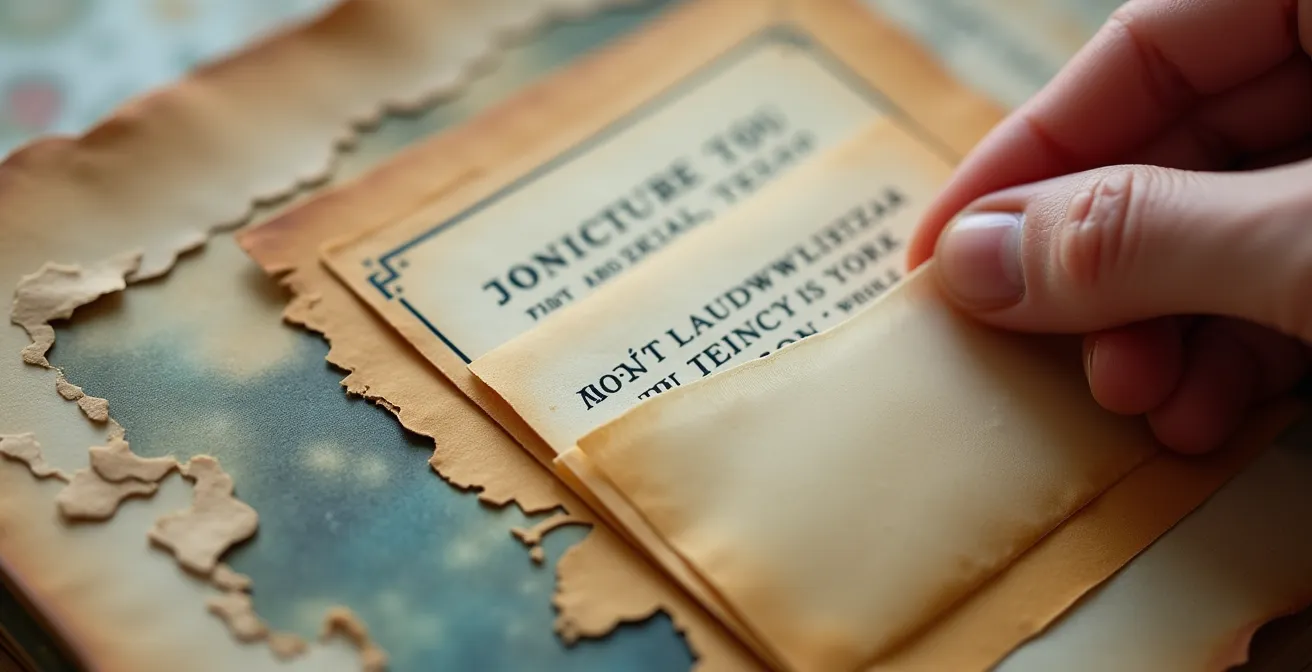
The archivist’s solution is to create non-destructive, interactive elements. Using archival-quality pockets, flaps, and envelopes allows you to include these items safely. You can buy pre-made photo corners and vellum envelopes, or create your own using acid-free paper. This approach has several benefits: it protects the original item, allows future generations to handle it and read both sides, and adds a delightful element of discovery to the album. A study from the University of Cambridge found that the act of selective sharing and interaction with memories enhances recollection of details. These interactive elements serve a similar purpose, inviting your descendants to engage more deeply with the story.
The digital equivalent involves creating a more robust file structure. Instead of just a folder of JPEGs, create a sub-folder for each key event. Inside, you can have the photos, a scanned PDF of the ticket stub, and a simple text file with your written memories of the day. You can even include a short audio or video file where you tell the story. The principle is the same: you are bundling the context with the primary artifact, creating a richer, multi-layered memory package.
By treating every piece of your history with care, you build an archive that is not just seen, but experienced, touched, and explored for years to come.
Fixative Spray: How to Stop Your Charcoal Drawings from Smudging?
In the art world, a charcoal drawing is not finished until it has been sprayed with a fixative. This invisible layer protects the fragile particles from smudging, ensuring the artist’s vision endures. For a family archivist, the concept of a “fixative” is a powerful metaphor for digital preservation. A digital file, like a charcoal drawing, is inherently unstable. Without a protective strategy, it is destined to degrade and disappear into the digital ether, a victim of the looming Digital Dark Age.
The convenience of digital storage has lulled us into a false sense of security. We assume our data is permanent, but the reality is that digital formats become obsolete, storage media fails, and files silently corrupt. The danger is real; a recent report from the Digital Preservation Coalition found that 6 digital content categories showed increased risk for the second consecutive year, meaning our ability to access them in the future is actively diminishing. Your digital photo library requires its own “fixative spray”—a proactive strategy of maintenance and migration.
This strategy includes:
- Regular Backups: The 3-2-1 rule is a good start (3 copies of your data, on 2 different media types, with 1 copy off-site).
- Format Migration: Every 5-7 years, review your files and consider converting them to a more current, stable format (e.g., from an old RAW format to a DNG or TIFF).
- Metadata: Embedding captions, dates, and keywords directly into the file’s metadata ensures the story travels with the image, even if it’s separated from its original folder.
This active management is the only way to combat digital decay. As researchers on the Digital Dark Age have warned:
Like monks from the Middle Ages who preserved books (and therefore, knowledge), we must preserve digital objects of today. Otherwise, future generations will be left with gaps in knowledge about our present-day lives.
– Digital Preservation Researchers, The Conversation – Digital Dark Age Study
Your role as a family archivist is to be that modern-day monk, applying the necessary fixative to ensure your family’s digital legacy doesn’t simply fade away.
Open Shelving vs. Closed Cabinets: Which Is Better for Dust-Prone Collectibles?
In home decor, the choice between open shelving and closed cabinets is one of aesthetics versus protection. Do you want your collectibles visible but exposed to dust, or safe but hidden away? In personal archiving, we face a parallel decision: do we store our curated memories on “open shelves” like social media, or in “closed cabinets” like private hard drives and physical albums?
Posting family photos online offers the immediate gratification of social validation and easy sharing. It makes the memories feel alive and part of a public conversation. However, this accessibility comes at a cost. You surrender control over your data, expose your family’s history to data mining, and tie its future to the whims of a corporation that may not exist in 20 years. This is context collapse, where a personal memory is stripped of its intimate meaning and becomes public content.
A private, “closed cabinet” approach—whether a physical album on a bookshelf or an encrypted hard drive in a safe—offers maximum control and protection. You control who sees it, how it’s presented, and its long-term preservation plan. The trade-off is a lack of immediate accessibility and shareability. This method requires a more formal plan for future access, such as creating a digital estate plan that designates a “digital executor” with the credentials and instructions to access your archive after you’re gone.
This table compares the trade-offs of storing your family’s legacy in public versus private spaces.
| Aspect | Open (Social Media) | Closed (Private Storage) |
|---|---|---|
| Accessibility | Immediate, widespread | Controlled, limited |
| Vulnerability | Data mining, context collapse | Physical degradation only |
| Emotional Impact | Social validation reinforces memories | Personal reflection preserved |
| Future Access | Platform dependent | Requires estate planning |
There is no single right answer, but an archivist would urge you to prioritize long-term control and security over short-term visibility. A legacy is a private treasure before it is a public story.
Key Takeaways
- True preservation is an active, ongoing process for both physical albums (fighting acid) and digital files (fighting bit rot).
- The value of a family archive lies in intentional curation and contextual storytelling, not the quantity of photos or the medium used.
- The best archival system is the one you are personally most committed to maintaining for decades to come, including plans for future access.
Cardstock vs. Crepe: Which Paper Holds Its Shape for Large Flowers?
In the world of paper crafts, choosing between sturdy cardstock and flexible crepe paper depends entirely on your goal. One provides structure, the other offers malleability. This choice mirrors the final decision you face as a family historian. Do you opt for the defined, unchangeable structure of a printed photobook, or the creative, flexible, and ever-expandable nature of a physical scrapbook?
By now, it should be clear that this is not a question of which is “better,” but which best aligns with your long-term archival commitment. A digital photobook offers perfect structure. It’s clean, easily reproducible for other family members, and the design is locked in, safe from scissors or spilled coffee. Its cost is predictable, though it can vary based on size and paper quality. It is the cardstock of memory-keeping: strong, defined, and unchanging.
A physical scrapbook is like crepe paper: infinitely flexible. You can add new pages, tuck in new mementos, and invite others to add their own handwritten notes over the years. It is a living document. This creative freedom comes with variable costs for high-quality supplies and a greater need for disciplined use of archival materials. Some people find the hands-on process of taping, cutting, and writing therapeutic, while others prefer the clean interface of a software program.
Many find a hybrid approach to be the ideal solution. You can design and print a digital photobook with plenty of white space or even blank pages. This gives you a structured foundation that can be easily shared, while also providing space to add handwritten stories and physical mementos like ticket stubs or a lock of a baby’s hair. This method combines the durability of cardstock with the creative potential of crepe paper, creating a robust yet personal family treasure.
The most important decision was made when you committed to the process of intentional curation and storytelling. Choose the format that brings you the most joy in that process, as that is the one you will sustain for the generations who will one day hold it in their hands.
Frequently Asked Questions About Preserving Family Photos
What if I can’t remember specific dates or details for a photo?
Focus on emotional and sensory context instead of facts. Label storage files or album sections by era, such as ‘The Younger Days’ or ‘Happy Memories,’ rather than specific dates. You can also write about what you remember hearing, smelling, or feeling in that moment to create a richer story than a simple timestamp.
How can I add context to a photo without factual details?
Describe the sensory memories associated with the photo. What song was playing? What did the air smell like? How did the moment feel emotionally? These details provide a powerful and intimate context that is often more meaningful to future generations than a date or location.
Should I leave space for others to contribute to the memories?
Yes, absolutely. Collaborative memory-keeping enriches the archive. In a physical scrapbook, leave blank spaces or pages for others to add their recollections. In a digital archive, you can use shared documents or even QR codes in a printed book that link to online folders where family members can upload their own photos or voice memos.
When should I choose digital photo books over physical scrapbooking?
Digital photo books are the ideal choice if you know multiple family members will want a copy, as they are easy to reprint. They are also great if you enjoy working on the computer and learning new software. They provide a clean, structured, and easily shareable final product.
What if I want both the structure of a digital book and the creativity of a physical one?
A hybrid approach is your best option. Design and print a digital photobook with a primary narrative, but intentionally leave some pages blank or with lots of white space. You can then add handwritten notes, physical mementos like ticket stubs, and other personal touches to these pages, giving you the best of both worlds.