
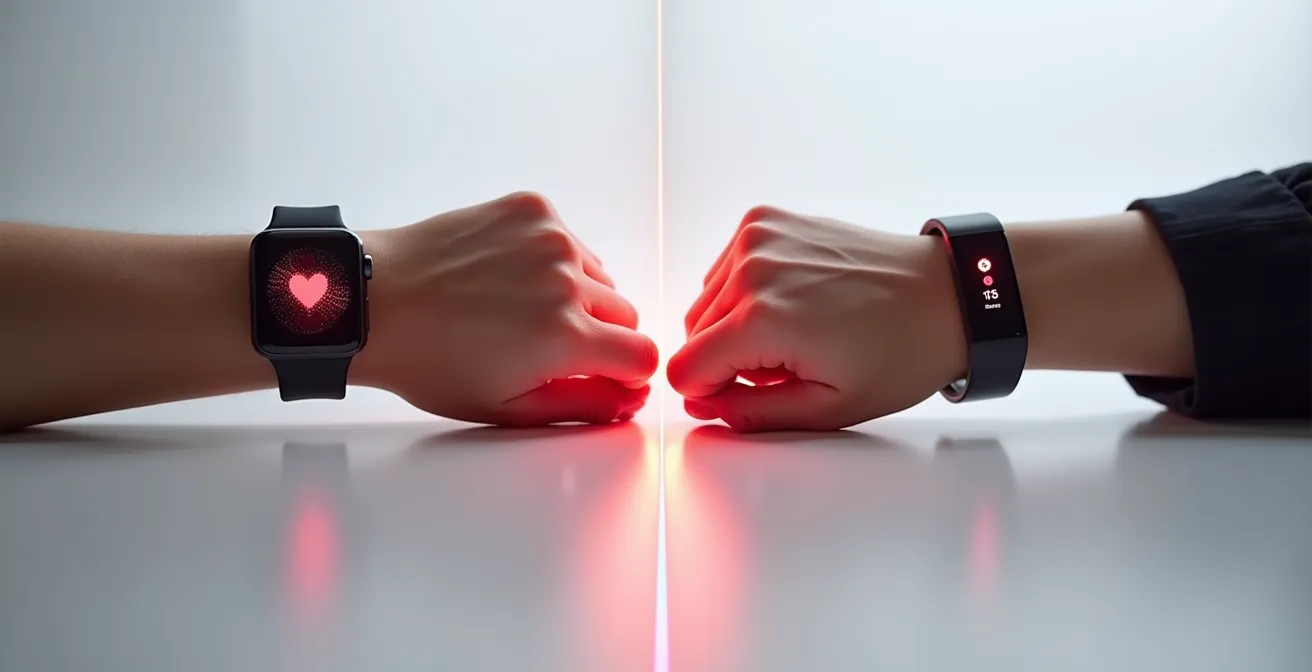
Choosing between an Apple Watch and a Fitbit based on heart rate accuracy alone is asking the wrong question.
- True accuracy is contextual, fluctuating with activity type, sensor age, and even how you wear the device.
- The psychological impact of data (like sleep-tracking anxiety) and the privacy risks of sharing it are often more significant than minor differences in sensor precision.
Recommendation: Shift your focus from finding the “most accurate” device to becoming a more critical user of your data—understanding its limitations, protecting your privacy, and prioritizing how you feel over what the numbers say.
The debate between Apple Watch and Fitbit often boils down to a head-to-head comparison of features, battery life, and ecosystem integration. For the data-driven fitness enthusiast, however, one question eclipses all others: which one has the most accurate heart rate monitor? It’s a valid query, but it steers the conversation in the wrong direction. We obsess over fractions of a percentage point in accuracy, comparing lab tests and spec sheets, assuming that more precise data automatically leads to better health outcomes.
This pursuit of numerical perfection overlooks a far more critical landscape. As a sports physiologist, I argue that the utility of a fitness tracker isn’t found in its raw sensor precision but in our ability to practice “data literacy.” This means understanding the context behind the numbers, recognizing the technology’s inherent limitations, and managing the profound psychological and privacy implications of strapping a 24/7 data-collection device to your wrist. The most “accurate” tracker is useless, and potentially harmful, if it fosters anxiety or if your personal data is being sold to third parties without your full comprehension.
Instead of declaring a winner in the Apple Watch vs. Fitbit race, this article will equip you to be a smarter user of whichever device you choose. We will dissect the hidden costs of tracking, from the paradox of sleep monitoring to the trade-offs between features and functionality. We’ll explore the murky world of data ownership and provide actionable steps to safeguard your privacy. Ultimately, you’ll learn to use your tracker as a tool, not a tyrant, by knowing when to trust the data and, more importantly, when to trust your own body.
This guide provides a comprehensive framework for evaluating your fitness tracker beyond its marketing claims. The following sections will walk you through the critical, often-overlooked aspects of wearable technology, helping you maximize its utility while minimizing its risks.
Table of Contents: A Deeper Look into Wearable Data Accuracy and Utility
- Orthosomnia: When Sleep Tracking Actually Ruins Your Sleep Quality
- How to Sync Your Smart Scale to Your Nutrition App Without Glitches?
- GPS or Battery Life: What Do You Sacrifice in a Fitness Tracker?
- Who Owns Your Heartbeat? The Risks of Sharing Fitness Data with Insurers
- When to Replace Your Tracker: 3 Signs the Sensors Are Failing
- Ball Chair or Ergonomic Mesh: Which Is Better for 8-Hour Shifts?
- HIPAA Compliant? How to Check if Your Health App Sells Your Data
- Electrolytes: Do You Need Them If You Aren’t Running a Marathon?
Orthosomnia: When Sleep Tracking Actually Ruins Your Sleep Quality
The promise of sleep tracking is seductive: quantify your rest, optimize your recovery, and wake up energized. Yet, for a growing number of users, this quest for the perfect sleep score backfires, leading to a condition known as orthosomnia—an obsession with achieving ideal sleep data that paradoxically creates anxiety and degrades sleep quality. Instead of resting, the user lies in bed wondering if they are getting enough “deep sleep” or worrying about a low score from the previous night. This creates a feedback loop where the stress of monitoring sleep becomes the very thing that prevents it.
This phenomenon highlights the psychological overhead of constant data monitoring. The tracker’s data, which uses optical sensors and accelerometers to estimate sleep stages, isn’t a direct measurement from a sleep lab. It’s an algorithmic interpretation. When we grant this data more authority than our own subjective feeling of being rested, we disconnect from our body’s natural cues. In fact, recent research reveals that up to 14% of sleep tracker users show signs of this performance anxiety related to their sleep data.

The image above captures the subtle intrusion of technology into our most private space for recovery. The focus should shift from achieving a perfect nightly score to recognizing long-term trends and, most importantly, correlating the data with how you actually feel. A “bad” score on a night before you feel great is noise; a week of poor scores accompanied by fatigue is a signal worth investigating. The goal is not to please the app but to use it as one of several tools to understand your well-being.
How to Sync Your Smart Scale to Your Nutrition App Without Glitches?
The modern health ecosystem promises a seamless flow of information: your smart scale communicates your weight to your fitness app, which then adjusts your daily calorie targets in your nutrition log. This connected universe is powerful when it works, but its fragility is a source of constant frustration for many users. Syncing glitches, data lags, and app conflicts are not just minor annoyances; they undermine the very utility of collecting data in the first place. When data is incomplete or inaccurate, it becomes unreliable for making informed decisions.
These technical failures expose the weak links in the chain of data transfer. A common issue is Bluetooth connectivity, where devices fail to pair or maintain a stable connection. Another is data lag, where information from one platform takes minutes or even hours to appear on another, leading to confusion. App conflicts can also arise, where two applications compete for control of a data source, or a software update on one end breaks compatibility on the other. This forces the user to become a de facto IT technician, troubleshooting a complex system they were told would “just work.”
Understanding the most common failure points is the first step toward resolving them. The process often involves a tedious cycle of resetting devices, force-closing apps, and checking for software updates. Below is a breakdown of typical issues and their standard solutions.
This table, based on an analysis of common user complaints, illustrates how frequently sync issues occur and the typical steps required for resolution. For example, a data lag issue, the most frequent problem, is often solved simply by waiting, as indicated by a recent comparative analysis of device ecosystems.
| Issue Type | Frequency | Solution | Success Rate |
|---|---|---|---|
| Bluetooth Connection | 35% | Reset both devices | 85% |
| Data Lag | 45% | Wait 3-5 minutes | 90% |
| App Conflicts | 20% | Force close and restart | 75% |
The ultimate takeaway is a lesson in patience and lowered expectations. While the vision of a perfectly integrated health data network is compelling, the reality is often messy. Being prepared for these glitches helps manage frustration and ensures you don’t abandon your tracking efforts due to technical hiccups.
GPS or Battery Life: What Do You Sacrifice in a Fitness Tracker?
For any outdoor fitness enthusiast, from runners to cyclists, built-in GPS is a non-negotiable feature. It provides accurate tracking of distance, pace, and route without needing to carry a smartphone. However, this precision comes at a steep price: battery life. This is the fundamental trade-off at the heart of every fitness tracker and smartwatch design. There is no device, whether Apple Watch or Fitbit, that offers best-in-class GPS accuracy without a significant impact on how long it can last on a single charge.
The reason for this drain is simple: the GPS chipset requires a constant, power-hungry connection to satellites to pinpoint your location in real time. From a physiological data perspective, this means you are forced to make a choice. Do you want precise location data for every workout, requiring you to charge your device daily? Or do you prioritize multi-day battery life, forgoing GPS or using it only sparingly? According to industry tests, the compromise is stark; GPS reduces battery life by up to 80% during active tracking compared to standby mode.
This decision directly impacts the consistency and completeness of your data. An athlete who forgets to charge their watch after a long run with GPS enabled may miss out on tracking their sleep and recovery metrics that night. This creates gaps in the long-term data trends that are often more valuable than the pace data from a single workout. Some users adopt a hybrid approach, using “Connected GPS,” which leverages their phone’s GPS to save the watch’s battery, but this negates the primary benefit of a standalone device.
Real-World Battery Performance Comparison
Testing revealed that fitness trackers can run for days or even weeks on a single charge when GPS is disabled. For instance, devices like the Suunto Race S can last up to 13 days in smartwatch mode, and specialized Garmin Instinct models offer even more extended battery life. However, once continuous GPS tracking is activated for activities, these figures drop dramatically to a matter of hours, illustrating the direct and significant sacrifice required for location accuracy.
Ultimately, the “better” choice depends on your primary use case. A marathon runner may accept daily charging as the cost of getting precise training data. In contrast, someone focused on 24/7 health monitoring (sleep, steps, resting heart rate) might be better served by a device with a less powerful GPS but a week-long battery life. The question isn’t just “Apple Watch or Fitbit,” but which operational mode you will realistically live with.
Who Owns Your Heartbeat? The Risks of Sharing Fitness Data with Insurers
While we worry about the accuracy of our heart rate data, a far bigger question looms: who owns that data, and what are they doing with it? Fitness trackers and health apps collect some of the most intimate information about our lives—our sleep patterns, activity levels, heart rate variability, and even stress responses. This data is incredibly valuable, not just to us, but to a host of third parties, including advertisers, researchers, and, most notably, insurance companies. The market for our health data is booming, with some projections estimating that revenue from health device data sold to insurance companies could reach $855 million by 2023.
Many insurance providers now offer “wellness programs” that reward users with lower premiums or other perks for sharing their fitness tracker data. On the surface, it seems like a win-win: you get a discount for being active. However, this practice opens a Pandora’s box of privacy and ethical concerns. What happens if your activity level drops due to an injury or illness? Could your premium increase? Could you be denied coverage based on data that suggests a “high-risk” lifestyle? The data, stripped of its context, could be used to make automated judgments about your health that have real financial consequences.
The core of the problem is a lack of transparency and regulation. Unlike medical records held by a doctor, most fitness tracker data is not protected by stringent privacy laws like HIPAA. This gives companies wide latitude to use, share, or sell your information as outlined in their lengthy and often-confusing privacy policies. As one authoritative study points out, transparency is a major weakness in the industry. As a study in Nature Digital Medicine analyzing privacy in consumer wearable technologies found:
High Risk ratings were most frequent for transparency reporting (76%) and vulnerability disclosure (65%), while Low Risk ratings were common for identity policy (94%) and data access (71%)
– Nature Digital Medicine Study
This highlights that while companies might be good at securing your identity, they are very poor at being transparent about what they do with your data. Protecting your data requires proactive effort. It’s not enough to trust the brand; you must become a critical manager of your own privacy settings.
Action Plan: Protecting Your Fitness Data Privacy
- Privacy Settings Review: Immediately access your app’s settings and change your profile from ‘public’ to ‘private’. This is the first line of defense.
- HIPAA Check: Inventory your health apps and verify if any are connected to a healthcare provider. Most consumer-grade trackers are not covered by HIPAA, so assume your data is unprotected unless proven otherwise.
- Policy Keyword Scan: Confront the privacy policy. Use your browser’s search function (Ctrl+F) to find keywords like “share,” “aggregate,” “third-party,” and “sell” to quickly identify how your data is monetized.
- Legal Compulsion Awareness: Acknowledge that even with strong privacy settings, companies can be legally forced to share your data in legal proceedings. Your data is never truly 100% private.
- Acquisition Watch: Set up a news alert for the company that makes your tracker. Be aware that if the company is acquired, its data protection policies can change overnight under the new ownership.
When to Replace Your Tracker: 3 Signs the Sensors Are Failing
We upgrade our phones when the battery dies or the software becomes slow, but we often expect our fitness trackers to perform flawlessly for years. This is a flawed assumption. The sophisticated optical sensors (photoplethysmography or PPG) used to measure heart rate are physical components subject to wear and tear. Over time, their accuracy can degrade due to micro-scratches on the lens, degradation of the LEDs, or moisture damage. This concept of sensor degradation is crucial for anyone who relies on their tracker for consistent data.
A brand-new Apple Watch or Fitbit may be highly accurate out of the box, but a three-year-old device that has been through countless workouts, showers, and accidental bumps may not be. The challenge is that this degradation is often gradual and invisible. Your device won’t flash a “sensor failing” warning. Instead, you might notice subtle anomalies in your data: a resting heart rate that seems inexplicably higher or lower than your long-term average, or erratic heart rate spikes during a steady-state cardio session. While even new devices have a margin of error, often between a 4-16% measurement error, a failing sensor will produce data that is consistently unreliable.
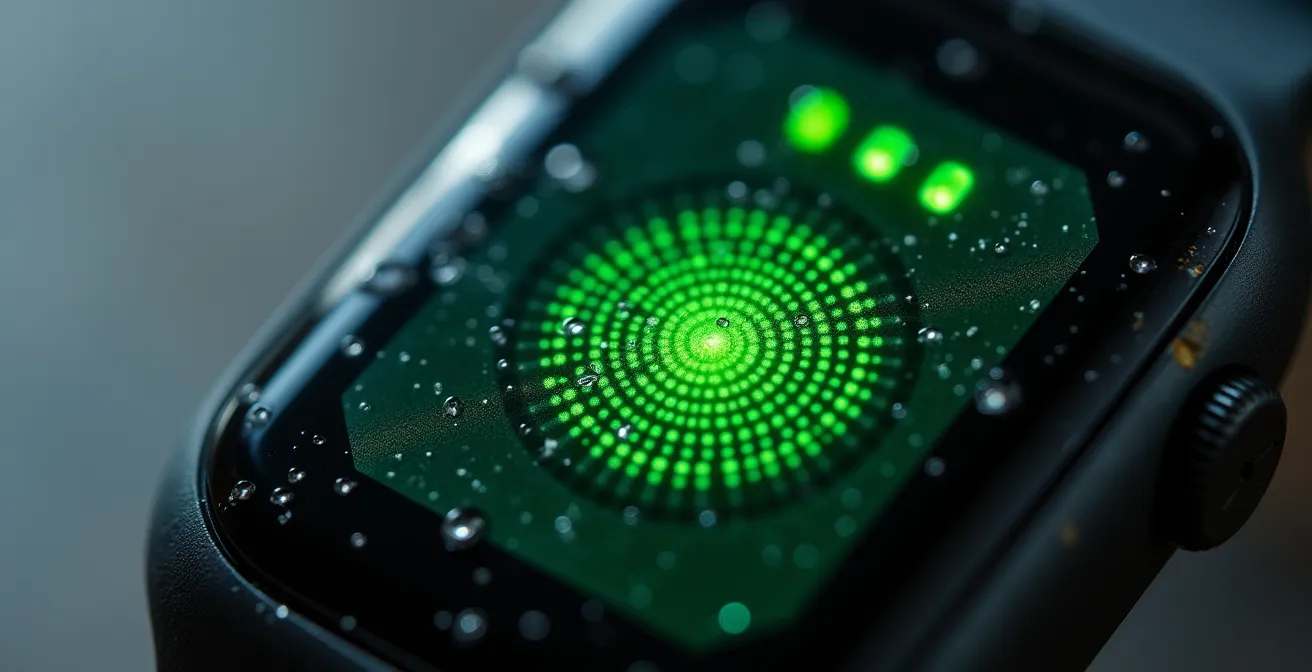
The three key signs that your tracker’s sensors may be failing are:
- Increased Data Inconsistency: You see wild, unexplainable fluctuations in your heart rate during activities where it should be stable. For example, your heart rate reads 170 bpm while you’re on a gentle walk.
- Deviation from a Known Baseline: Your long-term resting heart rate (RHR) trend suddenly shifts by several beats per minute without any corresponding change in your training, stress, or health.
- Failure to Lock On: The device frequently has trouble getting a heart rate reading, displaying “–” or greyed-out numbers, especially at the start of a workout, even when worn correctly.
You can perform a simple diagnostic by comparing your tracker’s reading at rest with a manual pulse check (counting your pulse at your wrist for 60 seconds) or with a reading from a pharmacy blood pressure cuff. If there is a consistent and significant discrepancy, it may be time for a replacement.
Ball Chair or Ergonomic Mesh: Which Is Better for 8-Hour Shifts?
The discussion around fitness trackers is often confined to workouts and sleep. However, their utility extends far beyond the gym. These devices are powerful tools for understanding our “passive” physiology—the subtle ways our bodies respond to our environment throughout the day, especially in a sedentary office setting. For instance, a fitness tracker can provide objective data to help settle a classic office debate: is a stability ball chair or a high-end ergonomic mesh chair better for an eight-hour workday?
Traditionally, this choice is based on subjective comfort. The ergonomic chair offers lumbar support and adjustability, while the ball chair promises to engage your core. A fitness tracker elevates this decision from a matter of opinion to a data-driven experiment. By wearing your tracker for a week with each chair, you can collect metrics that reveal how your body is actually reacting to each seating option. You can monitor your sedentary heart rate, track the frequency of “stand” reminders, and even analyze the micro-movements detected by the accelerometer.
This application transforms the tracker from a simple step counter into a personal ergonomics consultant. You might discover that while the ball chair feels like it’s “working,” it also slightly elevates your resting heart rate due to constant stabilization, a sign of low-level stress. Conversely, the ergonomic chair might result in fewer stand reminders, indicating prolonged, unhealthy periods of inactivity. This approach aligns with research showing the viability of wearables in clinical and workplace settings.
Using Fitness Trackers to Evaluate Workplace Ergonomics
A study published in a prominent scientific journal explored this very concept. Researchers had 39 adults wear fitness trackers during 20 minutes of sedentary activity, finding that the devices could effectively measure heart rate changes corresponding to different seated positions. This validates the use of consumer-grade wearables to gather meaningful physiological data in a typical office environment, empowering individuals to make evidence-based choices about their workspace.
By leveraging your tracker in this way, you move beyond the generic “Apple Watch vs. Fitbit” comparison and start using the technology to answer specific, personal questions about your health and environment. It’s a prime example of practicing data literacy—using the tool to generate actionable insights for your unique context.
HIPAA Compliant? How to Check if Your Health App Sells Your Data
One of the most pervasive myths about health data is that it’s all protected by the Health Insurance Portability and Accountability Act (HIPAA). This U.S. federal law sets the standard for protecting sensitive patient data. However, a critical distinction is often missed: HIPAA generally applies only to “covered entities” such as healthcare providers, health plans, and healthcare clearinghouses, and their business associates. Your Fitbit, Apple Health, or MyFitnessPal account? In most cases, they are not covered.
This creates a significant HIPAA coverage gap. When you willingly share data with a consumer technology company, you are operating in a regulatory gray area. These companies are typically governed by consumer protection laws and their own privacy policies, which, as we’ve discussed, can be vague and permissive. According to guidance from the U.S. Department of Health and Human Services, it’s confirmed that most fitness trackers are NOT covered by HIPAA unless they are provided as part of a treatment plan by a covered entity (e.g., a doctor prescribes a specific app to monitor a condition).
So, how can you check if your data is being sold? The most direct method is to read the privacy policy, but this can be a daunting task. A more efficient strategy is to search the document for specific keywords. Look for terms like:
- “Third-party” or “Partners”: This language often indicates that data is shared with other companies for marketing, research, or other purposes.
- “Anonymized” or “Aggregated Data”: Companies often claim they only sell “anonymized” data. However, research has shown that such data can often be “de-anonymized” and traced back to individuals.
- “Sell”: Some policies will be explicit about selling data, though this is becoming less common due to public backlash.
- “Marketing” or “Advertising”: This indicates your data is being used to target you with ads, either directly or through partners.
The absence of comprehensive federal protection in the U.S. puts the onus entirely on the consumer. In contrast, residents of Europe benefit from the GDPR, and Californians have some rights under the CCPA, but for most users, diligent self-policing is the only option.
Key takeaways
- The pursuit of perfect sleep data can lead to “orthosomnia,” an anxiety that ironically harms sleep quality. Prioritize how you feel over the device’s score.
- Your health data is a valuable commodity. Most fitness trackers are not covered by HIPAA, leaving your data vulnerable to being shared or sold to third parties like insurers.
- The accuracy of a tracker’s sensors degrades over time. Watch for signs like inconsistent readings or sudden shifts in your baseline metrics to know when a replacement is needed.
Electrolytes: Do You Need Them If You Aren’t Running a Marathon?
The final and perhaps most important aspect of data literacy is knowing the limits of the technology and when to trust your body’s signals over the device’s output. A fitness tracker is excellent at measuring certain metrics like heart rate and movement, but it cannot see your full physiological picture. For example, it can’t directly measure your hydration status or electrolyte balance, two critical factors for performance and well-being.
While a tracker can’t detect dehydration directly, it can pick up on its secondary effects. For instance, research indicates that resting heart rate increases 3-5 bpm when dehydrated as the body works harder to maintain blood pressure. An astute user might notice a slight elevation in their RHR after a hot day with low water intake and interpret it as a signal to hydrate. This is a perfect example of using the tracker’s data as one clue in a larger diagnostic puzzle, rather than as a definitive answer.
This also applies to more serious health concerns. While some advanced trackers can perform an ECG-like reading to detect atrial fibrillation (AFib), they are not a substitute for medical-grade equipment. As noted by experts like Peter Charlton from the University of Cambridge, while some fitness trackers can identify irregular heart rhythms with sufficient accuracy to warrant further clinical investigation, these wrist-based devices cannot fully substitute for a comprehensive ECG test. They can provide an early warning—a signal—but the diagnosis must come from a healthcare professional.
Frequently Asked Questions on Apple Watch or Fitbit: Which Health Tracker is Most Accurate for Heart Rate?
Does HIPAA protect my fitness tracker data?
No, HIPAA generally does not cover consumer fitness trackers and health apps unless they are provided by or share data with a covered healthcare entity.
What laws do protect wearable device data?
In Europe, GDPR provides protection. In California, the CCPA offers some rights. However, there is no comprehensive federal law in the US specifically for fitness tracker data.
Can companies sell my health data without my knowledge?
Yes, if their privacy policy allows it. Many companies sell ‘anonymized’ data to third parties, though this data can sometimes be de-anonymized.
Ultimately, whether you choose an Apple Watch, a Fitbit, or another device, the most important skill to develop is critical thinking. Use the data to ask better questions, not to find definitive answers. Pay attention to trends over time, correlate the numbers with your subjective feelings, and never abdicate your own intuition to an algorithm. The most accurate sensor is, and always will be, your own body.
The next logical step is to critically evaluate your own relationship with your health data, review your privacy settings, and start treating your tracker as a valuable but imperfect guide.