
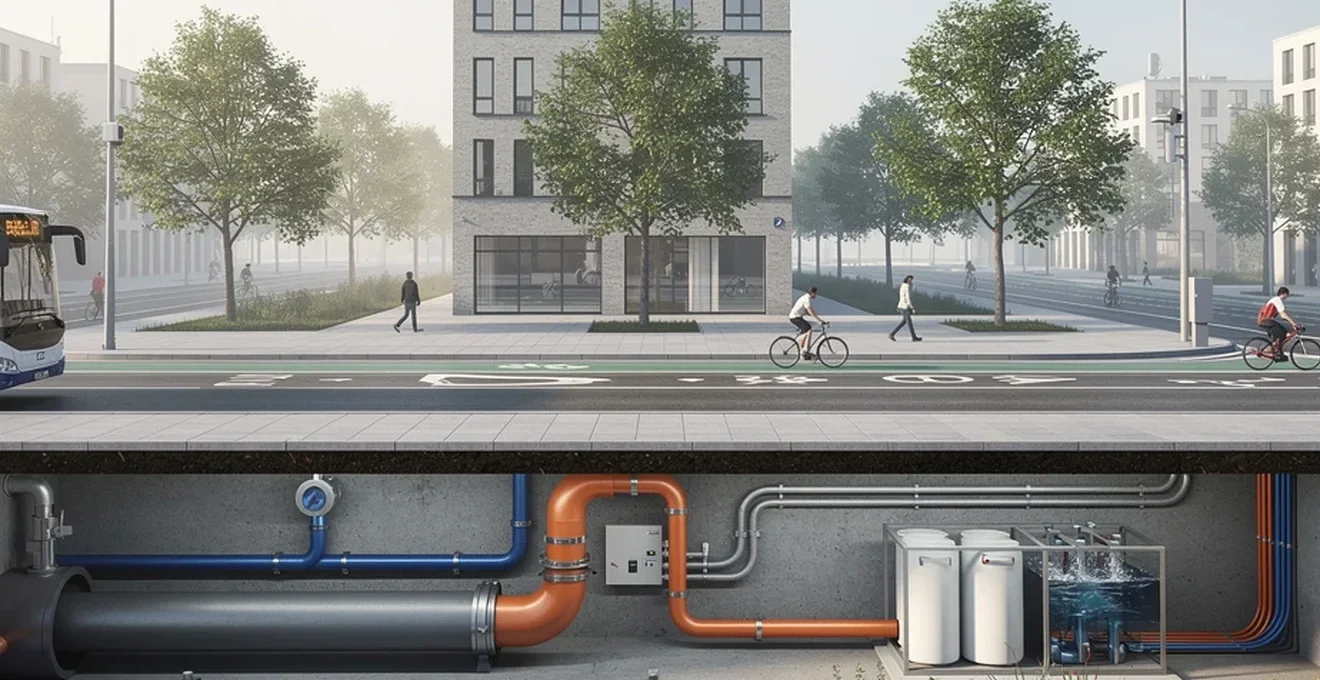
With more than half the world’s population now living in cities, and that figure projected to approach 70% by 2050, the systems running beneath and around our streets have never mattered more. Water pipes, transport corridors, power grids, drainage channels and digital networks form the invisible scaffolding of urban quality of life. When these systems function well, they support public health, reduce environmental risk and give residents the freedom to move, work and live safely. When they fail or fall behind demand, the consequences are felt disproportionately by the most vulnerable urban dwellers. This article examines how core areas of municipal infrastructure – from sanitation and transport to energy, drainage, digital connectivity and waste management – shape the liveability and resilience of the cities we inhabit.
Water supply networks and sanitation systems as public health foundations
Clean water and effective sanitation remain among the most fundamental determinants of urban public health. The World Health Organization has identified overcrowded and poorly serviced environments as breeding grounds for infectious disease, and water infrastructure sits at the heart of preventing this. Standards such as BS 8680:2020 Water quality. Water safety plans. Code of practice provide a framework for managing water safety systematically, helping utilities anticipate risks before they reach the taps of residents.
Combined sewer overflow management in Victorian-Era cities
Many major cities still rely on sewer systems designed more than a century ago, when engineers combined stormwater and wastewater into single pipe networks. During heavy rainfall, these combined systems can overflow, releasing untreated sewage into rivers and coastal waters. Managing this legacy infrastructure requires substantial investment in storage tunnels, overflow monitoring and gradual separation of stormwater from foul water, an ongoing challenge for ageing urban centres balancing historic infrastructure with modern environmental expectations.
Membrane bioreactor technology in modern wastewater treatment plants
Contemporary wastewater treatment increasingly combines biological treatment with membrane filtration, producing effluent of a higher quality than conventional processes while requiring a smaller physical footprint. This matters in dense urban environments where land for new treatment infrastructure is scarce, and it supports water reuse strategies that reduce pressure on freshwater supplies.
Lead pipe replacement programmes: lessons from flint, michigan
The contamination crisis in Flint, Michigan, became a global reference point for the dangers of deteriorating water infrastructure and inadequate corrosion control. It highlighted how ageing lead service lines can silently compromise public health, particularly for children, and underscored the importance of proactive pipe replacement programmes rather than reactive crisis management once contamination is detected.
Smart water metering and Non-Revenue water reduction strategies
Smart metering allows utilities to track consumption patterns in real time, helping identify leaks and reduce so-called non-revenue water – water that is treated and pumped but never billed due to losses in the network. This directly supports the kind of efficiency demonstrated in developments such as London’s East Village, which uses roughly half the water of a typical urban area through recycling and reed-bed filtration systems that treat rainwater naturally before it is reused for irrigation and flushing.
Transport infrastructure and multimodal connectivity planning
Transport is consistently cited among the factors shaping urban quality of life, and the WHO links inadequate transport infrastructure directly to road traffic injuries and poor health outcomes. Sustainable transport planning increasingly means giving priority to buses, bicycles and pedestrians over private vehicles.
Bus rapid transit corridors: the curitiba model and its global adaptations
Bus rapid transit (BRT) systems, which use dedicated lanes to move large numbers of passengers quickly and reliably, have been adopted in cities such as Johannesburg as a cost-effective alternative to rail. These dedicated corridors reduce congestion and journey times without the capital expense of building new railway lines, making them particularly relevant for rapidly growing cities in lower and middle-income countries.
Cycle superhighways and the copenhagenize index methodology
Copenhagen has become a reference point for cycling infrastructure, including a bridge built exclusively for bicycles that prioritises cyclists over motor traffic. Investment of this kind reflects a broader shift towards active travel as a core pillar of sustainable urban transport, reducing emissions while improving public health outcomes tied to physical activity.
Light rail transit integration in manchester’s metrolink expansion
Light rail systems offer a middle ground between heavy rail and bus networks, providing higher capacity than buses while remaining cheaper to build than underground metro systems. Expanding tram networks into surrounding boroughs helps connect residential areas to employment and services, addressing the demand for transport access that comes with urban growth.
Congestion charging zones: london’s ultra low emission zone framework
Charging schemes that discourage the most polluting vehicles from entering city centres are one practical tool for tackling air quality, a factor with direct implications for public health. Research cited by the WHO found that COVID-19 patients exposed to higher air pollution spent four days longer in hospital, with health impacts comparable to being a decade older. Reducing traffic-related emissions through pricing mechanisms is one way cities are responding to this evidence.
Energy grid resilience and distributed generation integration
As cities grow, so does demand on ageing electricity networks. Modern energy infrastructure must balance reliability, affordability and decarbonisation, all while accommodating a rising share of renewable and decentralised generation.
Smart grid sensors and SCADA systems for Real-Time load balancing
Smart energy systems, including dynamic electricity pricing and automated distribution networks, allow grid operators to respond to fluctuating demand in real time. Smart streetlights and home energy automation systems are among the tools already being deployed in cities that have adopted these technologies at scale, helping to optimise consumption and reduce waste.
District heating networks: the copenhagen combined heat and power model
Combined heat and power (CHP) systems generate electricity and usable heat from the same energy source, improving overall efficiency compared with generating each separately. East Village in London demonstrates this principle at a neighbourhood scale: biomass is burned to heat water into steam, which drives a turbine to generate electricity, while the resulting hot water is piped to nearby apartments for heating. This approach contributes to the development’s overall energy use being roughly 30% lower than a typical urban area.
Microgrid deployment for critical facility redundancy
Localised microgrids, capable of operating independently from the main grid during outages, add a layer of resilience for hospitals, emergency services and other critical infrastructure. This kind of redundancy is increasingly relevant as extreme weather events, linked to rising global temperatures, place greater strain on centralised power networks.
Stormwater management and sustainable urban drainage systems (SuDS)
Flooding risk is rising in many urban areas, compounded by both climate change and the sheer extent of impermeable surfaces in built-up environments. In the UK, over 570,000 new homes were built in the five years to 2021 in areas not resilient to future high temperatures, underlining the urgency of drainage infrastructure that can cope with more extreme rainfall patterns.
Permeable pavement applications in Flood-Prone districts
Permeable surfaces allow rainwater to soak into the ground rather than overwhelming drainage systems, reducing the risk of surface flooding. This is one component of the broader « sponge city » concept pioneered in China, where urban areas are designed with open spaces that absorb floodwater and release it gradually.
Bioswales and rain gardens as green infrastructure solutions
Nature-based drainage solutions, such as greened rooftops and streets, have been used in cities including New York to manage stormwater runoff while simultaneously improving the local climate. These features do double duty: they reduce flood risk and provide green space that supports resident wellbeing, addressing both environmental and health priorities simultaneously.
Retention basin design for 1-in-100-year flood events
Retention basins are engineered to hold large volumes of stormwater temporarily during major rainfall events, releasing it slowly to avoid overwhelming downstream infrastructure. Designing for events of this severity requires forward planning rather than reliance on historical rainfall data alone, given that climate change is shifting the frequency and intensity of extreme weather.
Digital infrastructure and the smart city paradigm
Smart city infrastructure relies on two components: widespread deployment of connected devices generating real-time data, and the institutional capacity to act on that data for public benefit. As one industry report notes, the point of becoming a smart city is to respond more effectively and dynamically to residents’ needs, optimising shared infrastructure, resources and spaces.
Fibre-to-the-premises (FTTP) rollout for municipal broadband access
Reliable broadband is now foundational to participation in economic, educational and civic life. Municipal investment in fibre networks supports not only individual connectivity but also the wider data infrastructure that smart city services depend upon, from telemedicine to digital citizen engagement platforms.
Iot sensor networks for air quality monitoring in urban cores
Real-time air quality monitoring allows cities to identify pollution hotspots and respond with targeted interventions, whether through traffic management or public health advisories. Given the documented links between air pollution and worse health outcomes, this kind of monitoring infrastructure has direct relevance to resident wellbeing.
Barcelona’s sentilo platform for integrated city data management
Cities that succeed with smart infrastructure tend to be those that integrate data across multiple domains, rather than running isolated systems for transport, energy, water and waste separately. Bringing this data together supports coordinated decision-making and allows administrators to identify where interventions will have the greatest impact on liveability.
Waste management infrastructure and circular economy principles
Efficient waste infrastructure is central to both environmental sustainability and everyday liveability, reducing landfill dependency while recovering value from materials that would otherwise be discarded.
Anaerobic digestion facilities for organic waste valorisation
Processing organic waste through anaerobic digestion converts food and garden waste into biogas and nutrient-rich digestate, offering an alternative to landfill disposal. This aligns with the circular economy models increasingly favoured in urban sustainability strategies, which emphasise reuse and restoration over disposal.
Materials recovery facilities (MRFs) and Single-Stream recycling efficiency
Sorting facilities that process household recycling, separating cardboard, paper, plastics and metals into materials that can be baled and sent for reprocessing, are a practical example of this infrastructure in action. In East Village, for instance, 99% of parkland waste is recycled rather than sent to landfill, supported by fortnightly household recycling collections and dedicated sorting facilities.
Pneumatic waste collection systems: the barcelona and songdo precedents
Automated waste collection, in which refuse is transported through underground pipes directly to processing facilities, removes the need for traditional bin lorries in dense residential areas. This reduces street-level congestion and noise while improving collection efficiency, illustrating how infrastructure choices made at the design stage can shape daily quality of life for residents long after construction is complete.